Agent Mode
With RocScript installed, the Scripting tools can also be utilized by RSInsight’s Agent Mode feature. Agent Mode allows engineers to upload DIPS project files and external geological and structural datasets in multiple formats to automate the stereonet generations and statistical analysis of orientation data. The RSInsight system can identify the relevant inputs, map them to the correct parameters, and build or modify the model.
Agent Mode in DIPS
Using Agent Mode, workflows such as stereonet generation, kinematic analysis, and sensitivity studies can be executed directly through natural-language interaction with the DIPS model. Users can define the analysis objective, and RSInsight translates that intent into the appropriate model operations and visual outputs.
Example Workflow
A typical workflow begins with importing joint data via CSV and generating a stereonet plot. Below is an example of such a workflow using RSInsight.
With Agent Mode selected, the user uploads a file to RSInsight, and uses the following prompt:
"Plot a stereonet using the attached CSV file including measured joint data."
RSInsight will plot the orientation data, and the user can immediately proceed to kinematic analysis by defining slope geometry parameters such as dip and dip direction. From there, users can continue the conversation:
"Run a planar sliding kinematic analysis by setting Slope Dip = 70° and Slope Dip Direction = 320° in Kinematic Analysis dialog. Show me the kinematic analysis result on 2D stereonet view."
RSInsight performs the analysis and displays the critical zone and joint poles directly on the stereonet. To then find the most critical slope dip direction within a range, follow up with another question:
“Run a planar sliding kinematic sensitivity analysis for slope dip direction range 290°-340° in Kinematic Sensitivity Analysis and plot the sensitivity chart.”
For engineers new to DIPS, this provides guidance through standard workflows and slope stability assessments. For experienced users, it removes the operational steps between the question and the answer.
How to initialize RSInsight Agent Mode
Before using RSInsight Agent Mode, the DIPS MCP Server needs to be installed and activated. To do so:
- After logging into your RocPortal account, go to the RSInsight page (https://www.rocscience.ai/).
On the home screen, click Opt In to enable Agent Mode features. You can also opt in from your RSInsight Settings. Click on your Profile Icon in the bottom left of the screen, select the Agent Mode tab and tick the checkbox to Opt In.
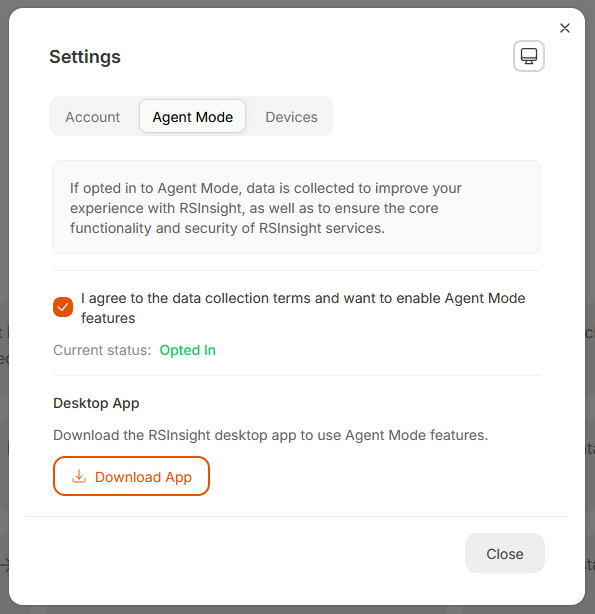
- Click Download App to install the RSInsight Desktop app.
- Once installed, launch the RSInsight Desktop app. You will be prompted to connect with your RocPortal account. Follow the prompts on your browser.
In the RSInsight Desktop app, go to the MCP Store and click Browse.
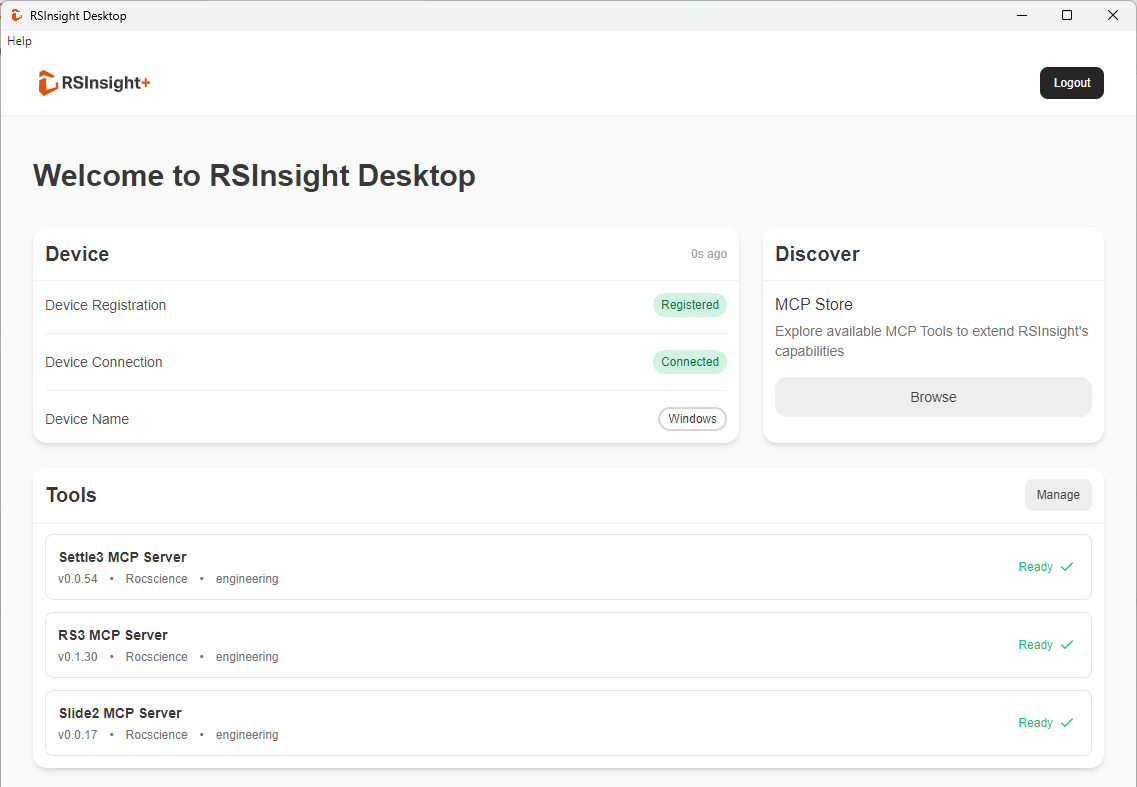
Locate the DIPS MCP Server and click Install. Note that you will first need the latest version of DIPS to proceed with installation.
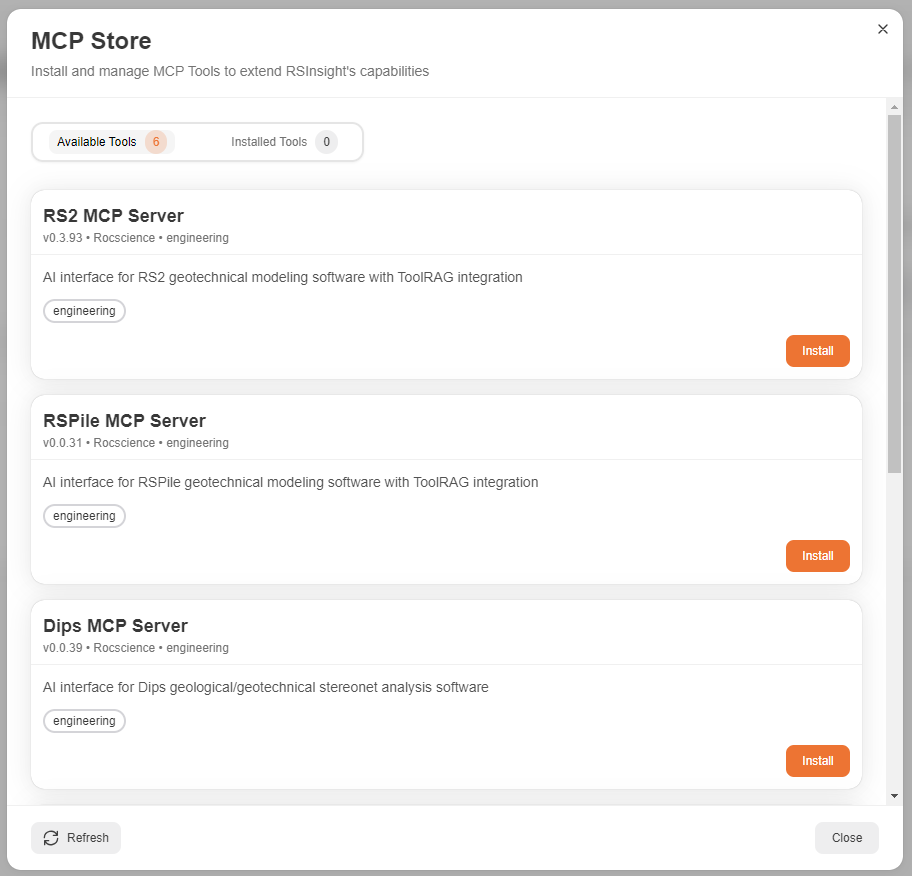
- Once installed, the DIPS MCP Server will appear under the Tools section, where you can view the connection status. When connected, the server will say “Ready.”
Start a conversation with Agent Mode
- Log in to your RocPortal account and go to RSInsight.
Launch the RSInsight Desktop app to connect to the DIPS MCP Server.
If you have not installed the DIPS MCP Server, see the instructions above before proceeding.- Click Chat to start a new chat.
In the Chat box, click the drop down on the left and change Ask to Agent.
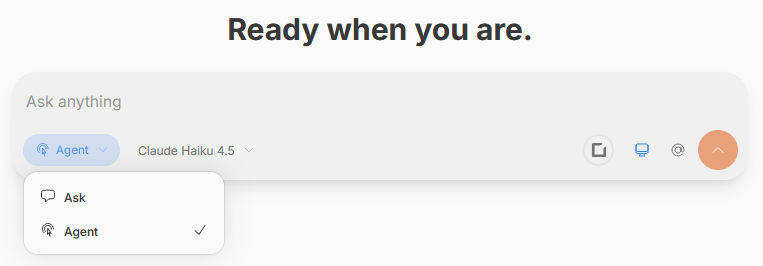
You are now ready to begin your conversation with RSInsight.
- Click @ to attach data and model files.
- Enter prompts into the chat box to initiate actions.
DIPS MCP Server Capabilities
At the moment, not all scripting functions are supported by the DIPS MCP Server. Below lists the scripting functions currently available.
Supported
- Basic script-ready operations in DIPS
- Sensitivity analysis
- Data processing
- Computation and interpretation of results
Not Supported
- GUI-only operations such as view controls, display/contour styling, drawing tools, and report layout interactions.
- Direct UI compute workflow automation.
- Dedicated end-to-end import/export UI workflow automation (the user still needs to input which file they’d like to work on. Multiple projects are not currently supported.