Borehole Oriented Core
Below are some definitions for Borehole Oriented Core conventions.
Data Orientation Convention
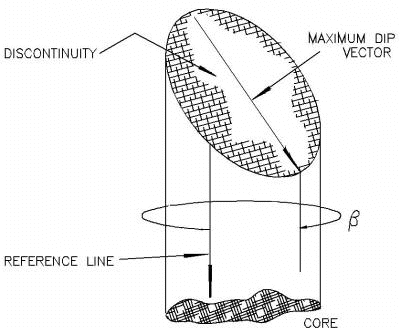
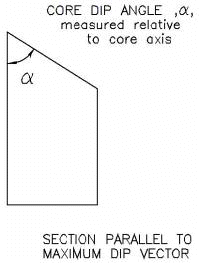
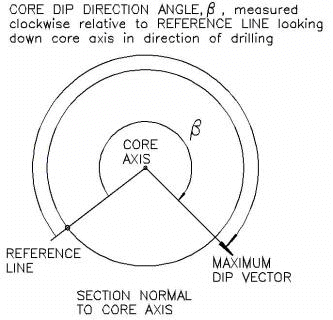
If orientation data were measured from the logging of core from a borehole, then the orientation columns in the Discontinuities tab of the Orientation Data dialog must contain the measurements of the Alpha and Beta angles, as defined below. This applies to both Linear Borehole Oriented Core and Curved Borehole Oriented Core traverse types.
ALPHA
The Alpha angle is the minimum angle between the maximum dip vector of the plane of the discontinuity and the core axis.
BETA
The Beta angle is the clockwise angle from the Reference Line to the direction of the maximum dip vector, looking along the direction of borehole advance.
See the figures below for illustration.
Traverse Format
The Traverse Format defines the orientation of the Traverse itself and also the reference line for local Beta angles (i.e., Orient 1).
ORIENT 1
Orient 1 is the angle from the top of the core to the reference line (measured clockwise looking in the down core direction). Use Orient 1 = 0 if the borehole is vertical.
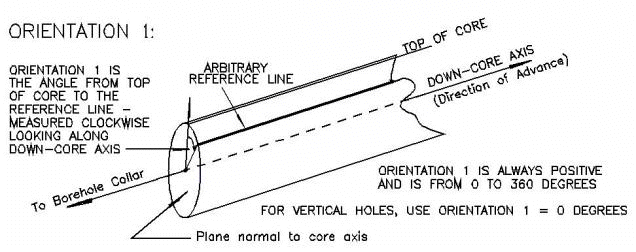
The Orient 1 value entered in the Orientation Data dialog for a Borehole Oriented Core Traverse, is required because the Beta angle measured for each discontinuity on the core must be measured with respect to some reference line along the length of the core.
If the reference line is the top of the core (i.e., a line along the physical top of the core), then Orient 1 = 0. If the reference line is along the bottom of the core, then Orient 1 = 180 degrees. These are the most common situations. However, DIPS allows the reference line to be located at any position with respect to the top of the core; hence, an “arbitrary” value can be entered if the reference line is at some arbitrary position (e.g., 45 degrees from the top line of the core).
The Orient 1 value serves to orient the rotational position of the core with respect to the borehole. Without the reference line, you do not know how the core was positioned with respect to the borehole; therefore, this is always a required input for oriented core analysis.
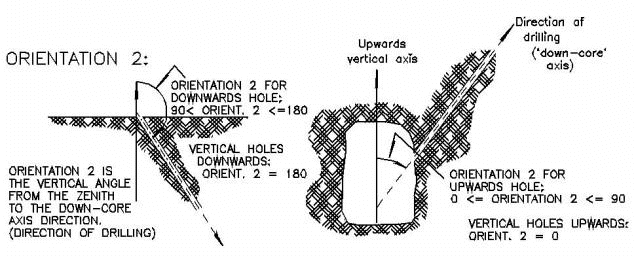
ORIENT 2
Orient 2 is the inclination of the borehole axis from the zenith. Use Orient 2 = 0 for a borehole oriented vertically upwards, and Orient 2 = 180 if the borehole is oriented vertically downwards.
ORIENT 3
Orient 3 is the azimuth of the borehole measured from true north. For a vertical borehole, use the clockwise angle from true north to the reference line, looking along the direction of borehole advance.
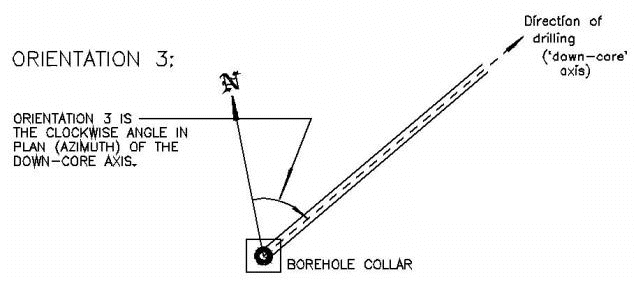
For a vertical borehole, the Orient 3 value serves to define both Orient 1 and Orient 3.
For a vertical borehole, Orient 1, as defined in DIPS, cannot technically be defined because there is no "top" of core, since the core is vertical. That is, there is no "top" line from which to measure an angle to the reference line. So you should simply enter Orient 1 = 0 since it is not actually used.
Orient 3 serves both purposes of defining the azimuth direction and orienting the core within the borehole, by defining the orientation of the Reference Line on the core, with respect to north. Combined with the fact that the hole is vertical, that gives you all the information you need to correctly orient the core within the borehole.
For a vertical borehole, Orient 2 is either 0 or 180 degrees, according to whether the borehole was drilled downwards (Orient 2 = 180) or upwards (Orient 2 = 0).