Size
Fracture size in the context of DFNs is the equivalent radius of a circle with an area equal to the area of the polygon that represents the fracture (Elmo, 2006; Elmo et al., 2014).
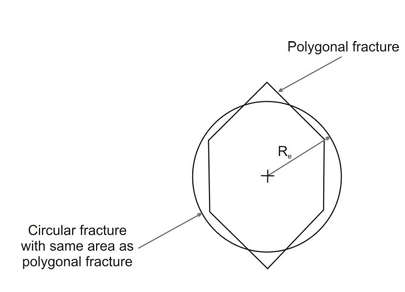
Fracture size distribution is commonly determined from trace length distributions. The fracture size distributions available in the Baecher DFN Wizard include the following:
- Constant
- Normal
- Triangular
- Log normal
- Exponential
- Gamma
- Beta
Refer to Statistical Distributions for more information on each distribution.
Note that the fracture size is constrained by the bounding box dimensions specified in the Setup section. Fractures cannot be larger than the bounding box. For example, if a bounding box is 10 m x 10 m x 10 m, and the fracture shape is a square (4 sides, no elongation), then the maximum Size input is 3.99 m.
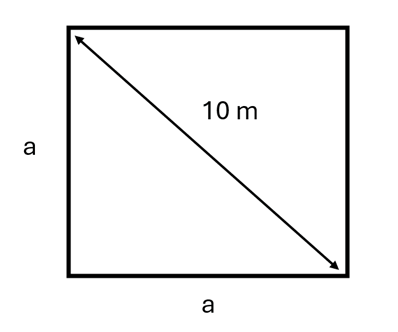
Because the bounding box dimension is 10 m x 10 m x 10 m, the maximum diagonal length of a square inside the box is 10 m. The area of a square with a diagonal of 10 m is 50 m2. The radius of a circle with an area of 50 m2 is 3.99 m. This number (3.99 m) represents the maximum fracture Size input in the Geometry section.
References
Elmo D. 2006. Evaluation of a hybrid FEM/DEM approach for determination of rock mass strength using a combination of discontinuity mapping and fracture mechanics modelling, with particular emphasis on modelling of jointed pillars. Ph.D. Thesis, University of Exeter, United Kingdom.
Elmo, D., Liu, Y., & Rogers, S. 2014. Principles of discrete fracture network modelling for geotechnical applications. DFNE 2014, Vancouver, Canada.