Soil Models
Four different types of strength are available under the Soil Models failure criterion.
Undrained
For the Undrained soil model, the friction angle phi is automatically set to zero. The shear strength is defined only by the cohesion of the material. Three sub-options for defining the Undrained cohesion are available, by selecting from the Cohesion Type drop-down list:
Constant
Cohesion is constant throughout the material.
F(Depth from Top of Layer)
Cohesion is a function of depth, where depth is measured from the top of the material layer that is local to the slice, to the center of a slice base.

- Cohesion (Top) is the Cohesion at the top of the material layer.
- Cohesion Change is the rate of change of Cohesion with depth.
- If you wish to specify a maximum soil strength, select the Cutoff checkbox and enter a maximum value for Cohesion. If the rate of Cohesion Change is negative, then this value represents the minimum soil strength.
F(Depth from Horizontal Datum)
Cohesion is a function of depth, where depth is measured from a user-specified Datum (y-coordinate) to the center of a slice base.

- Cohesion (Datum) is the Cohesion at the Datum elevation.
- Cohesion Change is the rate of change of Cohesion with distance (ydatum-y) from the Datum. If the Cohesion Change is positive, then cohesion increases below the datum and decreases above the datum, according to the change in elevation ydatum-y.
- If you wish to specify a maximum soil strength, select the Cutoff checkbox and enter a maximum value for Cohesion. If the rate of Cohesion Change is negative, then this value represents the minimum soil strength.
- Datum is the datum elevation (y-coordinate).
F(Distance to Slope)
Cohesion is a function of depth, where depth is measured from the closest point on the slope (actual distance) to the center of a slice base as shown below.
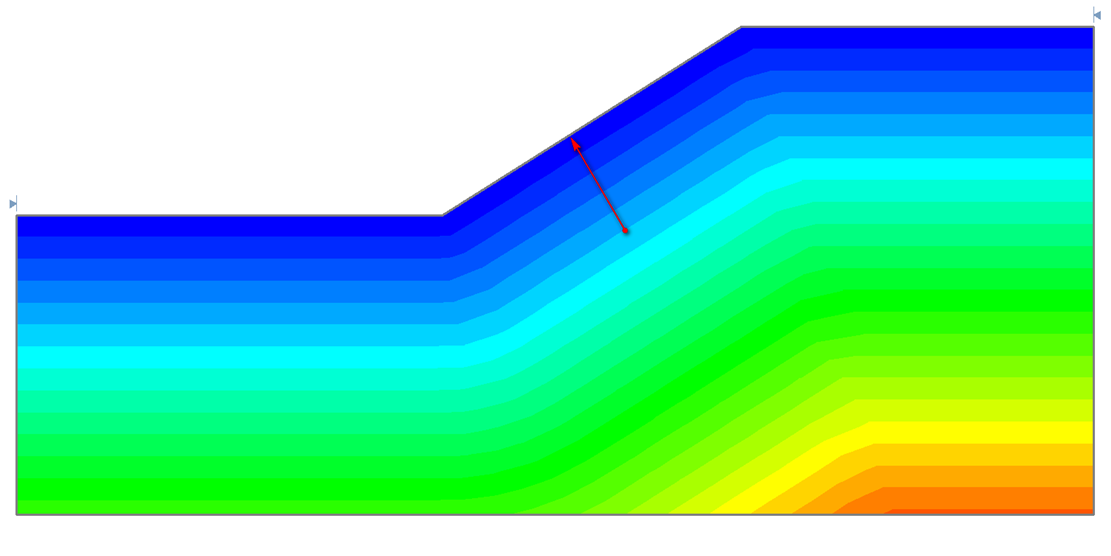
- Cohesion (Top) is the Cohesion at the top (closest point on the slope) of the slope to the center of a slice base.
- Cohesion Change is the rate of change of Cohesion with depth.
- If you wish to specify a maximum soil strength, select the Cutoff checkbox and enter a maximum value for Cohesion. If the rate of Cohesion Change is negative, then this value represents the minimum soil strength.
Note that the Water Parameters are automatically disabled in the Define Materials dialog when Strength Type = Undrained, since pore water pressure is not required.
Vertical Stress Ratio
With the Vertical Stress Ratio model, the shear strength at the base of each slice is determined by multiplying the effective vertical (overburden) stress by a constant K for the material.

- The effective vertical stress is computed from the total weight of each slice, and the pore pressure acting at the center of the base of each slice.
- The "vertical stress ratio" K is simply a constant, equal to the ratio of the shear strength to the vertical stress. (e.g. if K = 0.3, then the shear strength will be 30 % of the effective vertical stress.)
Drained-Undrained
The Drained-Undrained option allows you to define a soil strength envelope which considers both drained and undrained Mohr-Coulomb strength parameters. The shear strength is defined in terms of effective stress parameters c’ and phi’, up to a maximum value of shear strength defined by the undrained cohesion Cu.
If you only need to define constant strength parameters which do NOT vary with depth, then you can enter the parameters directly in the Define Materials dialog. In this case, the shear strength envelope is defined by constant values of:
- Cu (undrained cohesion)
- c’/Cu ratio (drained cohesion c’ is defined as a fraction of Cu)
- drained phi’
Cohesion Varies with Depth
If the cohesion is variable with depth, then you must select the Cohesion varies with depth checkbox. This will enable the Define button. Select the Define button, and you will see another dialog (the Drained-Undrained Strength Properties dialog), in which you can define the drained and/or undrained cohesion as a function of depth.
See the Drained-Undrained Strength topic for more information.
SHANSEP
The SHANSEP model (Stress History and Normalized Soil Engineering Properties) is widely used for modelling the undrained shear strength of soils (Ladd and Foote, 1974).
See the SHANSEP strength topic for details.
CNI
The CNI strength model in Slide2 uses the non-linear formulation [Cylwik et al., 2023] described by the following equation:
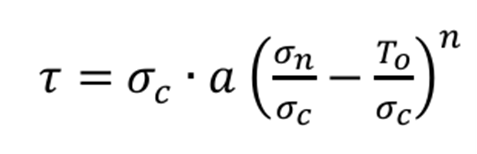
where:
σc is the rock mass compressive strength
a is the strength magnitude coefficient
σn is the normal stress
To is the direct tensile strength expressed as a negative value
n is the curvature coefficient
See the CNI topic for more detailed information.