Rapid Drawdown Analysis
Rapid Drawdown is the sudden lowering of the water level that, due to loss of stabilizing force from the weight of water and slow dissipation of pore pressures, can lead to significantly reduced stability in the slope. This dissipation of pore pressure is dependent on material properties such as permeability but can nonetheless exist as excess pore pressures depending on the drawdown level. This means designs involving water with stabilizing effects, such as dams or embankments, should consider this analysis to account for the worst-case scenario.
The strengths used to determine the post-drawdown condition is the key component to determining stability. These strengths are considered as combinations of undrained and drained properties depending on the material. The following rapid drawdown analysis methods are available in Slide2:
- Duncan, Wright, Wong, 3 stage (1990)
- Army Corps of Engineers, 2 stage (1970)
- Lowe and Karafiath (1960)
- Effective Stress using B-bar
For each method, the final reported factor of safety is taken from the method’s final stage. An overview of each method is provided in this page. All methods, except the B-bar method, require an initial and final drawdown water surface to indicate the level of drawdown that occurs in the model.
Duncan, Wright, Wong 3 Stage (1990)
The Duncan, Wright and Wong (1990) method uses a three-stage approach for modelling rapid drawdown.
Stage 1 - Pre-drawdown: A standard analysis is performed using the initial water level. The material's drained strength envelope (c', phi') is used to determine the pore pressures from the initial conditions. This stage establishes the initial factor of safety and records the stresses at each slice base.
Stage 2 - Interpolated undrained strength: The water level is lowered to the defined drawdown elevation, and new pore pressures are computed from the drawdown water table. For materials marked as undrained, the shear strength is interpolated between the fully drained envelope and the consolidated-undrained envelope. This interpolation accounts for the degree of consolidation that existed under the undrained condition, assuming that the soil was likely consolidated under the pre-drawdown stresses but is now shearing under drained conditions. The methods used to calculate the interpolated strength are described in the Undrained Behavior Strength Envelopes section.
Stage 3 - Drained strength check: At each slice, the fully drained effective strength is compared against the interpolated undrained strength from Stage 2. The lower of the two is used.
Army Corp Eng. Method (1970)
Stage 1 - Pre-drawdown: Identical to the Duncan, Wright, Wong 3 Stage method.
Stage 2 - Minimum strength: The water level is lowered to the drawdown elevation. For each undrained slice, both the drained and undrained shear strengths are evaluated at the post-drawdown effective normal stress:
- Drained strength: τd =c'+σ'n tan(ϕ')
- Undrained strength: τu=cR+σ'ntan(ϕR)
The minimum of the two is used as the governing strength for that slice. The result is expressed as an equivalent cohesion (phi = 0).
Lowe and Karafiath (1960)
Both Stage 1 and 2 are Identical to the Duncan, Wright, Wong 3 Stage method. The key difference from Duncan-Wright-Wong is that there is no Stage 3 and thus no comparison between the drained and undrained strengths. The final result is based on the drained strengths.
Effective Stress (B-bar Methods)
This method is distinct from the other methods as it modifies the pore pressure using the B-bar coefficient rather than utilizing any undrained envelopes and/or interpolation. Most notably, the method uses a single stage.
For each slice in a material marked as undrained:
- The change in vertical total stress due to the removed water is calculated: Δσv = (weight of removed water) / (slice width)
- The pore pressure change is: Δu= B*Δσv
- The post-drawdown pore pressure is: u=upredrawdown-Δu
Because no undrained envelope is needed, B-Bar can be used with any effective-stress strength criterion. The only material input required is the B-bar coefficient and the Undrained Behaviour checkbox.
A drawdown line (final water table) is not required for the B-Bar method. If no drawdown line is defined, a complete drawdown is assumed. Please see Excess Pore Pressure for details on calculating B-bar.
Undrained Behaviour Strength Envelopes
When selecting any of the three rapid draw down methods, Duncan, Wright, Wong, 3 stage (1990), Army Corps of Engineers, 2 stage (1970), or Lowe and Karafiath (1960), it is important to determine which materials in the model will be drained and which will not be drained when performing a rapid drawdown analysis. Should a material be expected to act in an undrained manner during drawdown, the Undrained Behaviour checkbox should be enabled in the Rapid Drawdown tab of the Material Properties dialog. An undrained shear strength envelope type must then be selected:
- Total Stress R Linear - defined by parameters cR and ϕR
- Kc = K1 Linear - defined by parameters d and Ψ
- Total Stress R Non-linear - defined by a shear-normal function
- Kc = K1 Non-linear - defined by a shear-normal function in the Kc=K1 form
The Total Stress R approach defines the undrained strength in a Mohr-Coulomb form using the parameters cR and ϕR. The Kc = K1 approach defines the undrained strength as a modified Mohr-Coulomb approach using the stresses during consolidation and the difference in principal stresses at failure. d is the intercept of the failure envelope and Ψ is the angle of this envelope. The two methods (Total Stress R and Kc = K1) support a non-linear definition method as well, where a shear-normal function can be defined.
The two methods are related by the following equation:

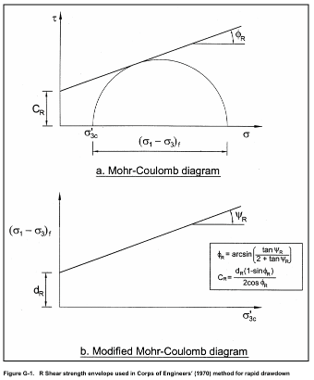
Slide2 converts between the Total Stress and Kc=K1 representations as needed. Materials that are not marked as undrained retain their standard drained strength throughout all stages.
Currently, only Mohr-Coulomb and Shear/Normal Function strength models support the undrained envelope definition for this method.
- Depending on the model, it is possible that material strength is reduced such that surfaces can reach a factor of safety near 0. These surfaces can be filtered using the surface filter options but should be considered as it may be indicative of some failure due to low effective stresses.
- The strength and subsequently factor of safety of a surface is still dependent on the base material of the surface slices. This means regardless of the drawdown level or other related undrained parameters, if the slice base is located within a material with this undrained behavior disabled, it will compute the drained strength using the initial drawdown water level as a typical water surface, disregarding any excess pore pressures.
For Duncan, Wright, Wong 3 Stage (1990) and Lowe and Karafiath (1960) drawdown methods, Tthe interpolated strength can be calculated using one of two methods:
- Duncan, Wright, Wong (1990)
- VandenBerge, Wright (2016)
Both methods interpolate either in the Total R Stress Envelope (cR, ϕR) or the Kc = K1 envelope (d, Psi) as indicated by the material’s undrained behavior.
In the Kc = K1 envelope method, Kc is the effective principal stress ratio during consolidation. The Duncan, Wright, and Wong (1990) method uses stress ratios at K1 = Kc and Kf derived from the drained condition to weight the contribution of the drained and undrained envelopes. K1 is the principal stress ratio at the undrained consolidation state and Kf is the upper-bound consolidation stress ratio corresponding to failure. These bounds define the space in shear stress versus normal stress state in which the shear strength can be interpolated.
Because each K value is a ratio of the principal stresses, these values can be determined by computing σ1 and σ3. Given an effective normal stress and shear stress, the Kc = K1 and Kf can be calculated using the following equation:

where τfc is the mobilized shear stress found from the stage 1 factor of safety, σn is the effective normal stress at the slice base, and c' and ϕ' are the drained Mohr-Coulomb properties. The shear envelope at each ratio is then calculated as the following:


The final interpolated shear strength is linearly interpolated within Kc space using the following equation:

The VandenBerge & Wright (2016) method is an improved interpolation that introduces a modified stress ratios (K*) with an additional component a’.


The interpolated strength is expressed as an equivalent cohesion (with phi = 0), representing the undrained shear strength at the post-drawdown effective stress.
References
- Duncan, J.M., Wright, S.G. and Wong, K.S., 1990. "Slope Stability during Rapid Drawdown," Proceedings of the H. Bolton Seed Memorial Symposium, Vol. 2, pp. 253-272.
- VandenBerge, D.R. and Wright, S.G., 2016. "Improved Undrained Strength Interpolation Scheme for Rapid Drawdown," Journal of Geotechnical and Geoenvironmental Engineering, 142(6): 06016002.
- Lowe, J. III and Karafiath, L., 1960. "Stability of Earth Dams upon Drawdown," Proceedings of the 1st Pan-American Conference on Soil Mechanics and Foundation Engineering, Mexico City, Vol. 2, pp. 537-552.
- U.S. Army Corps of Engineers, 1970. "Engineering and Design -- Stability of Earth and Rock-Fill Dams," Engineering Manual EM 1110-2-1902, Department of the Army.