Unsaturated Behaviours
The Unsaturated Behaviours option in the Define Material Properties dialog allows you to account for the impact of negative pore pressures (commonly referred to as matric suction) on material shear strength (suction strength) in the unsaturated zone above the water table. Unsaturated shear strength parameters are Phi_b and Air Entry Value, as described below.
Negative pore pressures can result from:
- Finite element groundwater analysis (either steady-state or transient)
- Water pressure grid interpolation
- Water tables or piezo lines (negative pore pressures are automatically computed above the water surface)
For any of the above groundwater methods:
- If negative pore pressures are calculated AND
- You define unsaturated shear strength parameters,
then materials in the unsaturated zone above the water table, will exhibit additional shear strength due to matric suction as described below.
Approaches
The unsaturated soil mechanics can be predicted in various ways. The following options are provided to interpret unsaturated behavior:
- Unsaturated Shear Strength
- Single Effective Stress
Please see the RS2 theory manual on this topic for additional information in RS2 Documentation | Unsaturated Behaviors.
Unsaturated Shear Strength
Soil in unsaturated zones typically increase in strength when suction is present. Three methods for the unsaturated shear strength calculation are provided: Fredlund, Vanapalli, and User Defined PhiB.
Fredlund (1978)
Suggested by Fredlund et al (1978), the unsaturated shear strength is calculated as:

Where c' is the effective saturated cohesion, σ is the total stress, (σ - ua) is the net normal stress on the plane of failure at failure, s=ua-uw is the matric suction, ua is the pore-air pressure, uw is the pore water pressure, Φ' is the effective saturated angle of friction, and Φb is the angle of friction accounting for matric suction contribution to shear strength. Users need to input the unsaturated shear strength angle (Φb) and an air entry value, as described below.
Unsaturated Shear Strength Angle (Phi_b)
By specifying an Unsaturated Shear Strength Angle (Phi_b) for a material, the shear strength of the material in the unsaturated zone will be INCREASED by the amount:

where  = matric suction (POSITIVE value), and
 = unsaturated shear strength angle. (NOTE: by convention, the term matric "suction" implies the POSITIVE, or absolute value of the negative pore pressures calculated in the unsaturated zone.)
By default, the Unsaturated Shear Strength Angle = 0. This means that matric suction in the unsaturated zone, WILL NOT have any effect on the shear strength or safety factor. If you enter a non-zero value for Unsaturated Shear Strength angle, then slip surfaces which pass through a material in the unsaturated zone, will have INCREASED shear strength, and safety factor.
The Unsaturated Shear Strength Angle is usually not a well-known quantity. To obtain an appreciation of its importance, a parametric study can be carried out, in which the Unsaturated Shear Strength Angle is varied between 0 and the Friction Angle of the material. This can be easily accomplished using the Sensitivity Analysis capability of Slide2.
Air Entry Value
Air Entry Value is defined in Fredlund and Rahardjo (1993) as the matric suction value that must be exceeded before air recedes into the soil pores. The Air Entry Value is also referred to as the "displacement pressure" in petroleum engineering or the "bubbling pressure" in ceramics engineering.
In terms of strength, it is the point at which the strength of the soil deviates from its saturated effective Mohr-Coulomb behavior. If matric suctions exceed the air entry value, the strength is assumed to follow a linear envelope with Phi_b as the friction angle. Thus Slide2 uses a bilinear strength envelope where:
- c' and phi' are used with positive pore pressures, and with negative pore pressures (matric suction) up to the air entry value
- Phi_b is used when negative pore pressure exceeds the air entry value.
The following figure (after Fredlund (2000) ) illustrates the effect of the air entry value. For matric suction below the air entry value, the saturated effective stress friction angle is used. For matric suction greater than the air entry value, the unsaturated shear strength angle, Phi_b is used.
Effect of air entry value (aev) on unsaturated shear strength envelopes

Vanapalli (1996)
When you turn on a transient analysis, this method will become available. This uses the method in:
Vanapalli, S. K., et al. "Model for the prediction of shear strength with respect to soil suction." Canadian geotechnical journal 33.3 (1996): 379-392.
Using the relation in equation 17:

to determine the increase in shear strength in the unsaturated zone using the water content as a function of matric suction.
You need to do a transient analysis because the strength is a function of water content and volumetric water content in the unsaturated zone is only computed during a transient analysis.
User Defined PhiB
This option allows you to define a function for the relationship between Phi b (see above) and suction.
Single Effective Stress
The Single Effective Stress calculation approach is available for all failure criteria models. To enable the approach, the Advanced Transient Groundwater option must be selected under the Groundwater page in Project Settings dialog.
If the Advanced Transient Groundwater option is not selected, the Single Effective Stress approach option will not be available, and existing materials with this approach will be switched to Unsaturated Behavior = Undrained Shear Strength.
According to Bishop (1959), the single effective stress for unsaturated soils is written as:

where σ' is the effective stress, σ is the total stress, Χ is a coefficient, ua is the pore-air pressure, and uw is the pore water pressure. In practice, ua is omitted from the equation, thus the effective stress will be calculated as:
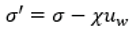
or it can be written as:
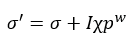
where pw is the suction, and I is the unit matrix. In Slide2, the value of X, can be determined by four different methods.
- Tabular Values - with respect to suction
- Users define a table of X vs. matric suction values.
- Tabular Values - with respect to effective degree of saturation
- Users define a table of X vs. effective degree of saturation (Se) values.
- Khalili (2004)
- Bolzon (1996)
- Kohgo (1993)
- Two additional parameters, Critical Air Suction and Material Parameter, are required for the Kohgo method. For detailed information, we recommend reviewing Kohgo et al. (1993).
The available methods here do not include all available methods in RS2. This is due to the remaining methods requiring degree of saturation. Degree of saturation is not directly calculated in Slide2 and only is supported as contour data when viewing groundwater analysis results. These methods utilize effective degree of saturation, which is calculated using the available water content parameters.
Use Cutoff
The Use Cutoff option is subjected to the Single Effective Stress approach only, intended for limiting the suction (pw). In the calculation based on the equation above, an upper limit cutoff value can be set for the term IXpw. The default input is -100 kPa.
This option is applicable exclusively to the Single Effective Stress approach. It is independent from the Negative Pore Pressure Cutoff.
Negative Pore Pressure Cutoff
If you are using Unsaturated Behaviours parameters for a material, the Negative Pore Pressure Cutoff option allows you to limit the contribution of negative pore pressure to the material shear strength. This option is in Project Settings > Groundwater.