I-Soil model (Numanoglu et al., 2023)
The I-Soil model proposed by Numanoglu et al. (2023) is a three-dimensional, effective-stress constitutive model developed to represent the cyclic shear and shear-induced volumetric response of sands. The model is based on the distributed-element plasticity framework, in which a collection of elastic–perfectly plastic components is arranged in parallel. Each component has a different stiffness and yield strength, and the sum of the component responses reproduces the specified monotonic shear stress–shear strain backbone curve.
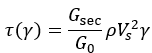
The backbone curve is defined using discrete shear stress–shear strain pairs obtained from the small-strain shear modulus and a selected modulus-reduction curve:
 | Eq. 1 |
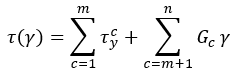
where Gsec / G0 is the normalized secant shear modulus, ρ is the soil mass density, Vs is the shear-wave velocity, and γ is the shear strain. The discrete backbone is decomposed into n nested components with shear moduli Gc and yield strengths τcy . At a given strain level, the total shear stress is calculated by summing the stresses carried by the yielded and elastic components:
 | Eq. 2 |
where m is the number of components that have yielded. This formulation allows the model to reproduce a user-defined nonlinear backbone curve over the full range of strains considered in the analysis.
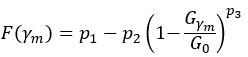
The cyclic response of soils generally does not follow the classical Masing rules, which may overestimate hysteretic damping at medium and large strains. I-Soil therefore uses the modulus-reduction and damping-factor (MRDF) non-Masing formulation to modify the backbone curve following a loading reversal:
 | Eq. 3 |
With
 | Eq. 4 |
where Fbb is the original backbone curve, F′bb is the mapped backbone used during unloading and reloading, Gym is the secant modulus at the maximum experienced strain, and p1, p2, and p3 are parameters used to match the selected damping curve. These parameters must be determined by fitting the calculated hysteretic damping to the target damping relationship.
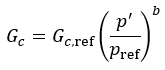
The one-dimensional formulation is generalized to three-dimensional stress space using the effective mean stress and the second invariant of the deviatoric stress tensor. The stiffness and yield strength of the nested components vary with effective mean stress, allowing the material response to change as pore pressure develops:
 | Eq. 5 |
where Gc,ref is the component shear modulus at the reference effective mean stress pref, p′ is the current effective mean stress, and b controls the pressure dependence of stiffness.
I-Soil represents shear-induced contraction and dilation using a non-associative plastic flow rule:
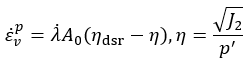 | Eq. 6 |
where ε̇vp is the plastic volumetric strain rate,  is the plastic multiplier, A0 controls the magnitude of the volumetric response, and ηdsr is the dilatancy stress ratio. The model predicts contraction when η < ηdsr and dilation when η > ηdsr . Under undrained conditions, the computed volumetric tendency produces changes in excess pore-water pressure rather than a change in volume.
Numanoglu et al. (2023) propose the following starting values for dense sands:
- b = 0.5 for the effective-stress dependence of stiffness.
- pref equal to the initial effective mean stress.
- An effective mean stress cutoff with a magnitude of approximately 1 kpa.
- ηdsr = 0.4 to 0.8, with 0.51 used as a representative value in the paper.
- A0 = 0.15 to 0.4, with 0.4 recommended when soil-specific calibration data are unavailable.
- Thirty points to define the backbone curve, with 15 logarithmically spaced between 0.0001% and 1% strain and 15 linearly spaced between 1% and 10% strain.
- p1, p2, and p3 fitted to the selected damping curve; no universal default values are proposed.
The values of A0 and ηdsr may be calibrated using drained or constant-volume cyclic shear tests. Further details regarding the formulation, parameter calibration, applicability, and limitations of the model are provided by Numanoglu et al. (2023).