Fully-coupled PWP Generation Model
In the FEM engine, excess pore pressure is not generated from an empirical cyclic ru model. Instead, generation arises naturally from the coupled Biot u-p formulation through volumetric deformation of the soil skeleton.
At each time step, the I-Soil constitutive model updates effective stress under the imposed strain increment. Plastic volumetric coupling is controlled by the volumetric-response parameters A0 and ηdsr which allows contractive or dilative plastic volumetric strain to develop during cyclic shear.
That volumetric strain increment then drives the excess pore-pressure source term in the Biot equation:
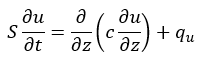 | Eq. 1 |
with the generation source related to volumetric strain by
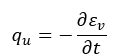 | Eq. 2 |
and fluid storage
 | Eq. 3 |
where εv = εxx + εyy +εzz is volumetric strain, n is porosity, and Kf is the bulk modulus of the pore fluid. In discrete form, the change in pore pressure increment is therefore
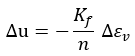 | Eq. 4 |
In this engine, the porosity is set to 1.0 which leads to the magnitude of pore pressure to be controlled solely by the fluid stiffness. Contractive volumetric response increases excess pore pressure; dilative response decreases it. Generation acts only in saturated elements below the water table. Because generation enters through qu in Eq. 1, pore-pressure generation and dissipation occur simultaneously during shaking.