Field Investigation
On the Field Investigation tab, user can customize the dropdown lists (e.g. sample types, drilling methods, etc.). These lists are used in the test hole data entry page in form of dropdown.
To adjust the default Field Investigation settings:
- Go to the left-hand navigation menu and select Settings page → Field Investigation tab,
- Change the default setting for any section:
- Select the desired list (sample types, field tests, and drilling methods),
- Add or edit the list (read more about working with tables),
- Click Save.
Sampling tab
- Sample Types: this list contains the sample types used in RSLog. This will affect data entry in Samples tab of the borehole page. Use the Export button at the top of the table to create the sample type legend.
- Location / Status Options: specify the list of locations or statuses for samples. This feature allows for sample tracking from field collection to transport, lab testing, storage and disposal.
Drilling tab
This tab covers the following list:
- Drilling Methods: this list contains the drilling methods used in RSLog. This will affect data entry in Drilling Details tab of the borehole edit page.
Field Tests tab
This tab covers the following list:
- Field Tests: this list contains both built-in and user-defined field tests. This will affect data entry in Field Tests tab of the borehole edit page (see next section for details).
Adding / Editing a Field Test
Each field test has a different set of data entry columns. For example, Cone Penetration Test (CPT) typically carries Depth, Qc, Fs, and U2 columns whereas a Downhole Seismic Test includes Depth and Vs.
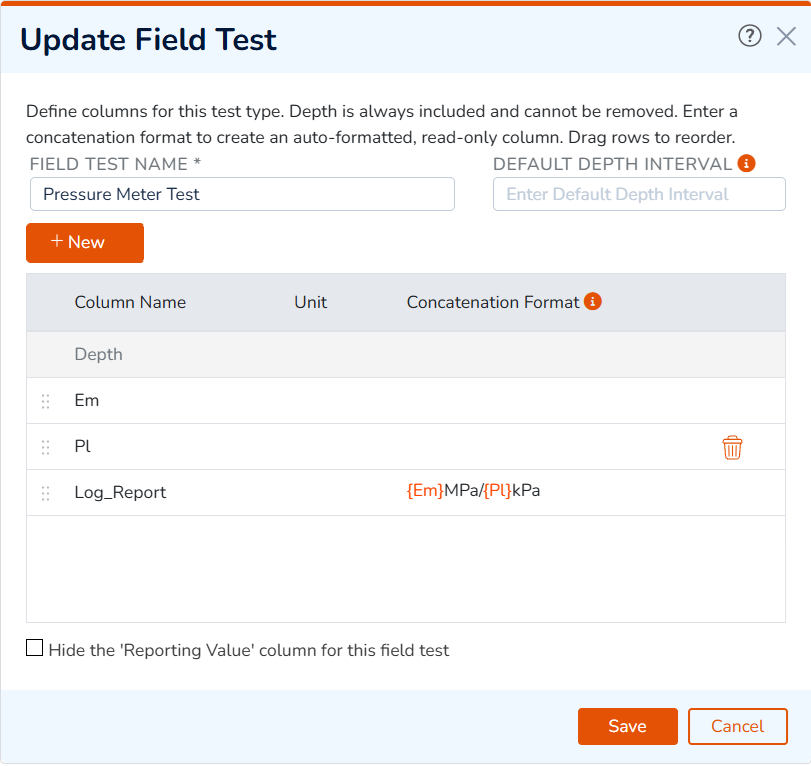
Each field test has two built-in columns: Depth and Value. You can add more columns to a field test by adding them to the table. For example, in the following screenshot user added a new column Log_Report to their Pressuremeter field test by combining the Em and Pl parameters together into one string.
You can also add units to the list of columns, for example "qc (MPa), fs (kPa), u2 (kPa)".
Concatenated Columns
Use this feature to add concatenated columns to your field test. These columns are compiled by RSLog based on the other columns in that field test. A simple example of this feature is when you have data for all four sets of SPT test (N1, N2, N3, N4) and in the borehole log you want to show the results by combining N1, N2, and N3 separated by a dash (e.g. "18-21-20"). In this case, the concatenated column will be automatically compiled using the format you specify.
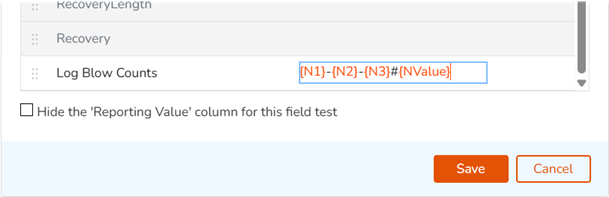
To reference a field test column in the concatenation format, enclose it in { } e.g. {N2}. As you write the concatenation format it automatically turns the referenced columns to orange. If an unknown column is enclosed in { } you will see an error message. The example shown below the value compiled for the Log Blow Count will looks like:
18-21-20
41
Please note that in this case the # character is the split character for pushing the text to a new line:
To group symbol characters (e.g. - or = or / etc.) with a field test column, capture them with [ ] e.g. [-{N4}]. As you write the capture group, the enclosing square brackets will automatically turn blue. Any characters or symbols in a capture group will be discarded if an enclosed column does not have a value e.g. if the captured N4 does not have a value, the attached "-" will not be written:
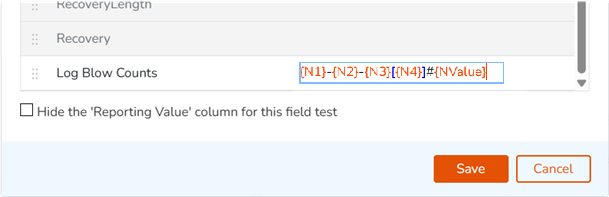
Please also see relevant documentation for Settings → Engine → Logs tab about handling leading and trailing symbols for concatenated texts. This features helps you prevent outputs such as "50-"
When you edit a borehole, concatenated columns are shown as the right end of the Field Tests table. To link a log column to a concatenated column:
- Edit the desired log template,
- Add a new / edit a log column of type Text/Number → Field Test Results,
- From the dropdown select the desired field test,
- Select the subject concatenated column,
- Click Save.
Instrumentation tab
This tab covers customization of the following dropdown lists:
- Borehole Survey: this list contains the borehole survey types used in RSLog. This will affect data entry in Instrumentation tab → Survey tab of the test hole data entry page,
- Piezometer / Well Type: this list contains the piezometer/well types used in RSLog. This will affect data entry in Instrumentation tab → Piezometer/Well tab of the test hole data entry page,
- Plug Types: this list contains the piezometer/well plug types (the top plug). This will affect data entry in Instrumentation tab → Piezometer/Well tab of the test hole data entry page.