Support Modelling Without Limits: Three New Enhancements in Slide3
- Sina Javankhoshdel, Senior Manager - LEM at Rocscience
In slope stability analysis, support systems are rarely the limiting factor; representing them accurately in a model often is.
Every project brings its own reinforcement reality: site-specific soil nails, proprietary anchoring systems, dense geosynthetic layouts, or support geometries originating outside the analysis environment entirely. In practice, engineers are constantly balancing two demands: accurately representing real-world reinforcement behaviour while keeping model construction efficient and consistent.
As project complexity increases and workflows become more data-driven, support modelling tools need to do more than “fit within predefined types.” They need to adapt. The latest release of Slide3 introduces three significant enhancements designed to make support modelling more flexible, more efficient, and better connected to external engineering workflows. The new capabilities include:
- User-Defined Support
- Enhanced Geosynthetic Placement Tools
- CSV Import and Export for Supports
Together, these features expand how engineers define reinforcement behaviour, accelerate model creation for large systems, and improve interoperability across design platforms.
User-Defined Support: Model Reinforcement on Your Terms
One of the most powerful additions to Slide3 is the new User-Defined Support type. This feature allows engineers to define support behaviour directly through custom force-capacity relationships, enabling virtually any reinforcement system to be represented within the Slide3 framework.
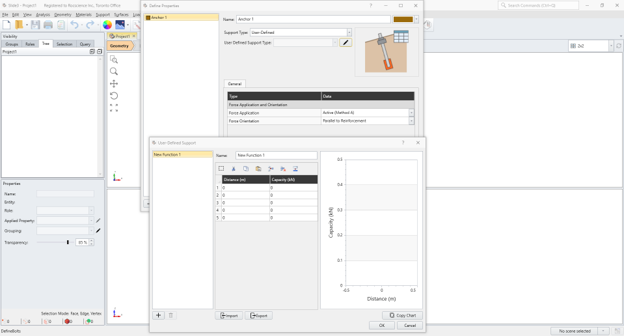
Traditionally, support types such as soil nails, grouted tiebacks, micropiles, and end-anchored systems are defined through dedicated models. While these built-in options remain available, they ultimately rely on predefined force-capacity formulations that govern how resistance develops along the reinforcement length.
The User-Defined Support feature removes that constraint by allowing engineers to explicitly define these relationships. Tensile, pullout, and stripping capacities can each be specified independently using user-defined functions, giving full control over reinforcement behaviour.
This unlocks several practical advantages. Engineers can now:
- Reproduce existing Slide3 support types using custom parameters
- Model proprietary reinforcement systems not available as predefined options
- Directly incorporate site-specific or experimental testing data
- Represent non-standard or spatially variable capacity distributions
- Run sensitivity studies on reinforcement performance with greater transparency
The result is a modelling framework that extends Slide3 beyond standard reinforcement libraries – supporting both conventional design workflows and emerging or project-specific reinforcement technologies.
Enhanced Geosynthetic Modelling for Reinforced Slopes
Geosynthetics remain a foundational reinforcement component in soil slopes, embankments, retaining structures, and MSE wall systems. To improve how these systems are built and managed, Slide3 now introduces a redesigned geosynthetic placement workflow.
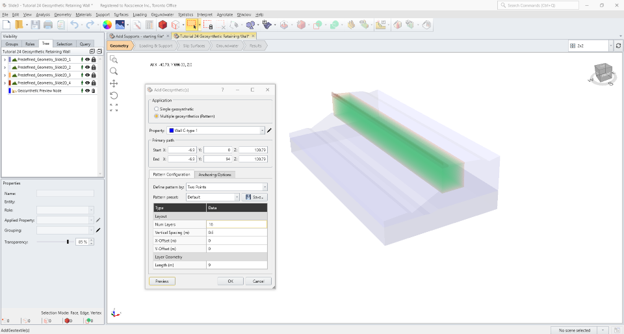
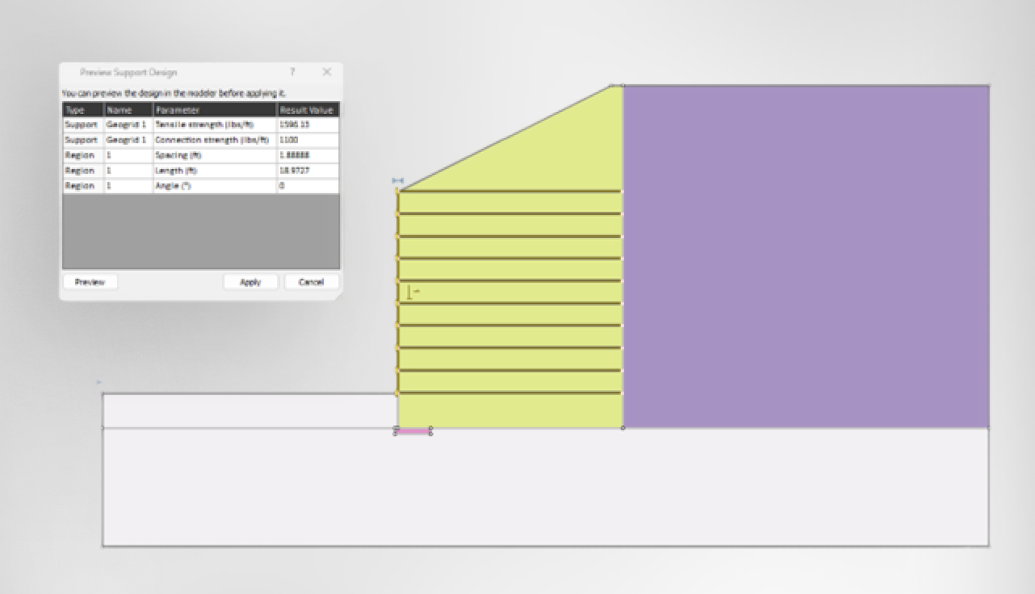
The new Add Geosynthetics dialog supports two complementary workflows:
- Single Geosynthetic Definition
Engineers can define individual reinforcement layers by specifying geometry, orientation, dimensions, and anchorage conditions. This is best suited for detailed modelling where layer-by-layer control is required.
- Geosynthetic Pattern Generation
For larger reinforced soil applications, the pattern-based workflow significantly reduces model setup time. Engineers define a complete reinforcement layout by specifying:- Primary path geometry
- Layer spacing
- Horizontal and vertical offsets
- Number of reinforcement layers
- Layer orientation
Reinforcement layouts can also be imported directly from external tables, enabling large systems to be generated automatically from existing design data. Preset configurations can be saved and reused, supporting consistent application across multiple analyses or project phases. Collectively, these enhancements reduce manual effort while improving consistency in reinforced slope and MSE wall modelling workflows.
CSV Import and Export: Connecting Slide3 to External Workflows
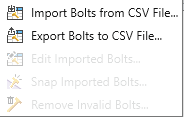
Large-scale support systems can involve hundreds or thousands of reinforcement elements. At this scale, manual coordinate entry is not only inefficient; it does not scale effectively in real project environments. To address this, Slide3 now supports full import and export of support elements using CSV files.
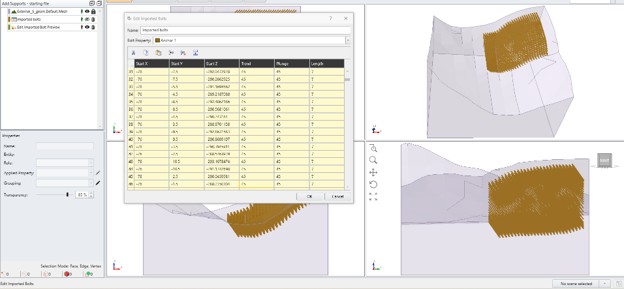
Support geometries can now be generated externally using tools such as:
- CAD platforms
- GIS systems
- Spreadsheet-based design workflows
- Survey or field data systems
- Proprietary engineering tools
These datasets can then be imported directly into Slide3, automatically generating the corresponding support layout within the model. Conversely, existing support systems can be exported to CSV format for documentation, review, QA/QC workflows, or transfer between project teams and tools.
This capability is particularly valuable for:
- Large reinforcement programs where manual entry isn’t feasible.
- Projects with existing support inventories or survey data.
- Design updates delivered by external consultants.
- Parametric studies requiring systematic variation of support geometries.
- Digital design workflows integrating multiple engineering tools.
The result is a more seamless connection between Slide3 and external engineering ecosystems, reducing manual effort while improving consistency and traceability of support data.
A More Adaptable Framework for 3D Reinforcement Design
Support systems in modern geotechnical engineering are becoming more diverse, more data-driven, and more distributed across platforms. As a result, the way engineers build and evaluate models is also evolving. These three enhancements in Slide3 reflect that shift.
The User-Defined Support feature removes constraints on how reinforcement behaviour can be represented. The enhanced geosynthetic workflow streamlines the creation of large-scale reinforced soil systems. And CSV-based import and export capabilities bridge Slide3 with the broader engineering data ecosystem.
Together, they reduce friction between design intent and model implementation; allowing engineers to move more efficiently from concept to analysis, and from analysis to informed design decisions. Whether working on reinforced slopes, embankments, mine infrastructure, transportation corridors, or other complex geotechnical systems, these updates expand what can be represented in Slide3 without increasing modelling complexity.
Because in modern geotechnical design, flexibility is no longer a convenience. It is a requirement.
Explore What’s New in Slide3 Support Modelling
See how User-Defined Support, enhanced geosynthetic workflows, and CSV-based import/export can streamline reinforcement modelling and improve flexibility across your 3D slope stability analyses.
Start Your Free Trial