Machine Learning Meets Structural Geology with Automatic Cluster Analysis in DIPS
- Yalin Dogan, Geotechnical Product Manager at Rocscience
- Beverly Yang, Geomechanics Specialist at Rocscience
Identifying discontinuity sets has always been one of the most critical and time-consuming tasks in geotechnical analysis. With the release of DIPS 9.004, Rocscience is changing that. Automatic Cluster Analysis brings machine learning and AI-powered technology directly into the discontinuity set identification workflow, reducing reliance on manual visual interpretation and enabling a more consistent, data-driven approach.
The Challenge with Manual Discontinuity Set Identification
Engineers and geologists use DIPS to identify discontinuity sets, which are fundamental for rock engineering analyses, such as slope stability analysis, underground excavation design, and rock mass characterization.
Until now, discontinuity set identification in DIPS has been a manual process, relying primarily on the engineer's visual interpretation of the stereonet. While experienced practitioners develop strong intuition for this task, the process is inherently subjective and difficult to reproduce consistently, particularly when datasets are large, multivariable, or span multiple data types.

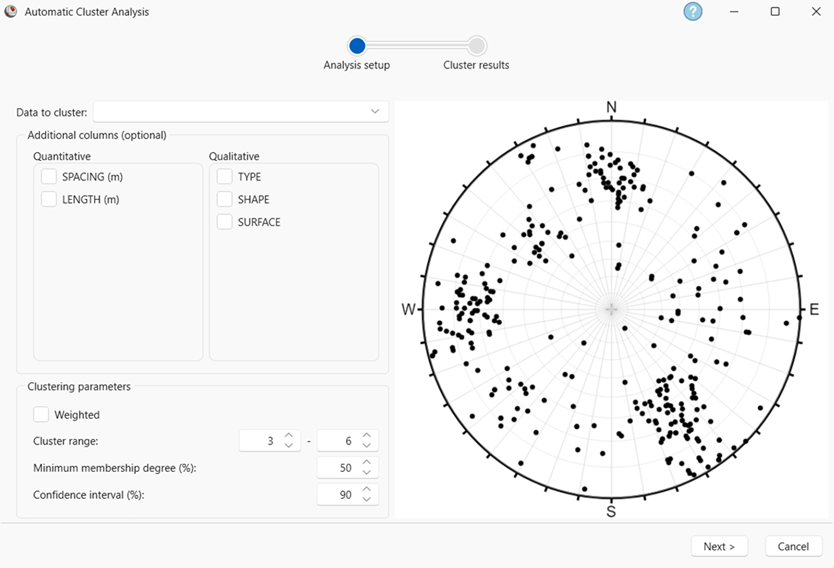
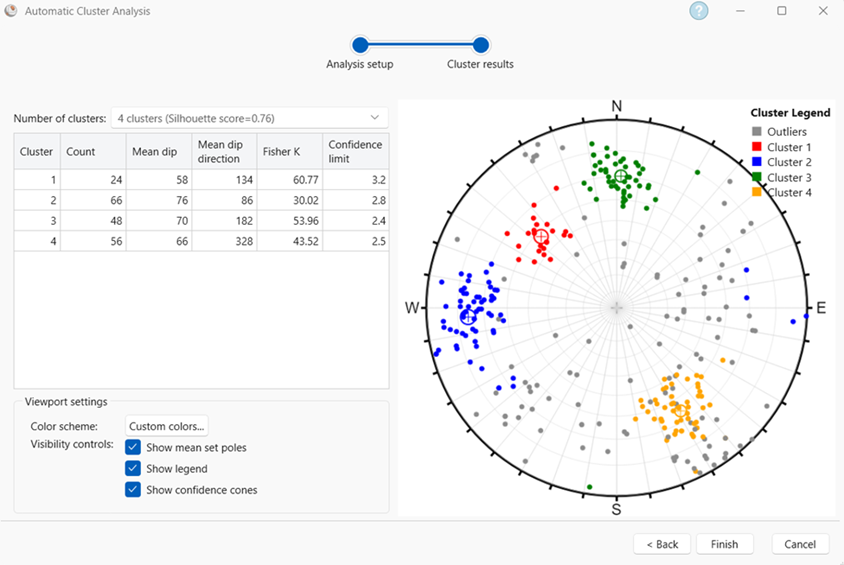
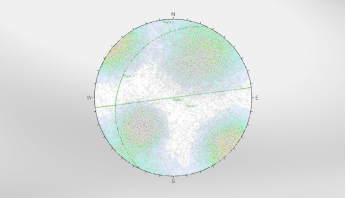
The new feature – shown in figures 1, 2 and 3 – automates the identification process while maintaining the visual clarity users expect from DIPS.
A New Capability: Clustering Mixed Data
The Automatic Cluster Analysis feature automates discontinuity set identification using two innovative and complementary technologies:
Fuzzy clustering:
Fuzzy clustering is a type of machine learning algorithm that automatically groups data into clusters. The advantage of fuzzy clustering is that it recognizes that a data point can partially belong to multiple clusters instead of one cluster. As a result, it is better equipped to handle the inherent uncertainty and complexity in geological data.
Clustering mixed data using AI-powered vector embeddings:
The core innovation of this feature is its ability to handle mixed data. Previous manual clustering in DIPS could work with orientation data, quantitative data, and qualitative data individually. What it could not do was combine all three in a single clustering operation.
The Automatic Cluster Analysis feature uses AI-powered vector embeddings to translate qualitative data (text-based field observations such as rock type, joint roughness, or weathering condition) into a numerical format that can be processed alongside orientation and quantitative data.
The result is that all data types can be clustered together in one analysis, allowing for a more comprehensive analysis of large and complex rock engineering datasets.
Summary
The Automatic Cluster Analysis feature represents a significant step forward in bringing advanced computational methods to geotechnical engineering practice. It replaces a process that has traditionally relied on visual judgment with a consistent, algorithm-driven workflow. By combining fuzzy clustering with AI-powered vector embeddings, the feature can handle any combination of orientation, quantitative, and qualitative data in a single analysis. It is designed to integrate naturally into the existing DIPS workflow and is built to grow with future enhancements.