Conditions for Agreement Between LEM and FEM in Slope Stability
- Sina Javankhoshdel, Senior Manager - LEM at Rocscience
Slope stability analysis ultimately comes down to one question: how and where will failure occur? Whether assessing an embankment, an earth dam, or a reinforced earth structure, this challenge has shaped the development of two distinct analytical approaches, each with its own strengths and limitations.
In practice, two methods dominate: Limit Equilibrium Methods (LEM) and Finite Element Methods (FEM). FEM provides rigorous stress-strain modelling and captures deformation, yet LEM remains the workhorse of the profession due to its efficiency, clarity, and direct calculation of the factor of safety.
FEM is often regarded as the more rigorous approach because it accounts for stress redistribution and deformation. In practice, however, the difference between the two methods is less about physics and more about how each identifies the critical failure mechanism. This distinction has become increasingly important as modern optimization algorithms have improved LEM’s ability to capture complex failure surfaces that were once thought to require FEM's sophisticated machinery.
This raises a persistent question: can these two fundamentally different approaches produce comparable results? This article examines the precise conditions under which LEM and FEM converge, with particular emphasis on slip surface search algorithms and metaheuristic optimization techniques in LEM, alongside the modelling assumptions that enable meaningful comparison.
The findings demonstrate that when advanced search techniques combine metaheuristic optimization with local surface optimizations, and when FEM models employ appropriate strength reduction assumptions, both approaches can indeed produce comparable results.
Limit Equilibrium Methods
Fundamental Concepts
Limit Equilibrium Methods evaluate slope stability by enforcing equilibrium along a potential slip surface. In two-dimensional analysis, the sliding mass is divided into vertical slices. In three dimensions, it is discretized into columns. Forces acting on each slice or column include the weight of the slice, normal forces at the base, shear resistance along the base, and interslice forces.
The factor of safety is defined as the ratio of available shear strength to shear stress. Several LEM methods exist, including Bishop, Janbu, Spencer, and General Limit Equilibrium (GLE). Among these, Spencer and GLE satisfy both force and moment equilibrium, making them the most rigorous formulations available.
Three-dimensional analysis extends the traditional method of slices to a method of columns. Here, equilibrium equations must be satisfied in two orthogonal directions, adding complexity but enabling analysis of truly three-dimensional failure mechanisms.
The Critical Challenge in LEM: Slip Surface Search
The mathematics of solving equilibrium equations poses little challenge in modern LEM. The real difficulty lies elsewhere: identifying the critical slip surface that yields the lowest factor of safety. This search problem fundamentally determines whether LEM can capture the true failure mechanism.
Traditional approaches employ relatively simple search patterns. Circular grid search, slope search, and path search methods work adequately for straightforward slope geometries. However, they may fail when confronted with identifying complex mechanisms in slopes with layered materials, anisotropic properties, weak zones, or irregular geometries.
Failure surfaces can take many forms, including:
- Circular 2D
- Non-circular surfaces 2D
- Sphere surfaces 3D
- Ellipsoid Surfaces 3D
- Multi-planar surfaces 3D
- Wedge-type surfaces 3D
If the search algorithm fails to adequately explore the solution space, the analysis will miss the global minimum factor of safety. The result appears stable on paper while harbouring an undiscovered failure mechanism. This gap between mathematical capability and search adequacy has driven the development of more sophisticated approaches.
Advanced Search Techniques
Recent advances in slope stability software have brought powerful optimization algorithms into practical engineering use. Metaheuristic optimization methods have proven particularly effective for the slip surface search problem. These algorithms excel at exploring large, complex solution spaces to identify near-optimal solutions.
The methods draw inspiration from diverse sources. Common metaheuristic methods include:
- Particle Swarm Optimization – inspired by the collective movement of bird flocks and fish schools.
- Cuckoo Search – derived from the parasitic nesting behaviour of cuckoo birds.
- Simulated Annealing
These algorithms generate candidate slip surfaces, then iteratively improve them based on the calculated factor of safety. However, even these sophisticated methods face limitations. A metaheuristic algorithm alone may still converge to local minima rather than the true global minimum.
This recognition led to the development of hybrid approaches that combine global search with local refinement.
Surface Altering Optimization (SAO)
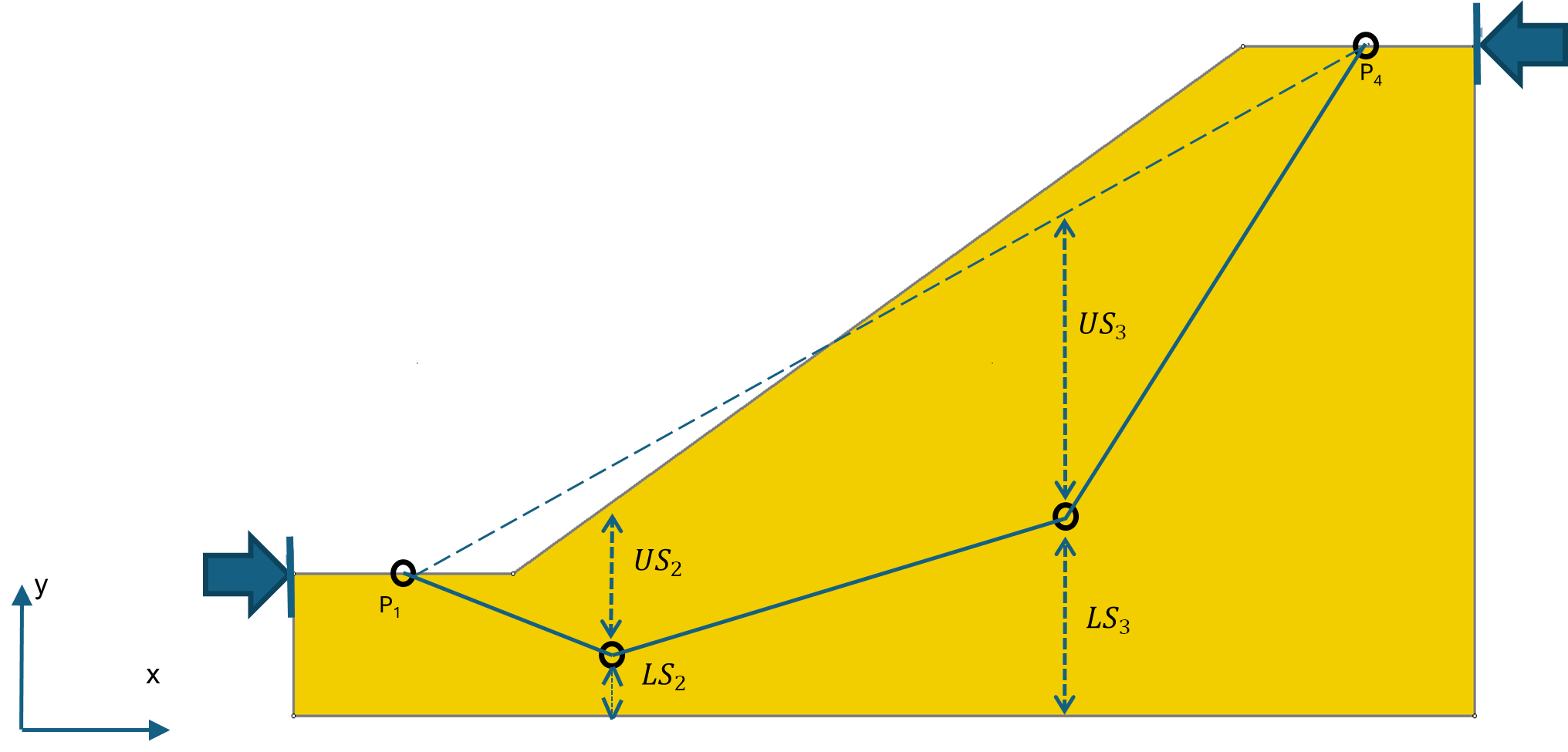
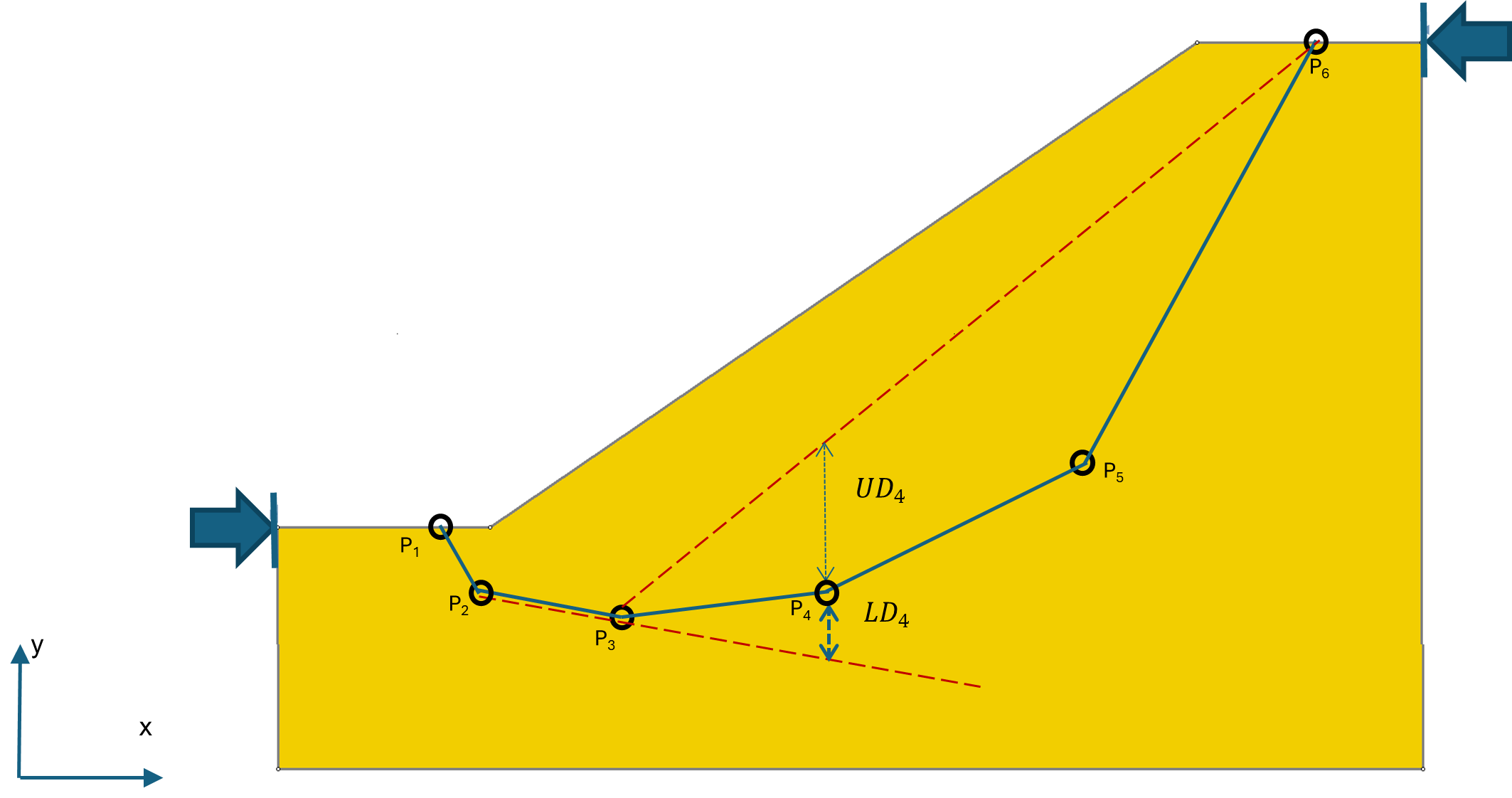
Surface Altering Optimization is a powerful technique used to refine candidate slip surfaces Mafi et al. (2021). Rather than relying solely on broad exploration of the solution space, SAO refines candidate slip surfaces through targeted geometric modifications.
The method systematically alters the geometry of an existing slip surface to further reduce the factor of safety. This approach builds on Bound Optimization by Quadratic Approximations (BOBYQA), a derivative-free constrained nonlinear optimization method.
Instead of generating entirely new surfaces from scratch, SAO performs geometric transformations on an existing surface to improve its shape and identify a lower factor of safety.
The power of this hybrid strategy – metaheuristic search methods and local surface optimization – becomes clear in practice. Metaheuristic methods provide global exploration, casting a wide net across the solution space. SAO then provides local intensification, squeezing every bit of optimization from promising candidates.
Together, these approaches form a detection system capable of identifying complex failure mechanisms that would elude either method working alone.
Multi-Modal Optimization
Slopes may contain multiple potential failure mechanisms, including both global and local failures. Recognizing this reality requires moving beyond the traditional focus on finding a single critical surface.
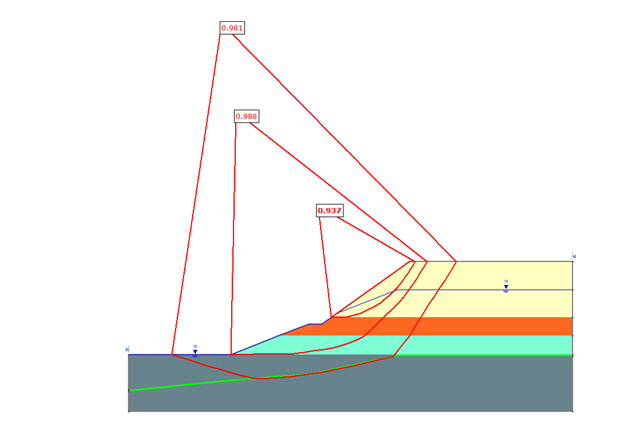
Multi-modal optimization (MMO) allows the detection of multiple critical slip surfaces during a single analysis. This capability matters because FEM naturally exhibits this behaviour. As strength reduction factors increase, FEM solutions can reveal multiple modes of failure, each becoming critical at different stages of the analysis.
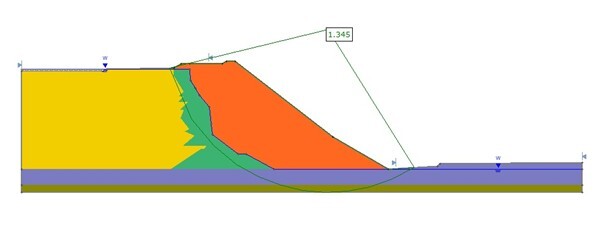
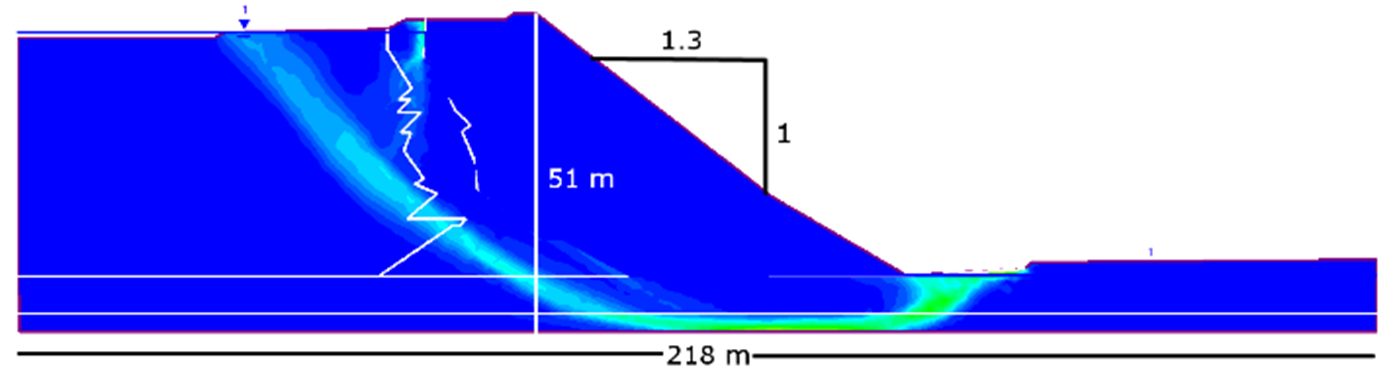
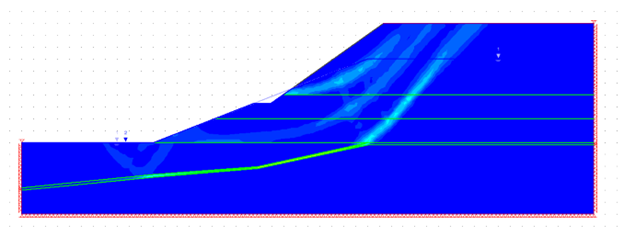
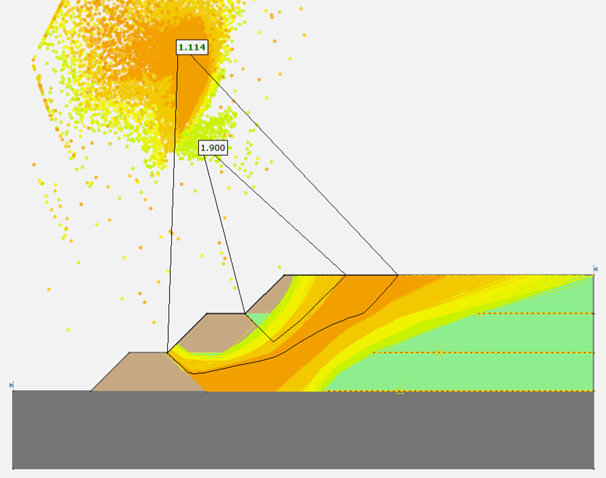
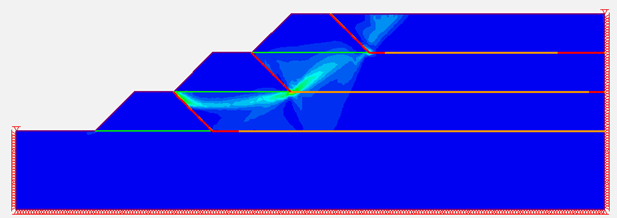
Hence, by enabling LEM to detect multiple failure modes, MMO improves consistency with FEM results. The comparison shifts from matching single surfaces to matching the complete spectrum of potential failures. Figure 3 demonstrates this capability, showing LEM (Slide2) and FEM (RS2) results side by side, with multi-modal failure mechanisms clearly visible in both analyses.
Conditions Under Which LEM and FEM Results Can Match
Achieving comparable results between LEM and FEM requires attention to specific conditions that vary with material properties and slope characteristics.
Purely Cohesive Slopes
- Bishop, Spencer, or GLE methods can be used.
- Circular slip surfaces typically represent the failure mechanism well.
Cohesive-Frictional Soils and Anisotropic Materials
- Spencer or GLE methods should be used.
- Metaheuristic search techniques are required.
- Local surface optimization methods should be applied.
Slopes with Multiple Weak Layers
- Advanced search algorithms must be used.
- Surfaces should be allowed to follow weak layers.
- Automatic or heuristic search methods are required.
Multi-Modal Optimization
Enabling multi-modal optimization allows LEM to capture both local and global failure mechanisms. This capability mirrors the behaviour observed in FEM analyses, where multiple failure modes can emerge depending on the strength reduction factor.
Requirements for FEM Models
Meaningful comparison with LEM requires careful configuration of FEM models. Several key requirements ensure that the two methods analyze comparable scenarios.
Shear Strength Reduction
The factor of safety should be computed using the SSR technique. This approach directly parallels LEM's factor of safety definition, enabling direct comparison of results.
Elastic Perfectly Plastic Behaviour
The soil model should be defined as elastic perfectly plastic, with failure governed solely by shear strength parameters. This assumption aligns with LEM's treatment of material behaviour at failure. More complex constitutive models, while potentially more realistic, introduce behaviours that LEM cannot capture.
Stiffness Considerations
In FEM slope stability analysis, stiffness primarily controls deformation and stress redistribution. However, for many strength-reduction analyses using a Mohr-Coulomb model, Young's modulus and Poisson's ratio exert little direct influence on the predicted factor of safety compared with shear strength parameters like cohesion and friction angle.
Avoiding Tension-Controlled Failure
FEM analysis sometimes produces tension-controlled failure mechanisms. Tension zones may appear due to stress redistribution, but they can generate unrealistic failure patterns inconsistent with LEM assumptions. Results from LEM and FEM analyses become comparable only where tension does not control the failure mechanism.
Structural Interfaces
When joints or structural interfaces appear in the model, they should be defined consistently with LEM assumptions. In many cases, elastic interfaces prevent unrealistic failure modes that would otherwise emerge from the FEM solution.
Reinforcement Modelling
For reinforced slopes, reinforcement elements should receive very high stiffness values. This prevents artificial deformation that has no counterpart in LEM reinforcement models, ensuring that the reinforcement behaves similarly in both methods.
Groundwater and Seepage
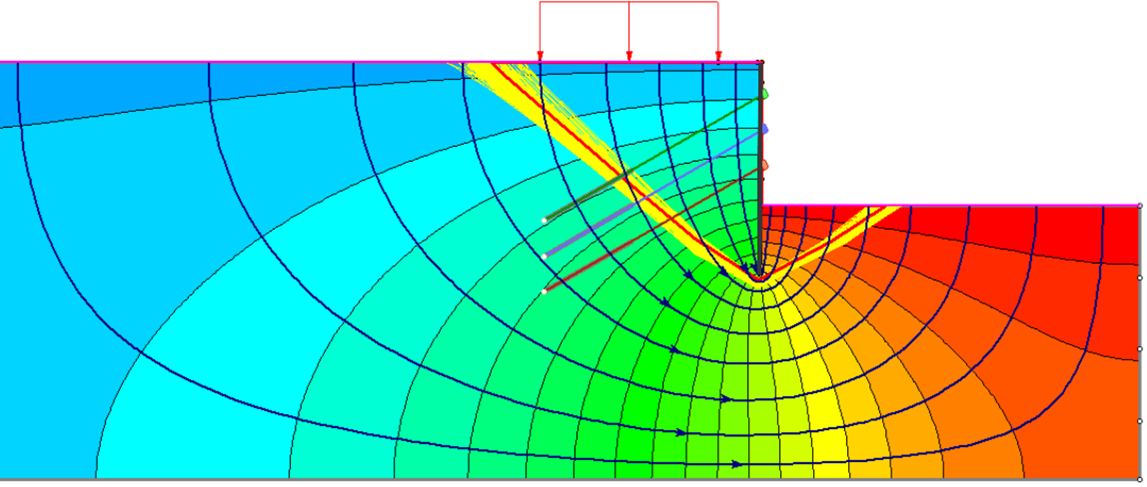
Groundwater conditions exert profound influence on slope stability through pore water pressures. Slide2 addresses this through integrated analysis. Seepage analysis within the program already employs finite element methods. The software internally computes pore water pressures using FEM seepage analysis, then incorporates these calculated pressures directly into the slope stability analysis.
This integration eliminates the need to export pore pressure grids from external FEM seepage analysis and import them into Slide2. The approach ensures consistent groundwater modelling within the slope stability framework, removing a potential source of discrepancy between methods.
Practical Implications
The results of this study have important implications for engineering practice.
- LEM remains a powerful and efficient tool for slope stability analysis.
- The accuracy of LEM depends strongly on the quality of the slip surface search algorithm.
- Advanced optimization methods significantly improve LEM performance.
- FEM is a robust method, and it becomes priority when deformation and stress redistribution are important.
For factor of safety calculations alone, LEM and FEM can provide comparable results when appropriate modelling assumptions are used.
Conclusions
This study examined the conditions under which Limit Equilibrium Methods and Finite Element Method of analyses can provide comparable results. The findings challenge some conventional assumptions while confirming the fundamental soundness of both approaches.
The results point to a clear conclusion. Differences between LEM and FEM are rarely rooted in the methods themselves. They arise from how the problem is defined, how the solution space is explored, and how material behaviour is represented.
For LEM, the defining factor is the quality of the slip surface search. Advanced optimization techniques, particularly the combination of metaheuristic search and local surface refinement, have significantly improved its ability to identify complex and governing failure mechanisms. Multi-modal optimization further strengthens this capability by capturing both local and global modes of failure within a single analysis.
For FEM, comparability depends on modelling discipline. When analyses are performed using shear strength reduction with elastic perfectly plastic material models, and when failure is governed by shear rather than tension, the resulting factors of safety align closely with LEM predictions.
The implication is practical. The choice between LEM and FEM should no longer be framed as a question of reliability. It is a question of purpose. FEM remains essential when deformation and stress redistribution govern behaviour. LEM remains highly effective for factor of safety calculations when supported by robust search algorithms.
Under consistent assumptions and with modern optimization techniques, the two methods converge for many real-world problems. The question is no longer whether they can match, but when they should be expected to.
Close the Gap Between LEM and FEM Results
Rocscience tools combine advanced slip surface search algorithms with rigorous numerical methods, allowing engineers to evaluate complex conditions with clarity and consistency.
Explore Rocscience Slope Stability Solutions