RSPile Expands Helical Pile Analysis with Installation Torque Modelling
- Ahmed Mufty, Senior Geomechanics Specialist
Helical pile design extends beyond verifying ultimate compression and uplift capacity. During installation, torque provides valuable insight into pile behaviour, serving as an important indicator of installation conditions and helping engineers evaluate whether design assumptions align with field performance.
The latest RSPile release strengthens this workflow by expanding the software's helical pile analysis capabilities with dedicated installation torque analysis. New C-Phi soil modelling, enhanced parameter controls, and an integrated Torque-Capacity Results environment enable engineers to evaluate installation torque alongside ultimate compression and uplift capacity within a single analysis workflow.
Together, these enhancements provide a more complete framework for analyzing helical pile behaviour from installation through final design performance.
Extending Helical Pile Analysis Beyond Capacity
RSPile's existing Helical Pile Analysis functionality calculates both installation torque and ultimate pile capacity using limit state analysis. Depending on soil conditions and pile geometry, results may be governed by cylindrical shear between helices or by the resistance developed at individual helical plates.
The software also provides flexibility through several optional modelling controls, including the ability to:
- Include or exclude shaft adhesion/friction above the first helix in capacity calculations.
- Include or exclude shaft resistance below the bottom helix in torque calculations
- Account for local shear failure.
- Use reduced helix area for end-bearing calculations.
- Apply shape and depth factors to modify bearing capacity factors.
These controls allow engineers to tailor analyses to project-specific assumptions and design approaches.
New C-Phi Soil Type for Mixed Soil Behaviour
One of the most significant additions in this release is the introduction of the C-Phi soil type for helical pile analysis.
Previously, helical pile analyses could be performed using either cohesive or cohesionless soil models. The new C-Phi option expands this capability to soils that exhibit both a cohesion intercept and an internal friction angle, allowing engineers to represent a broader range of real-world ground conditions within a single material model.
For C-Phi materials, engineers can use the Define Soil Properties dialog to define:
- Cohesion intercept
- Internal friction angle
- Shaft-soil friction angle
- Adhesion factor for shaft resistance
- Unit cylindrical shear limit
- Overconsolidation ratio (OCR)
In addition, a simple checkbox allows users to switch between Effective Stress Analysis and Total Stress Analysis, providing flexibility for different geotechnical design methodologies. The new soil type is fully supported for both capacity calculations and installation torque analyses.
Dedicated Installation Torque Parameters
To support the new torque analysis workflow, RSPile introduces a dedicated Define Installation Torque Parameters dialog.
The new interface allows engineers to define how lateral earth pressure influences installation torque calculations. For both shaft resistance and cylinder shear resistance, the coefficient of lateral earth pressure can be specified as either User Define or Passive.
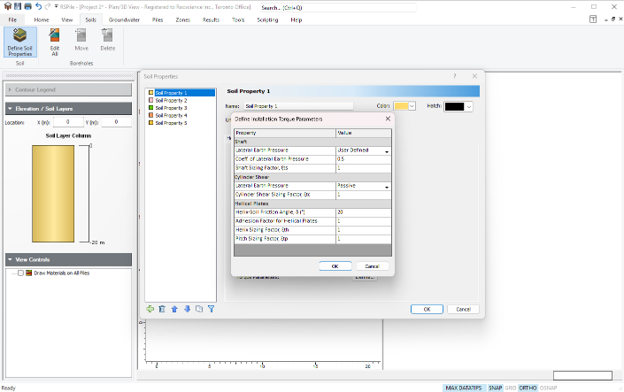
The workflow also introduces several sizing factors that can be used within the torque calculations:
- Shaft Sizing Factor (ξts)
- Cylinder Shear Sizing Factor (ξtc)
- Helix Sizing Factor (ξth)
- Pitch Sizing Factor (ξtp)
Additional helical plate parameters, including helix-soil friction and adhesion characteristics, can also be defined depending on the selected soil type. These controls provide a structured framework for representing the interaction between the pile shaft, helices, and surrounding soil during installation.
Expanded Earth Pressure Controls for Capacity Analysis
The release also enhances the existing Capacity Parameters workflow. Engineers can now define coefficients of lateral earth pressure separately for:
- Compression
- Uplift
- Shaft resistance
- Cylindrical shear resistance
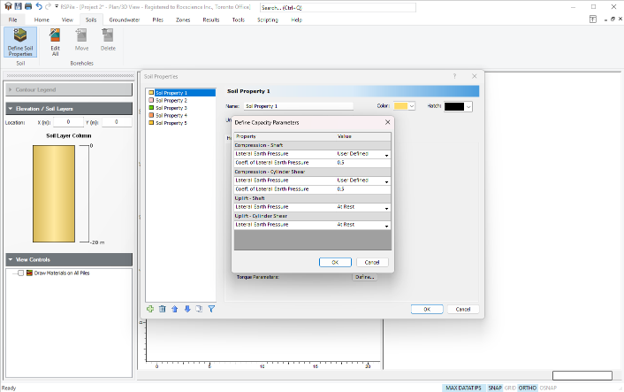
These values may be specified using User Defined inputs or calculated using At Rest earth pressure conditions, providing a consistent framework between capacity and torque analyses.
The result is greater flexibility when modelling soil-structure interaction under different loading conditions while maintaining consistency across the analysis workflow.
New Torque-Capacity Results View
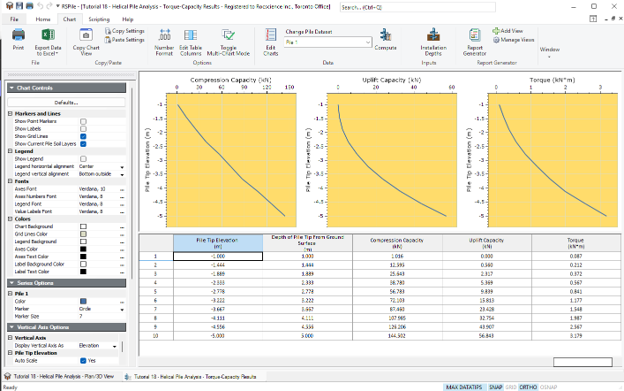
A major usability enhancement in this release is the introduction of the Torque-Capacity Results environment.
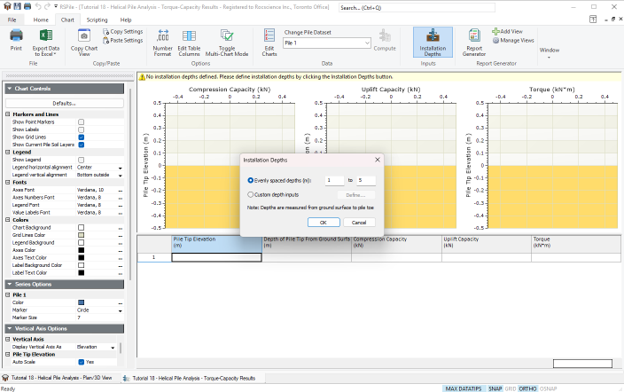
Accessible through Results > Installation Torque-Capacity, this dedicated view evaluates installation torque and capacity together, allowing engineers to investigate how pile performance changes as installation depth varies.
Users can define trial installation depths through the new Installation Depths dialog. Depths may be generated automatically using an evenly spaced range or entered manually as custom values. RSPile then repositions the pile geometry while preserving helix spacing and configuration before recomputing installation torque and capacity at each depth.
This allows engineers to quickly evaluate how changing embedment depth influences both constructability and foundation performance without repeatedly modifying the model.
The results interface generates three key outputs:
- Ultimate compression capacity
- Ultimate uplift capacity
- Final installation torque
Improved Visualisation and Reporting
The enhanced helical pile workflow is supported by detailed visualization and reporting tools.
Engineers can review depth-based distributions of:
- Shaft friction
- Cylindrical shear
- End bearing
- Total ultimate capacity
for both compression and uplift conditions. Detailed charts can be generated directly from the pile model, while torque-capacity results can be exported to Excel for further review and reporting.
The Report Generator also includes helical pile configuration data alongside soil properties, pile geometry, and project settings, helping streamline project documentation.
Bringing Installation and Capacity Analysis Together
Installation torque provides an important link between field installation and foundation performance. By bringing installation torque, compression capacity, and uplift capacity together within a unified analysis workflow, RSPile gives engineers a more complete understanding of helical pile behaviour throughout the design process.
Combined with the new C-Phi soil model, expanded lateral earth pressure controls, and dedicated torque analysis parameters, these enhancements make it easier to evaluate a broader range of ground conditions while improving confidence in both installation and design decisions.
Analyse Every Pile Type with Confidence
Discover how RSPile's comprehensive analysis capabilities can help streamline your foundation design from concept to construction.
Try RSPile For Free