Reese and Matlock Pile Response to Lateral Loading in Elastic Soil Using RSPile
- Ahmed Mufty, Senior Geomechanics Specialist
Introduction
RSPile can analyze the behavior of an elastic pile subject to lateral loads in a way that produces same results of the method published by Reese and Matlock (1956) and generalized by Matlock and Reese (1960), for elastic soils with linear stiffness increase with depth such as cohesionless soils or normally consolidated clays.
Many users of RSPile feel perplexed about this possibility. This article is devoted to depicting the steps and the equations that allow the users of RSPile to define the soil properties reflecting the elastic springs assumed by Reese and Matlock for a horizontally loaded elastic pile.
Summary of Reese and Mutlock method
The modulus of horizontal subgrade reaction kh along the pile length is defined in units of F/L3 as:
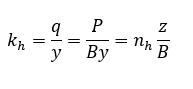
where q is the lateral soil pressure in units of F/L2 along the pile of a width B, while y is the lateral deflection of the pile, nh is the coefficient of modulus of horizontal subgrade reaction variation or simply the coefficient of stiffness variation with units of F / L3 and z is the depth taken positive downward from 0 at pile head. The modulus kh starts at zero at the surface (head of pile) and increases linearly with depth. Note that P is the soil reaction per unit length of the pile which builds the P – y curve for the pile-soil interaction.
Defining soil spring stiffness as a function of depth, in units of F/L2:
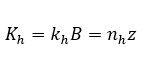
According to P – y theory the differential equation for the pile behavior may be put in the following form (assuming no axial force), with y and Kh are functions of the depth z:
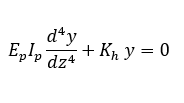
Subject to the following boundary conditions:
For a free head pile:
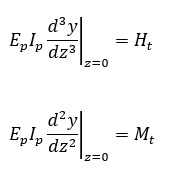
where Ht and Mt are the lateral force and the bending moment at the top of the pile head. Of course, y here refers to the deflection in yz plane, where z should be the axis of the pile.
For a pile with head fixed against rotation the boundary conditions will be:
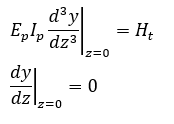
EpIp is the bending stiffness (also called flexural rigidity) of the pile.
The coefficient of stiffness variation, nh , varies according to the relative density of the cohesionless soil and the unconfined compressive strength for normally consolidated cohesive soils.
There have been many trials to define suitable values for nh , starting from Terzaghi (1955). Although Terzaghi has given his estimates based on a specific plate width, 0.305m x 0.305m (1 ft x 1 ft), the later research did not show dimensions effect on the constant as Terzaghi termed it. But Terzaghi did mention that the coefficient may be different in submerged and dry conditions. Based on an equation he presented
nh = 0.741 Ay’
where A depends only on density of the sane with a range of 100 for loose sands to 2000 for dense sands and may be found experimentally. Terzaghi (1955) adopted 200, 600 and 1500 for for loose, medium, and dense sands respectively, and gave the following values in his paper:
Relative density |
loose |
medium |
dense |
Submerged conditions |
1.25 |
4.4 |
10.7 |
Dry conditions |
2.2 |
6.6 |
17.6 |
Values in MN/m3
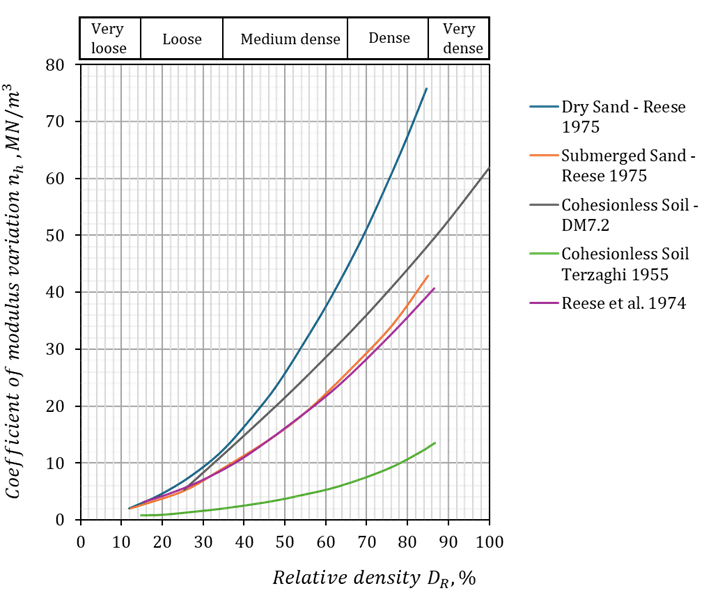
A curve was produced by Garassino et al. (1976) to show an average Terzaghi based values for nh and shown in Fig.1 along with other graphs from different literature. Nowadays Terzaghi’s values are considered very low for piles under lateral loads and very rarely used. Engineers who adopt the elastic analysis method usually use Reese (1975) values or the average DM7.2 values. Cited by Tomlinson and Woodward (2015), Garassino et al. (1976) produced another curve for Reese et al. (1974) which sounds close to the curve for submerged sands given later by Reese (1975) but not fully coinciding.
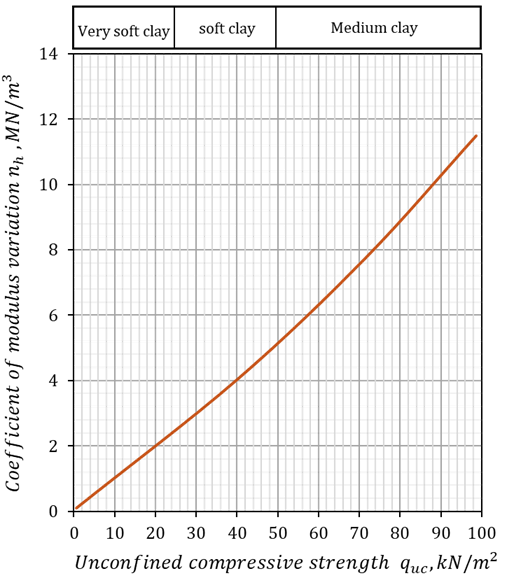
Another graph for NC clays, Fig.2, is adopted from DM7.2 (1986) where the coefficient of stiffness variation depends on the unconfined compressive strength covering clays from very soft to medium stiff consistency, from 0 to 100 kPa, above which the linear variation will no longer work and constant modulus and stiffness for the clay shall be adopted.
Non dimensional solution of Reese and Matlock
First let us introduce as a factor for the relative stiffness between the linearly increasing stiffness of the soil and the flexural rigidity of the pile:
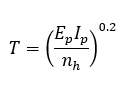
where z is the depth from pile head 0 to Lp , and hence the depth factor Z will in be unitless and starts from 0 at pile head to Zmax = Lp / T .
The solution of the differential equation with its boundary conditions may be based on T and Z and as follows:
For a pile head which is at the surface of the layer of linearly increasing stiffness, fixed against rotation such as a slender pile connected to a heavy pile cap,
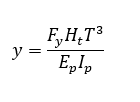
Deflection of the pile at any depth:
Bending moment, and soil reaction respectively:
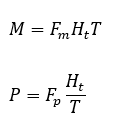
where Fy , Fm , and Fp are dimensionless factors which are functions of depth factors Z. and Zmax. To get values for these factors refer to Murthy (2002) or Tomlinson and Woodward (2015).
For a free headed pile in the same type of soil, the equations will be:
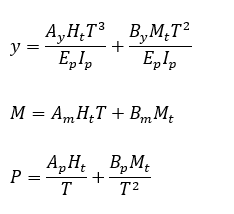
where the factors Ay , Am , Ap and By , Bm , Bp are functions of the depth factors Z and Zmax and pile length and can be obtained from tables or charts from same references.
How to apply in RSPile
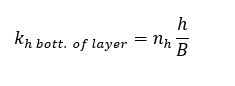
In RSPile, within project settings, choose Lateral or Axial/Lateral analysis. After you define the borehole, the soil layer properties shall be chosen as elastic for lateral analysis tab. Then set the elastic modulus of subgrade reaction kh to 0. Then, press on datum dependency tab and add your bottom modulus as:
where h is the layer thickness and B is your pile width.
RSPile will be easier regarding this input soon and more general and an essay will be issued regarding the changes.
It is important you use the full layer thickness and not the pile length here. Pile length will not affect the soil’s properties.
If you have more than one linear elastic layer each layer shall have its own start modulus and end modulus and the 0 will be only at the top of a surface layer.
Example applications
Example 1:
A pile 0.6 m in diameter and 7.5 m in length with a Young’s modulus of 31529 MPa is installed in a dry sand layer 20 m thick that is assumed linearly increasing in stiffness with depth and that has a relative density of DR = 54%. The pile is fixed to a rigid pile cap that suppresses the pile head rotation. A load of 200 kN is applied at the pile head in global x-direction.
To choose a value for the stiffness variation coefficient we refer to Fig.1 and use the curve for Reese (1975) for dry sand and a relative density of 54%, and we get an approximate value of 30 MN/m3.
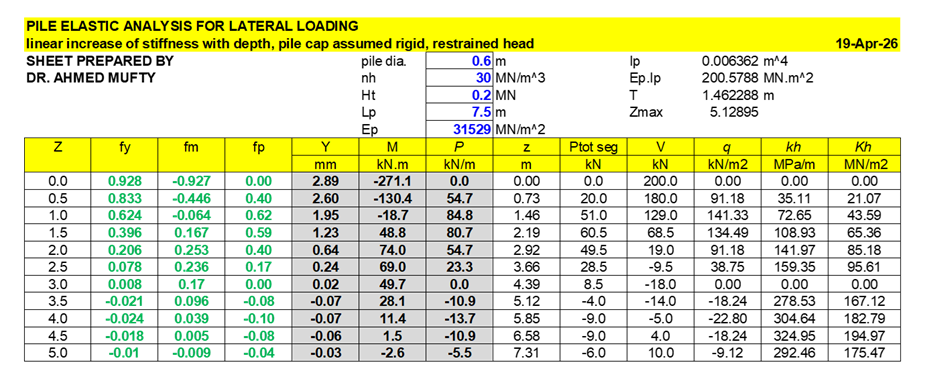
For this pile a spread sheet using Reese and Matlock method as explained above is used. The screenshot of the spreadsheet is shown in Fig.3. The input parameters are bold blue typed.
Note that T and Zmax are computed at the top right side of the sheet. As Zmax = 5.13 the factors Fy , Fm , and Fp are taken from the references for Zmax = 5.0 knowing that after 5.0 the effect of Zmax on the values of the factors is negligible. The factors are fed manually and typed in bold green.
The results are shown in black.
Now going to RSPile, the 20 m thick elastic layer is given a subgrade reaction modulus of zero in the soil properties tab and in the datum dependency tab at the bottom modulus of the layer is given as

The general layout of the model in RSPile is shown in Fig.4 and the dialogue boxes are shown in Fig.5.
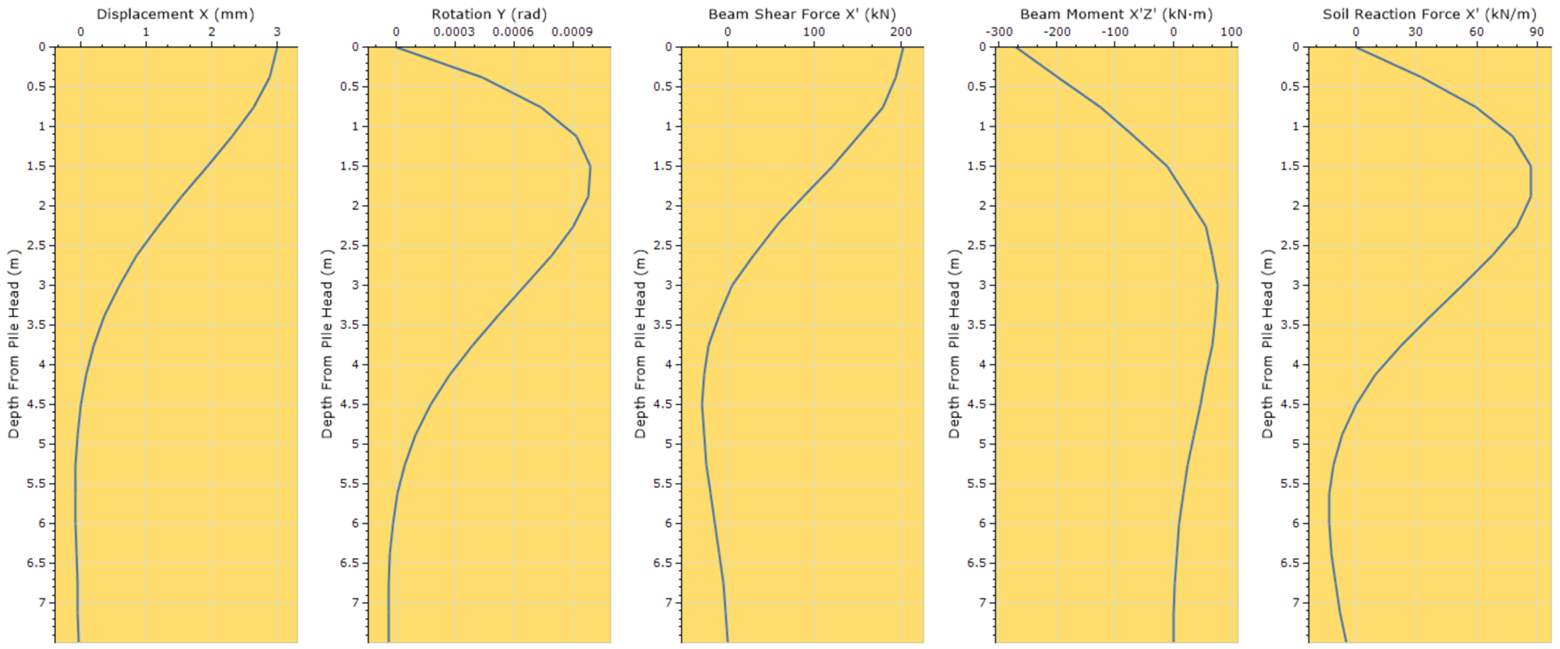
After all dialogue boxes are filled, the model is executed. Partial results for the RSPile run are shown in Fig.6.
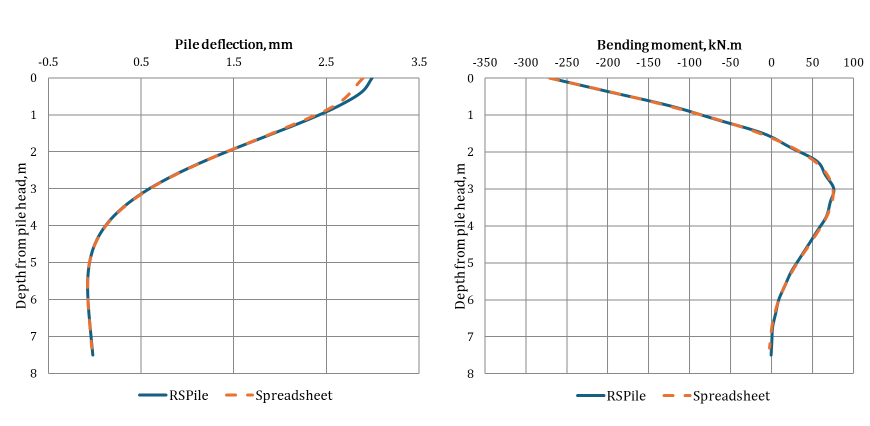
The results for deflection and bending moment are compared to the spread sheet results in Fig.7. It can be seen how close the results from the two sources are.
Example 2
For the same pile, pile load, and soil properties of example 1, except that the pile head is free to rotate, we shall solve for pile deflections, bending moments, etc.
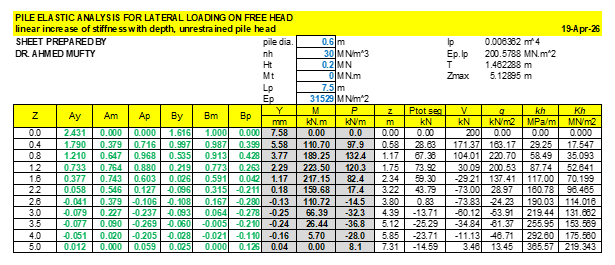
To prepare a spread sheet for this case same nh , T , Zmax and =5 are followed of course, but this time to get Reese and Matlock A’s and B’s coefficients for free headed pile in linearly increasing stiffness soil.
For Zmax =5, the collected factors, factors Ay , Am , Ap and By , Bm , Bp are listed in the sheet screenshot in Fig.8. The sheet shows also, the results of the method for the pile in the example.
Running the same pile with changing the loading dialogue removing slope=0 will leave only the horizontal force Fx = 200 kN. .
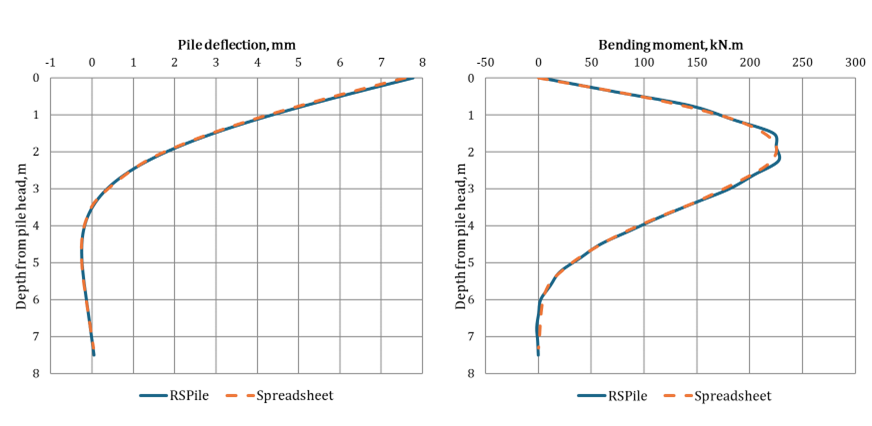
The results for Example 2 from RSPile are compared to the spreadsheet results as in Example 1 and the comparison is shown in Fig. 9.
As an additional exercise, try to add moment to the free headed pile equal to –271.1 kN.m , the same moment resulted in the fixed head pile, what do you expect to get? You should get the same results of the fixed head pile.
Concluding remarks
The elastic method is still a powerful and easy tool to obtain reasonable results of pile behavior in linearly increasing stiffness soil especially when the loads are in the working levels. RSPile can easily produce the results of such an analysis using soil properties features as explained.
Cited literature
Garassino, A., Jamiolkowski, M. and Pasqualini, E. (1976): “Soil Modulus for Laterally Loaded Piles in Sands and NC Clays”. Proceedings of the Sixth European Conference, ISSMFE, Vienna, Austria, Vol. I, No. 2, pp.429–434.
Matlock, H., and Reese, L. C. (1960). “Generalized solutions for laterally loaded piles”. J. Soil Mech. Found. Div., 86(5), pp.63–91.
Murthy, V.N.S. (2002): “Geotechnical Engineering: Principles and Practices of Soil Mechanics and Foundation Engineering”. CRS Press, 1056pp.
Matlock, H. and Reese, L.C. (1962): “Generalized Solutions for Laterally Loaded Piles". Transactions of the American Society of Civil Engineers.
NAVFAC DM7.2 (1986): “Foundations and Earth Structures”. Design Manual, Naval Facilities Engineering Command, USA.
Reese, L.C. (1975): "Laterally Loaded Piles". Proc. of the Seminar Series, Design, Construction and Performance of Deep Foundations: Geotech. Group and Continuing Education Committee, San Francisco Section, ASCE, Berkeley.
Reese, L.C. and Matlock, H. (1956). “Non-dimensional solutions for laterally loaded piles with soil modulus assumed proportional to depth”. Proc. 8th Texas Conf. on Soil Mechanics and Foundation Engineering, Austin, Texas, pp.1-41.
Reese, L.C., Cox, W.R. and Koop, F.B. (1974): “Analysis of Laterally Loaded Piles in Sand”. Proceedings of the Offshore Technology Conference, Houston, TX, Paper No. OTC 2080.
Terzaghi K. (1955): "Evaluation of Coefficients of Subgrade Reaction". Geotechnique, Vol 5., No. 4, pp. 297–326.
Tomlinson, M.J. and Woodward, J. (2015): “Pile Design and Construction Practice”. 6th Edition, CRC Press, Taylor & Francis Group, Boca Raton, Florida, USA, 574pp.