A New Versatile Ground Motion Manager: Bringing Target Response Spectrum-Consistent Uni- and Bi-directional Ground Motion Selection into RSSeismic
- Dylan Centella, Geotechnical Product Manager at Rocscience
- Dr. Youssef M A Hashash, at University of Illinois Urbana-Champaign
Ground motion selection is a key part of seismic site response analysis, representing the ground shaking driving the soil column. In preparing for a site response analysis, engineers define the seismic hazard level, identify an appropriate target response spectrum, assemble motions that are representative of the hazard, apply scaling when needed to have a target-spectrum-compatible suite of motions, and then import into SRA.
For most projects, this workflow conventionally takes place across multiple tools. Engineers may use one tool to develop the target spectrum, another to search ground motion databases, another to select and scale records, and then take additional steps to convert files into the format required for analysis. While this process follows standard engineering practice, it can be time-consuming, difficult to scale up for large parametric analyses, and vulnerable to inconsistencies during file conversion or data transfer. This is especially challenging when a project involves multiple hazard levels, multiple target spectra, large record pools, or paired horizontal components for bi-directional shaking analysis.
The new Ground Motion Manager in RSSeismic simplifies this disjointed workflow by bringing more of the target spectrum and ground motion selection and modification workflow directly into the same software platform. Users can still import and use ground motions generated elsewhere, but they can now also define the target spectrum, query external ground motion databases, sort for candidate records, select and scale motions, review the selected suite of ground motions and develop analysis-ready ground motion files for RSSeismic as well as export these ground motions for use elsewhere.
Ground Motion Manager Workflows
The Ground Motion Manager has evolved from a tool primarily used to bring externally prepared motions into RSSeismic to a more complete environment for defining the target spectrum, and selecting, scaling, and preparing ground motion suites. Figure 1 summarizes this evolution through multiple workflows, all of which produce analysis-ready input motion files for RSSeismic.
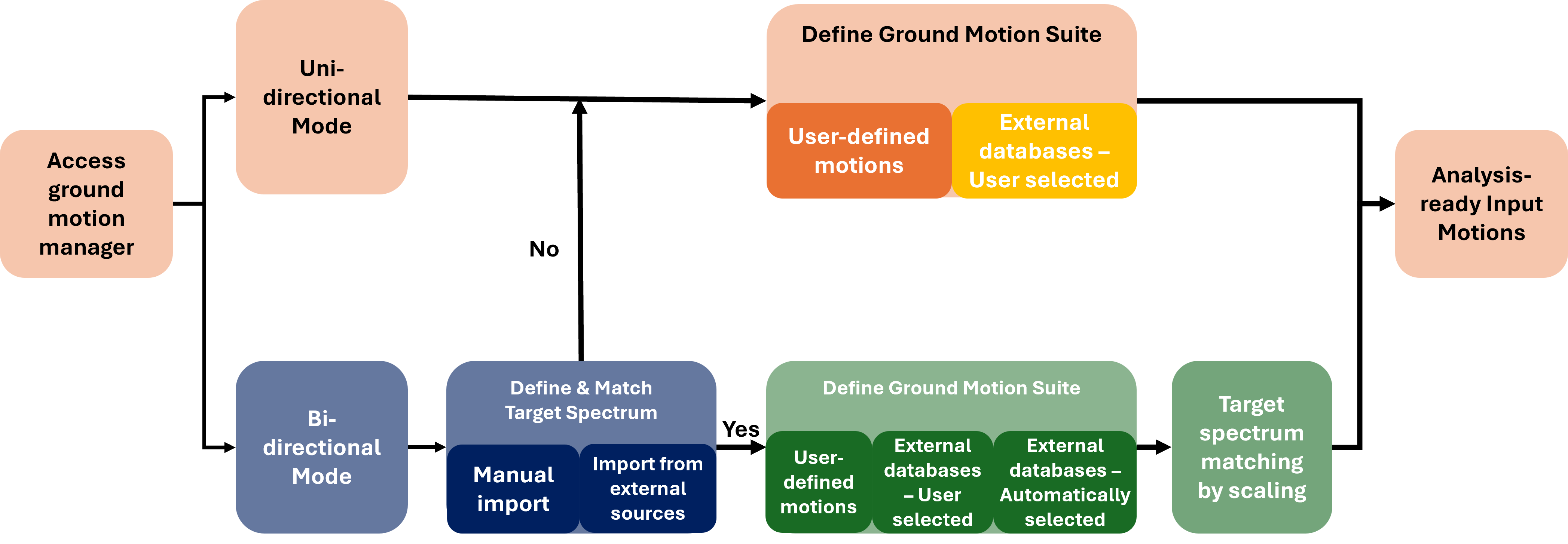
In the workflow available in RSSeismic v1, users prepared the ground motion suite outside the program. This typically included selecting records, applying any desired scaling, formatting the files, and organizing the final suite before SRA use. In the v1 workflow, the Ground Motion Manager served mainly as the entry point for bringing an already prepared suite into the program and converting it into analysis-ready input motion files.
RSSeismic v2 expanded this process by adding access to an external ground motion database. Instead of requiring users to assemble the entire motion suite externally, users could select an external database, query available records, and use those records to define the ground motion suite. This provided a direct connection between external ground motion database records and RSSeismic input motion files.
The Ground Motion Manager in RSSeismic v3 introduces significant additional features and workflows beyond the features in v1 and v2:
- Uni-directional and bi-directional ground motion handling: Ground motions can now be used and viewed as individual components or as component pairs, depending on the analysis type.
- New external databases: The new Ground Motion Manager expands access beyond the Ground-motion Relational Database (GMDB), to include the Engineering Strong-Motion database (ESM), which focuses on European, Mediterranean, and Middle Eastern events, and Center for Engineering Strong Motion Data (CESMD), which provides raw and processed U.S. strong-motion data. Users can search this broader collection by magnitude, distance, site conditions, tectonic setting, and other project-specific criteria.
- Target spectrum definition: In workflows where target spectrum is required, users can query a target spectrum from different supported sources and building codes, as well as importing a user-defined target spectrum. This target spectrum will then be employed in the record selection and scaling process.
- Ground motion suite definition for matching target spectra: When a target spectrum is defined, users can define the ground-motion suite manually or automatically select one from an external database. For automatic selection, users specify the database to be queried, the number of ground-motion pairs to be selected, and whether ground-motion scaling should be applied.
- Ground motion matching by scaling: In workflows that include ground motion selection, users can choose whether to scale the selected motions to improve their fit to the target spectrum or retain the motions at their original, unscaled amplitudes.
Users can select the appropriate workflow based on the analysis type, the need for a target spectrum, and the method used to define the ground motion suite. Each workflow produces analysis-ready input motion files for use in RSSeismic.
The following sections describe the newly introduced components of this expanded workflow in more detail.
Uni- and Bi-directional Ground Motion Handling for Advanced Site Response Analysis
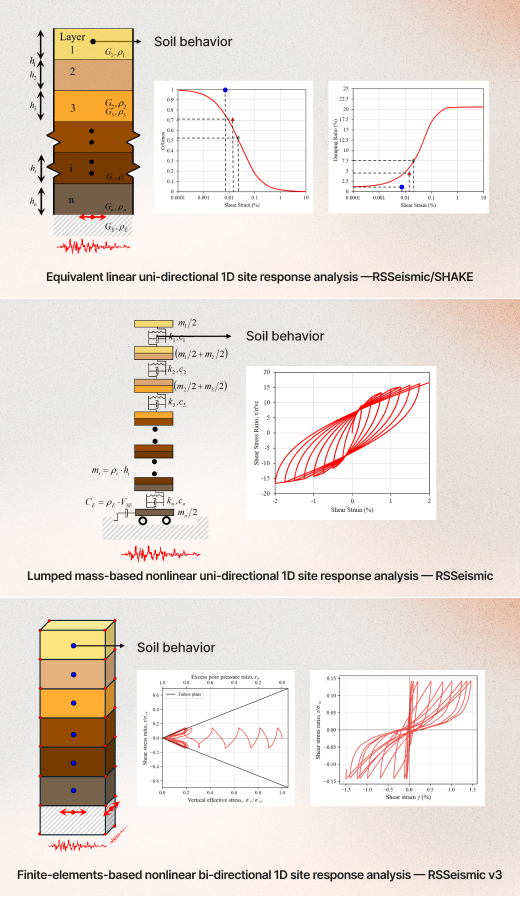
In conventional 1D site response analysis, ground motions are most commonly handled as uni-directional input motions. A single horizontal component is selected to represent the input shaking applied to the soil column, and the analysis evaluates the corresponding one-dimensional response of the site. In uni-directional mode, the Ground Motion Manager treats each ground motion as a single horizontal component. Users can import individual acceleration time histories, review their response spectrum, apply amplitude scaling when required, and prepare the selected motions as RSSeismic ground motion input files.
One of the major additions to the expanded Ground Motion Manager is support for horizontal bi-directional ground motion workflows via the “bi-directional mode”. The companion article provides a detailed explanation of a new first of its kind site response analysis incorporating bi-directional shaking, reflecting a more realistic representation of the actual shaking during an earthquake. In bi-directional mode, users can work with libraries of ground motion pairs rather than treating each horizontal component as a separate record. The bi-directional mode in the Ground Motion Manager provides tools for visualizing and evaluating two-component records. This allows users to review not only the individual components, but also the selected record set as a paired input motion.
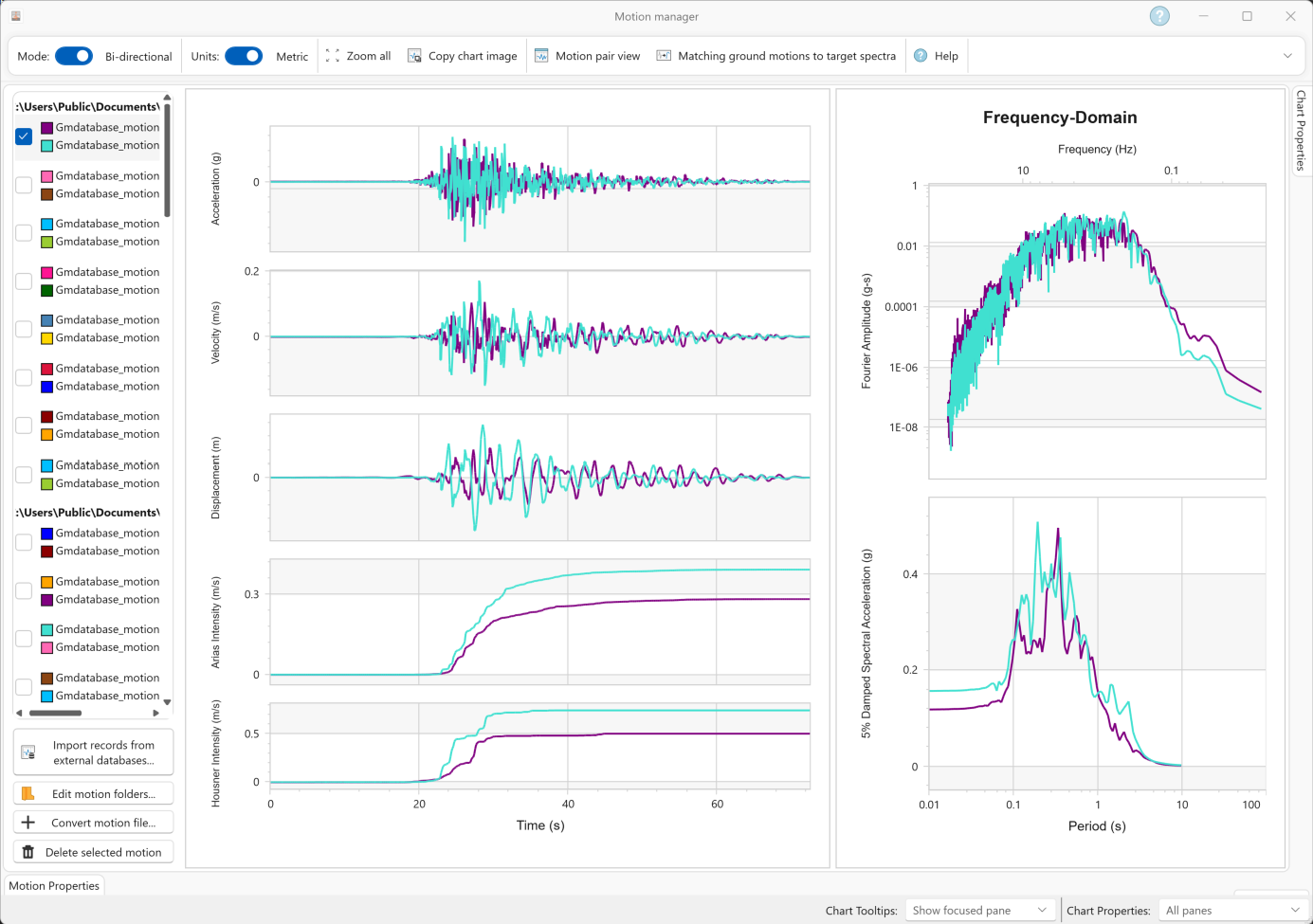
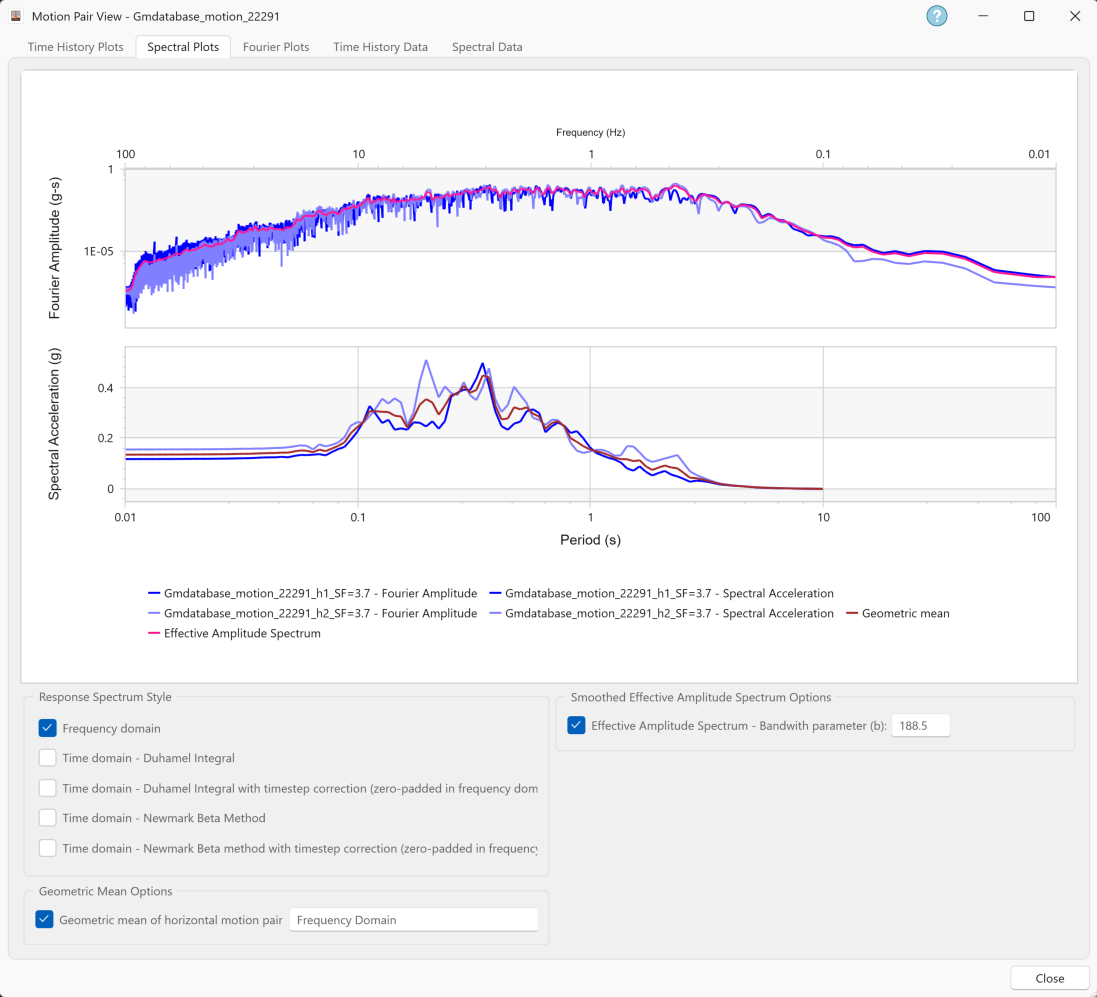
The Motion Pair view allows users to evaluate the characteristics of motion pairs through the geometric-mean response spectrum and smoothed effective amplitude spectrum (EAS). The geometric-mean response spectrum combines the response spectra of the two horizontal components into a single spectrum representing the ground-motion pair. The EAS provides a measure of the frequency content of the paired horizontal components. Unlike the response spectrum, which describes oscillator response, the EAS represents the amplitude characteristics of the ground motion in the frequency domain and can be used to review the broader spectral shape and energy distribution of a ground-motion pair. Figure 3 shows the geometric-mean response spectrum and smoothed EAS available in the Spectral Plots view.
These capabilities are important for current bi-directional FE-based analyses and help position the workflow for future ground motion models that make use of two-component measures such as EAS. By keeping paired components together and providing tools to calculate and review two-component spectral measures, the expanded Ground Motion Manager gives users a more consistent path from database records to bi-directional analysis inputs.
At the same time, RSSeismic continues to support the conventional uni-directional workflow used in many site response analyses. Users performing traditional analyses with a lumped mass approach can still select, scale, and prepare motions for uni-directional input. The new bi-directional mode expands what users can do inside RSSeismic, while preserving support for established uni-directional workflows that are common in engineering practice.
Expanded Access to External Ground Motion Databases
The expanded database access allows users to search a broader pool of recorded ground motions and filter candidate records using project-specific criteria, such as magnitude, distance, site conditions, tectonic setting, and other available metadata. The new Ground Motion Manager expands access to ground motion databases beyond the Ground-Motion Relational Database, GMDB, by Buckreis et al in v2. Users now have access to:
- Ground-Motion Relational Database (GMDB): The Ground-Motion Relational Database (GMDB) has been developed for researchers and engineers to access global ground-motion data and related metadata. The processed time series data, associated metadata, and ground motion intensity measures are organized into a web-served relational database consisting of 32 tables connected by primary/foreign key pairs. Ground motion metadata and intensity measures (but not time series) from the NGA-East and NGA-West2 projects are also contained in the database. (https://www.gmdatabase.org/)
- Engineering Strong-Motion database (ESM): ESM, the Engineering Strong-Motion Database, provides a set of facilities to search, select, download and analyze ground-motion data and associated metadata. The waveforms contained in ESM are relative to events with magnitude ≥ 4.0, mainly recorded in the European-Mediterranean regions and the Middle-East. ESM is targeted to applied seismologists, earthquake engineers, professional engineers, geologists and policy makers. (https://esm-db.eu/)
- Center for Engineering Strong Motion Data (CESMD): The Center for Engineering Strong Motion Data (CESMD) is a cooperative center established by the U.S. Geological Survey (USGS) and the California Geological Survey (CGS) to integrate earthquake strong-motion data from the CGS California Strong Motion Instrumentation Program, the USGS National Strong Motion Project, and the Advanced National Seismic System (ANSS). The CESMD provides raw and processed strong-motion data for earthquake engineering applications (https://www.strongmotioncenter.org/aboutcesmd.html)
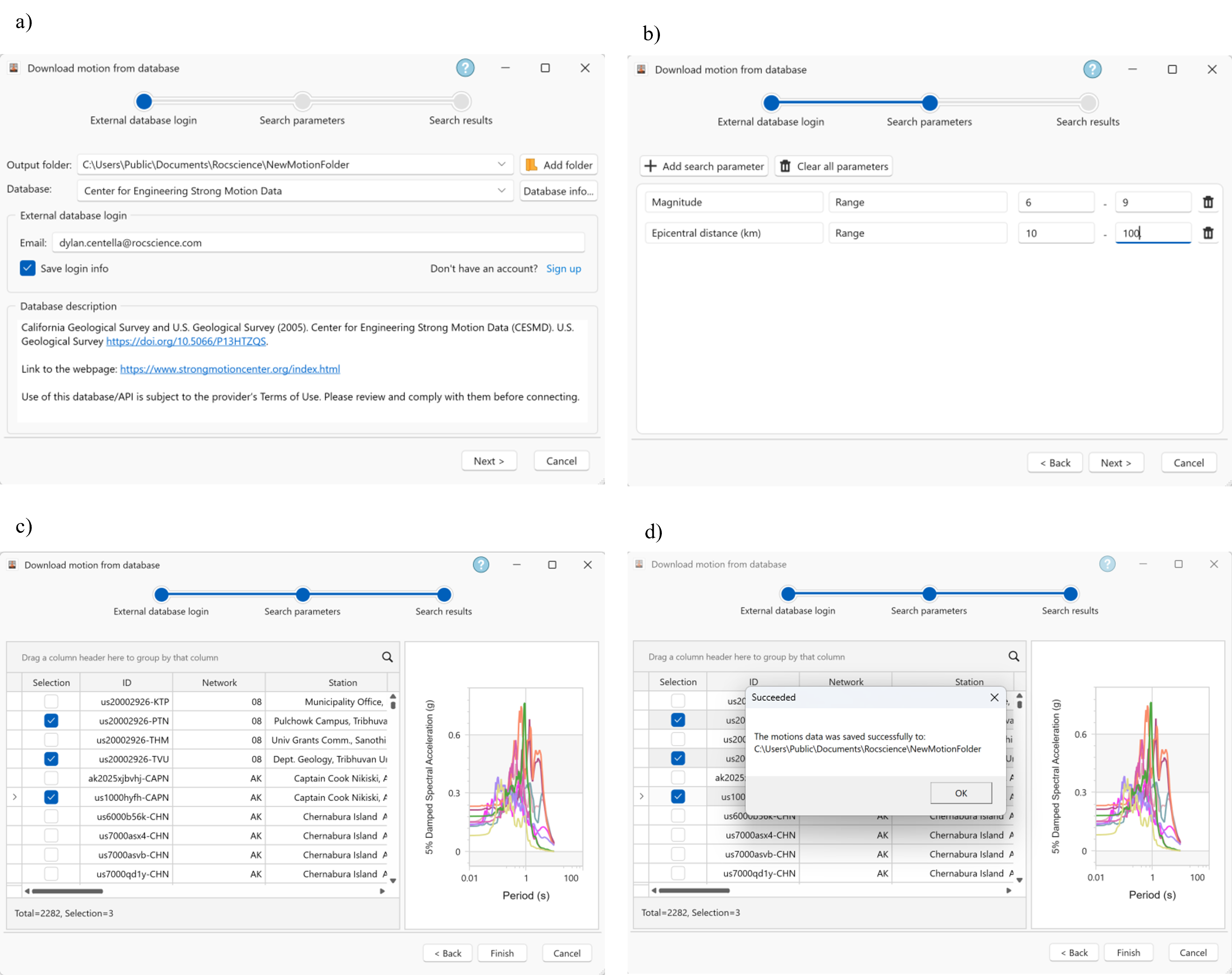
Figure 4 illustrates the workflow for querying records from the CESMD database.
Developing Spectrally Matched Ground Motions by Scaling
Defining and Matching the Target Spectrum
The target spectrum defines the hazard level that the selected ground motions are intended to match. In the Ground Motion Manager v3, users can develop the target spectrum either manually or by importing from external sources. v3 currently supports importing from the following sources:
- User-defined target response spectrum: This option allows users to manually define a target response spectrum or import one from an external file. The spectrum is specified as a series of spectral-period and spectral-acceleration values. Users should ensure that the imported values use the units selected in the Ground Motion Manager and that the periods are arranged in ascending order. This option is appropriate when the target spectrum has been developed independently, for example, from a site-specific probabilistic or deterministic seismic-hazard analysis, a building-code design spectrum, or another seismic-hazard application.
- NSHMP Dynamic Hazard Curves target spectra: The NSHMP option provides access to U.S. Geological Survey national seismic hazard models, including models for the conterminous United States, Alaska, Hawaii, and Puerto Rico/U.S. Virgin Islands. To use this option, the user generally provides the site location, site class or Vs30, and the hazard level, such as annual frequency of exceedance or return period. This tool can be accessed online at: https://earthquake.usgs.gov/nshmp/hazard/dynamic.
- ESM/REXEL: The ESM REXEL-target-spectrum web-service allows computation of design acceleration 5%-damping elastic spectra according to Eurocode 8 (EC8) (CEN 2003), Italian seismic code (NTC08) (CS.LL.PP. 2008) (Sgobba et al., 2019). Depending on the selected spectrum type, the required inputs may include site location, site class, topography, nominal life, functional type, limit state, and probability of exceedance. This tool can be accessed online at: https://esm-db.eu/esmws/rexel-target-spectrum/1/.
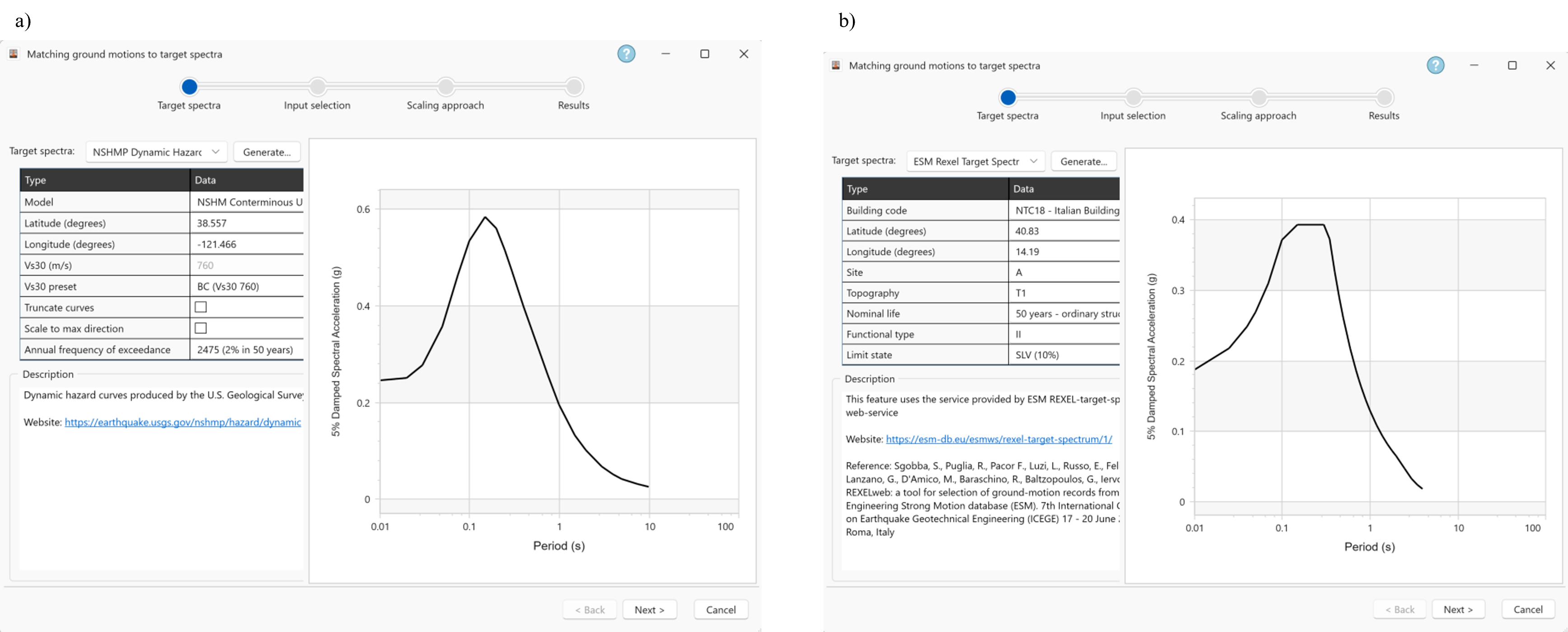
Figure 5a shows a sample target spectrum using the NSHM dynamic curves for a site in the Bay Area, San Francisco, California and Figure 5b shows a sample target spectrum from a site in Naples, Italy for a site class C based on EC8.
Configuring Ground Motion Suite Selection
Users begin by selecting either manual or automatic record selection. In manual record selection, users specify a folder containing ground motion pairs in the RSSeismic format, and the motions pairs in that folder are used to define the suite. In automatic record selection, the Ground Motion Manager selects a suite from an external ground motion database based on criteria specified by the user.
Users then specify the output folder where the selected ground motions and associated record selection results will be saved. For automatic record selection, users also select the external ground motion database to be queried.
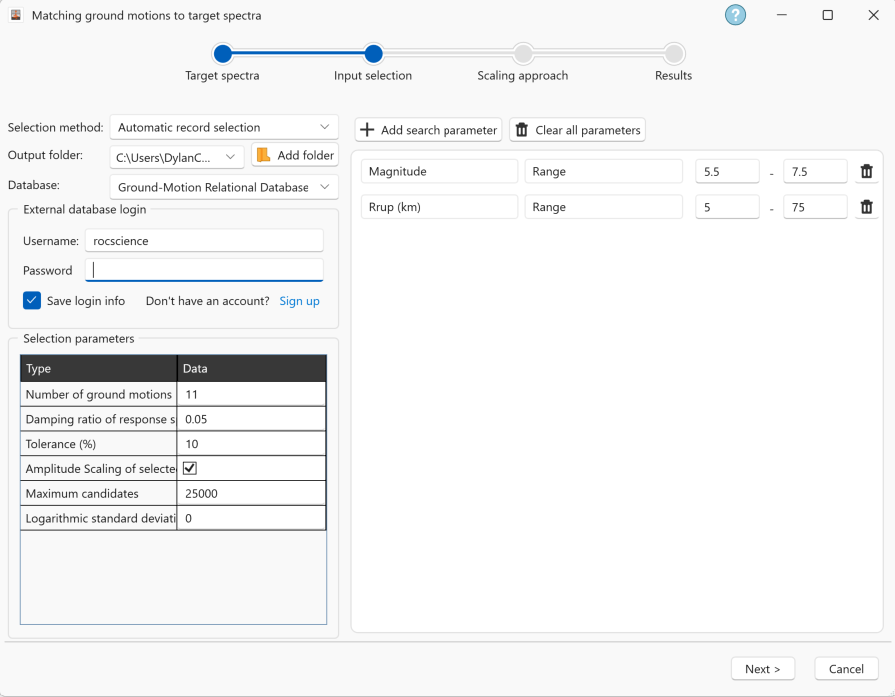
Users then define the database search parameters used to identify the candidate records. These parameters may include ranges for earthquake magnitude, rupture distance, and other record metadata available in the selected database. The available search parameters may vary depending on the database. Figure 6 shows the input selection settings for automatic record selection, including the selected external database, output folder, database search parameters, and parameters controlling the selection of the ground motion suite.
The remaining parameters control the automatic record-selection process. Users specify the number of ground motions or ground-motion pairs to be selected, and the damping ratio is used to calculate the response spectra. A damping ratio of 5% is used by default; however, users may specify a different value if needed. Users also define the allowable difference between the response spectrum of the selected suite and the target spectrum, referred to as the selection tolerance, and indicate whether amplitude scaling may be applied during record selection. The maximum number of candidate records limits the size of the record pool considered by the selection algorithm. Lastly, users specify the logarithmic standard deviation of spectral acceleration, which defines the target variability of the selected ground-motion suite.
Match Geometric Mean of Ground Motion Suite to Target Spectrum
Ground-motion pairs can be retained in their original, unscaled amplitudes or undergo amplitude scaling. When scaling is applied, each selected record is assigned an individual scale factor to improve agreement between the geometric-mean response spectrum of the ground-motion suite and the target spectrum over a user-defined period range. The objective is not for each record to match the target spectrum individually, but for the selected suite to provide a suitable overall match.
The user can control how scaling is applied by defining minimum and maximum scale factors. These bounds limit how much a record can be scaled down or scaled up before it is accepted into the selected set. This is useful when a project places limits on the amount of amplitude scaling that is allowed, or when the user wants to avoid selecting records that require large adjustments to match the target.
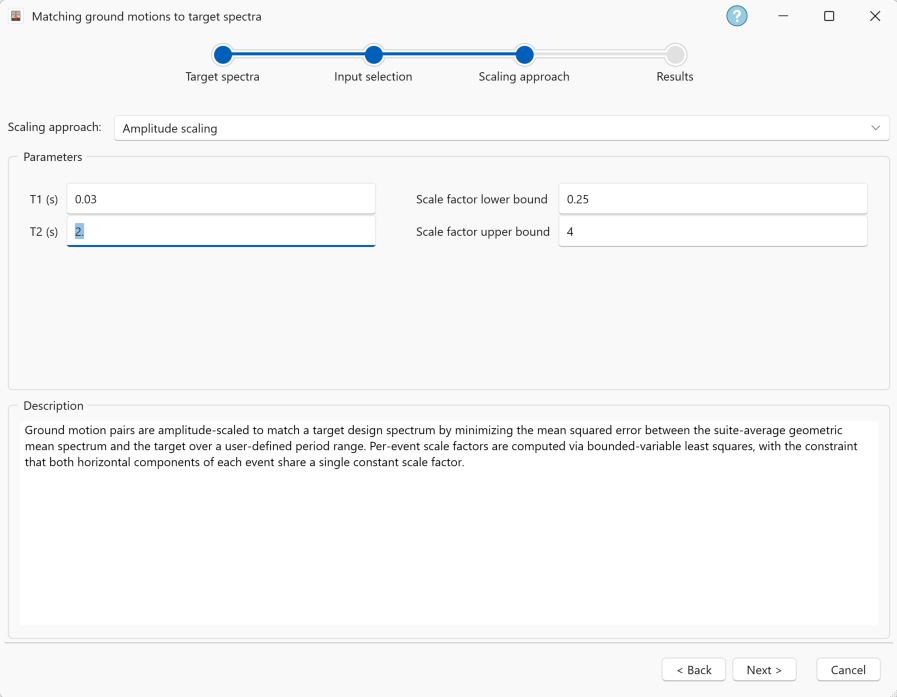
Scaling can be used in both manual and automatic selection. In the manual workflow, the user defines the candidate pool from an input folder and can scale the selected records to the target spectrum. In the automatic workflow, the user can choose whether the algorithm should use scaled records or raw records. The applied scale factors are retained with the selected records, allowing users to review how much each motion was modified and how the geometric mean spectrum compares with the target before generating the input motion files. Figure 8 shows a sample case where 11 ground motion pairs were scaled to match a target spectrum for a site in San Francisco, California. Beyond the geometric mean, the results page also shows geometric mean plus/minus the log standard deviation in order to provide users with a way to assess the variability of the resulting ground motions suite.
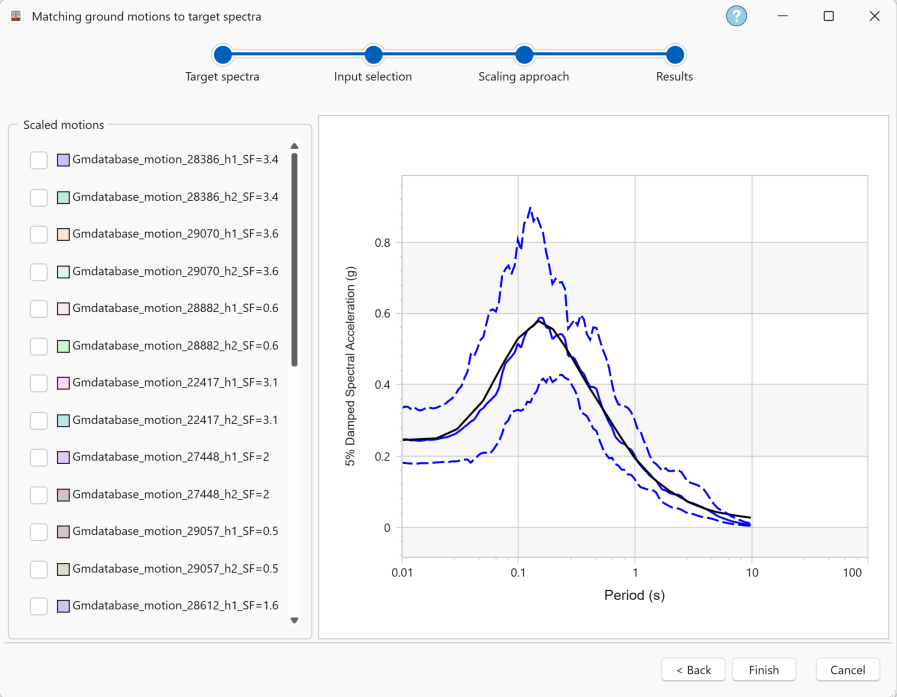
After record selection and scaling is complete, users can review the selected ground-motion suite before preparing the analysis-ready input motion files. The results display the selected ground motions, the scale factor applied to each motion when scaling is used, and the geometric mean of the response spectra of the selected suite relative to the target spectrum. When scaling is not used, the motions retain their original amplitudes. The geometric mean plus and minus the log standard deviation are also displayed, allowing users to evaluate the agreement of the suite with the target spectrum and the variability among the selected motions. Figure 8 shows the results for a suite of 11 ground-motion pairs selected and scaled for the example site in San Francisco, California.
The Ground Motion Manager also generates a CSV file containing the metadata associated with the selected ground motions, together with the scale factor applied to each motion. This file provides a record of the selected suite and can be used for documentation, review, or subsequent data processing.
What This Means for RSSeismic Users
The expanded Ground Motion Manager greatly enhances the role of RSSeismic in the ground motion preparation process. RSSeismic v3 can now support more of the engineering workflow used to develop the input motions.
The result is a more connected workflow from target spectrum to analysis-ready ground motions. By reducing the number of external steps needed to prepare records, the expanded Ground Motion Manager helps limit file conversion issues, reduce manual data handling, and make the selection process easier to review and reproduce.
Importantly, this expansion does not replace the conventional uni-directional workflow. Users can continue to perform site response analyses using uni-directional input motions if desired. The difference is that RSSeismic now supports a more advanced bi-directional ground motion workflow, allowing users to prepare paired horizontal components within the same ground motion selection environment.
Streamline Your Ground Motion Selection Workflow
See how the new Ground Motion Manager in RSSeismic simplifies uni- and bi-directional spectral matching.
Start Your Free Trial