How Unsaturated Soils Shape the Stability of Tailings Dams – and Why You Should Care
- Sina Moallemi, Geotechnical Product Manager
- Arsalan Jameei, Geomechanics FE Specialist
When a tailings dam fails, the consequences are catastrophic — entire communities can be displaced, ecosystems destroyed, and billions of dollars lost. Yet many stability analyses overlook a critical factor that could mean the difference between adequate safety margins and disaster: the behaviour of unsaturated soils.
Early developments in soil mechanics focused primarily on saturated soils and classical design frameworks. They were built on the concept of effective stress, which combines total stress and pore water pressure. Although this framework is appropriate for fully saturated soils (those below the water table), it is often applied to partially saturated primarily for convenience.
In unsaturated soils, matric suction above the phreatic surface can contribute to shear strength through its influence on the effective stress state. Classical saturated soil mechanics commonly ignored negative pore water pressures when applying Terzaghi's effective stress principle; the profession was uneasy about their direct inclusion, as it could, in theory, increase effective stress beyond total stress. This practice is still widely accepted in geotechnical engineering and generally leads to conservative stability assessments.
However, experimental and theoretical work by Fredlund, Vanapalli [1,2], among others, demonstrated that in partially saturated soils, matric suction influences soil behavior in a manner that depends on the degree of saturation and the soil water characteristic curve. In unsaturated soil mechanics, the influence of matric suction can be incorporated either through modified effective stress formulations in which its contribution is scaled by the degree of saturation using soil water characteristic curves, or through direct inclusion in the shear strength formulation. Both approaches allow suction effects to be represented in a physically meaningful way and lead to more realistic stability assessments, particularly for short term conditions in which unsaturated zones persist before significant dissipation of suction occurs.
These effects are especially important for geotechnical structures such as tailings storage facilities, earth dams, levees, and highway embankments with large and persistent unsaturated zones. In such systems, suction can increase the factor of safety and modify both the depth and shape of the critical failure surface. However, because this additional state-dependent strength is highly sensitive to changes in seepage and pore pressure conditions, unsaturated soil mechanics is still overlooked in practical stability analyses.
This article uses a tailings dam case study to demonstrate how unsaturated soil mechanics formulations implemented in RS2 and RS3 can capture matric suction effects and yield more realistic stability assessments than traditional saturated analyses.
Theoretical Background: Approaches to Modelling Unsaturated Soil Behaviour
There are two widely used approaches for incorporating unsaturated soil behaviour in finite element analyses: modifying the effective stress framework to account for matric suction, referred to here as the Single Effective Stress approach, and directly incorporating suction into the shear strength criterion, referred to as the Shear Strength Modification approach.
These approaches are complementary and represent different physical interpretations of unsaturated soil mechanics.
Approach 1: Single Effective Stress
The classical effective stress principle, introduced by Terzaghi for saturated soils, can be extended to unsaturated conditions through modified formulations that account for air and water pressures in the pores. A widely used extension is based on the Bishop effective stress concept [3], in which a saturation-dependent parameter scales the contribution of matric suction to effective stress. The effective stress may be expressed as:
σ' = σ − α χ(Sr) pw
where:
- σ' is the effective stress
- σ is the total stress
- α is the Biot coefficient, a material parameter ranging from 0 to 1 and typically close to 1 for most soils
- χ(Sr) is the surface fraction coefficient, expressed as a function of the degree of saturation
- pw is the pore water pressure, which is negative under unsaturated conditions and represents matric suction
The surface fraction coefficient χ(Sr) describes the proportion of interparticle contacts influenced by pore water pressure through a function of saturation state. Multiple formulations for χ(Sr) have been proposed in the literature, each reflecting different conceptual models of water distribution within the soil-pore space. For example, the original Bishop formulation assumes χ = Sr , whereas the formulation proposed by Bolzon et al. approximates this parameter using the effective degree of saturation [4]. The details of all available formulas are provided here.
The implementation in RS2 and RS3 allows engineers to select one of these formulations based on material characterization studies or laboratory measurements of soil water retention curves, thereby providing modelling flexibility across different soil types and saturation regimes. This approach directly modifies the effective stress, which then governs the soil's strength through the assigned constitutive model.
Approach 2: Shear Strength Modification
An alternative and complementary approach treats matric suction as a direct contributor to soil shear strength, without modifying effective stress. This phenomenological approach recognizes that matric suction generates capillary forces that resist shear deformation. In RS2 and RS3, two formulations are available for use within the Mohr-Coulomb shear strength framework.
Fredlund and Rahardjo Formulation:
A widely adopted simplified formulation directly incorporates suction into the shear strength expression by extending the cohesion component as:
τ = c' + (ua − uw) tan(ϕ’b ) + (σn − ua) tan(ϕ')
where:
- c' is the effective cohesion
- σn is the total normal stress
- ua is the pore air pressure
- uw is the pore water pressure
- ϕ' is the effective angle of internal friction
- ϕ’b is the angle defining the rate of increase in shear strength with matric suction
The term (ua − uw) represents matric suction. The parameter ϕ’b is typically smaller than ϕ' but greater than zero, reflecting the reduced efficiency of suction in mobilizing shear strength compared to normal stress. This formulation is intuitive and practical, as it directly increases shear strength in proportion to the matric suction present.
Vanapalli et al. Formulation:
A more advanced formulation incorporates the influence of the degree of saturation on suction's contribution to shear strength, expressed as:
τ = c' + (σ − ua) tan(ϕ') + (ua − uw) [tan(ϕ'){(Sr − Sre) / (100 − Sre)}]
where Sr is the degree of saturation, and Sre is the residual degree of saturation. This formulation reflects the reduction in suction-induced strength as the soil approaches residual saturation, more realistically representing the physics of unsaturated behaviour. The choice between these approaches depends on the specific application, the available material characterization data, and the saturation range of interest. Both approaches are implemented in RS3 and RS2, allowing practitioners to select the methodology best suited to their project requirements.
Problem Description: Tailing Dam Stability Analysis
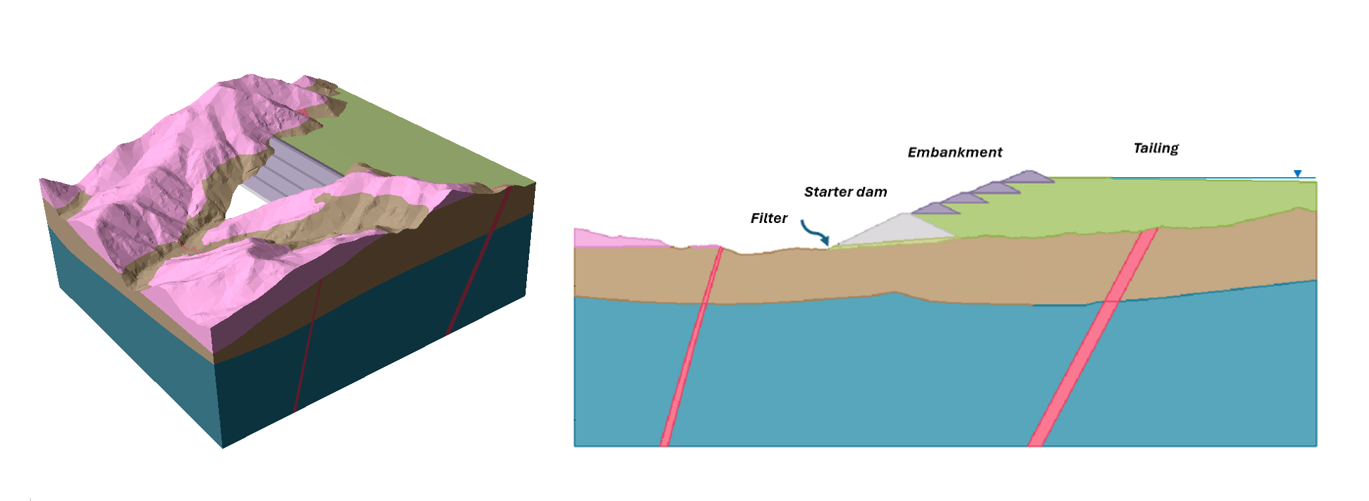
For this analysis, the Fredlund formulation was adopted to account for unsaturated soil behaviour by incorporating matric suction directly into the shear strength of partially saturated regions.
The material properties assigned to the different zones are summarized in the table below:
Material Zone | Young's Modulus | γ (kN/m³) | c' | φ' |
Starter Dam | 60 MPa | 20 | 10 kPa | 35° |
Tailings | 14.5 MPa | 18 | 4 kPa | 26.5° |
Embankments | 45 MPa | 21 | 25 kPa | 30° |
Results: Impact of Unsaturated Soil Mechanics on Factor of Safety
The stability analysis was performed using the shear strength reduction (SSR) method in both RS2 and RS3 to identify the critical failure mechanism. Two analysis scenarios were considered. In the first scenario, the contribution of unsaturated soil strength was neglected, whereas in the second, it was incorporated using the Fredlund formulation.
Figure 2 shows the 3D displacement pattern after failure. In addition, the relative displacement patterns at the critical cross-section in the 3D model and the corresponding results from the 2D analysis are presented in Figures 3 and 4, respectively.
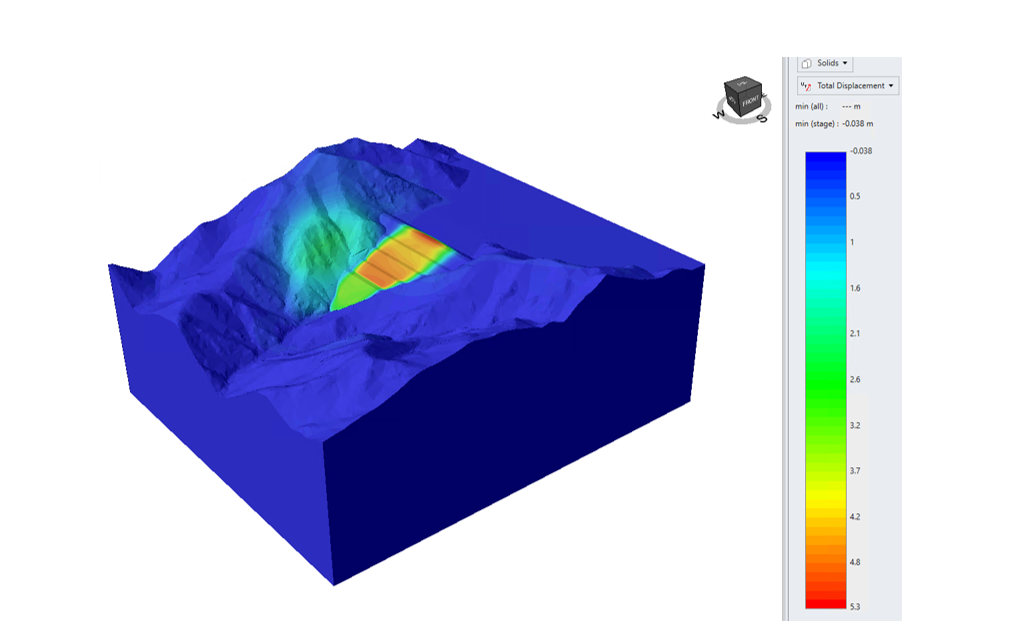
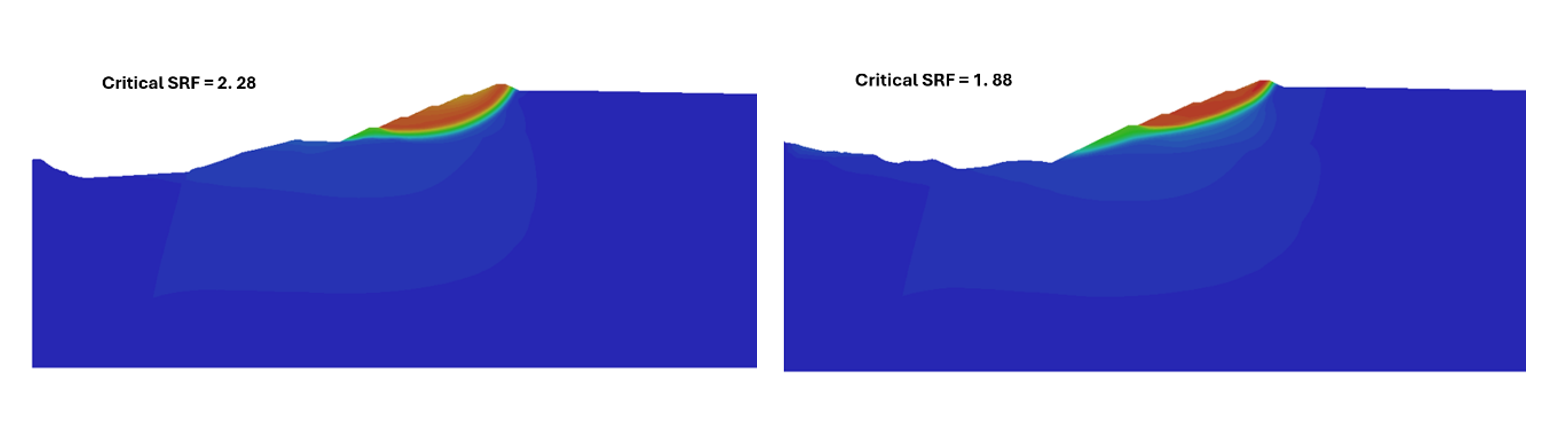
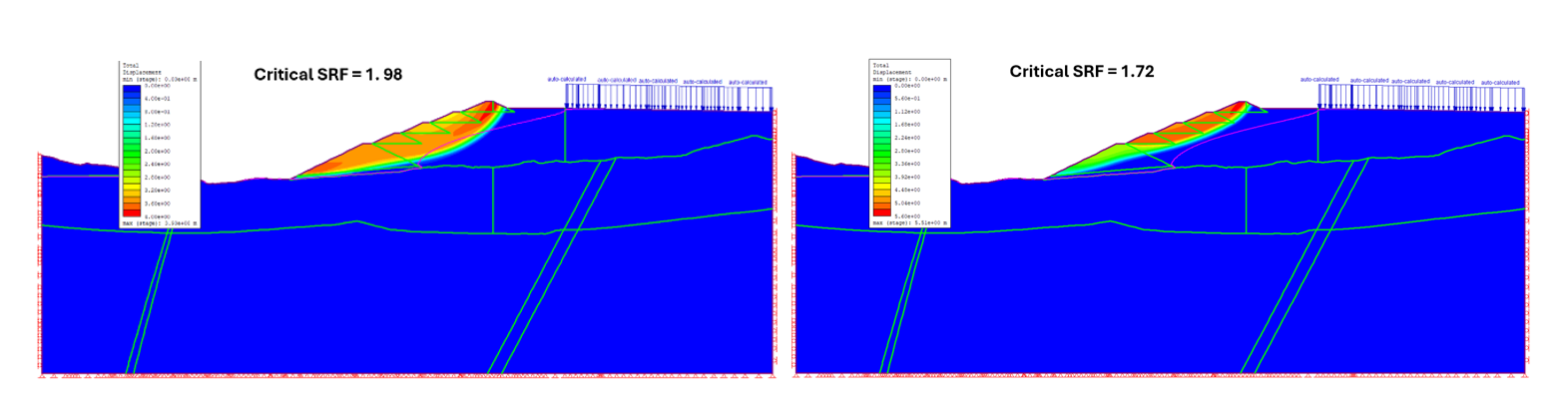
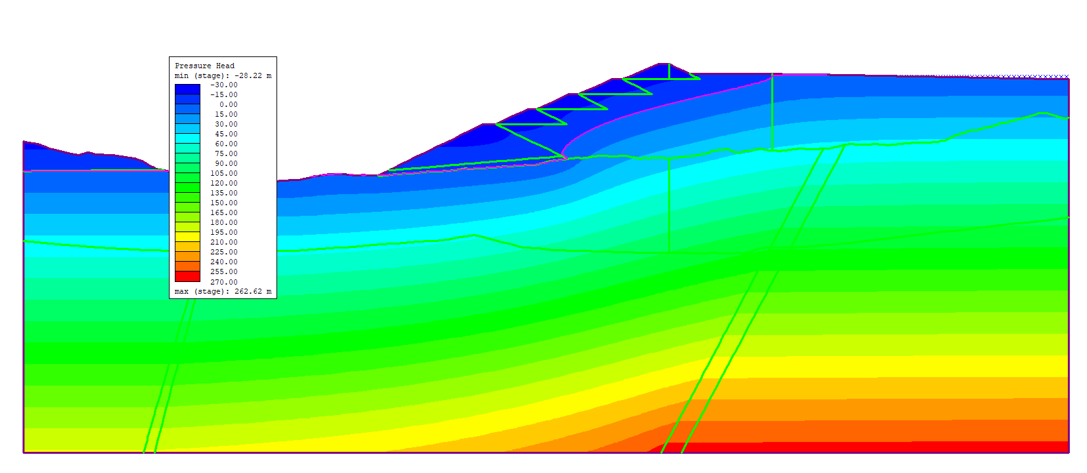
Figure 5 shows the pressure head distribution and the water table location in the 2D model. The results indicate that water flows through the filter beneath the starter dam, generating negative pore water pressures in the region near the dam raises.
A summary of the calculated critical SRFs for both the 2D and 3D analyses is provided in the table below:
Analysis Scenario | 3D | 2D |
Without unsaturated considerations | 1.88 | 1.72 |
With unsaturated soil mechanics | 2.28 | 1.98 |
In both 2D and 3D analyses, a significant increase in critical SRF, on the order of 15-18 percent, is observed when unsaturated soil mechanics is considered. This increase represents the direct contribution of matric suction within the partially saturated tailings to overall slope stability.
Comparison of the failure mechanisms in both the 2D and 3D scenarios reveals a fundamental difference in the predicted slip surfaces. When unsaturated soil effects are neglected, the critical failure surface is relatively shallow, initiating near the slope face and propagating into zones where lower shear strength is mobilized. This behaviour corresponds to a conservative interpretation of soil behaviour.
When unsaturated soil mechanics is included, the critical slip surface extends deeper into the soil mass, mobilizing a larger volume of material to resist shear deformation. This response reflects a realistic contribution of matric suction to strength within the partially saturated zone. The combined effect of increased shear strength along the failure surface and deeper failure mechanisms results in higher critical strength reduction factors.
Although both the 2D and 3D analyses exhibit the same overall trend, the absolute values of the critical SRFs differ. The 3D model captures the dam's true three-dimensional geometry and the associated confinement along the dam axis, allowing additional resisting shear stresses to develop along the flanks and abutments. In contrast, the 2D analysis assumes plane strain and neglects these effects, which results in a more conservative estimate of stability.
Conclusion
The analysis presented in this article demonstrates that unsaturated soil mechanics plays an important role in modern geotechnical engineering practice, particularly for earthen structures such as dams, levees, and embankments that feature large zones of partial saturation.
For structures with factors of safety near acceptable design limits, accounting for unsaturated soil behaviour can significantly influence stability assessments. In such cases, the resulting increase in calculated stability may shift a design from marginal to clearly acceptable, potentially reducing the need for remedial measures such as additional buttressing, slope flattening, or staged construction.
Both RS2 and RS3 include comprehensive capabilities for modelling unsaturated soil behaviour. They incorporate multiple formulations of effective stress (e.g., Bishop, Bolzon, Khalili) as well as direct suction-based shear-strength approaches (Fredlund and Vanapalli methods). When used appropriately, these tools can provide engineers with a robust framework for producing accurate, economical, and defensible positions.
The key takeaway is this: while conservative assumptions have their place in engineering, overlooking the well-established physics of unsaturated soil behaviour may lead to unnecessarily conservative designs that inflate costs without proportional safety benefits — or worse, may fail to capture critical behaviour under changing conditions. As the profession continues to advance, incorporating unsaturated soil mechanics into routine stability analyses should become standard practice rather than the exception.
The tools are available. The theory is sound. The question is whether we will use them to their full potential.
References
[1] Fredlund, D. G., & Rahardjo, H. (1993). Soil Mechanics for Unsaturated Soils. John Wiley & Sons.
[2] Vanapalli, S. K., Fredlund, D. G., Pufahl, D. E., & Clifton, A. W. (1996). Model for the prediction of shear strength with respect to soil suction. Canadian Geotechnical Journal, 33(3), 379-392.
[3] Bishop, A. W. (1959). The principle of effective stress. Teknisk Ukeblad, 39, 859-863.
[4] Bolzon, G., Schrefler, B. A., & Zienkiewicz, O. C. (1996). Elastoplastic soil constitutive law generalized to partially saturated states. Géotechnique, 46(2), 279-289.
Model Unsaturated Soil Behaviour with Confidence
Explore how unsaturated soil mechanics can improve the accuracy and defensibility of your next stability analysis.
Start Your Free Trial