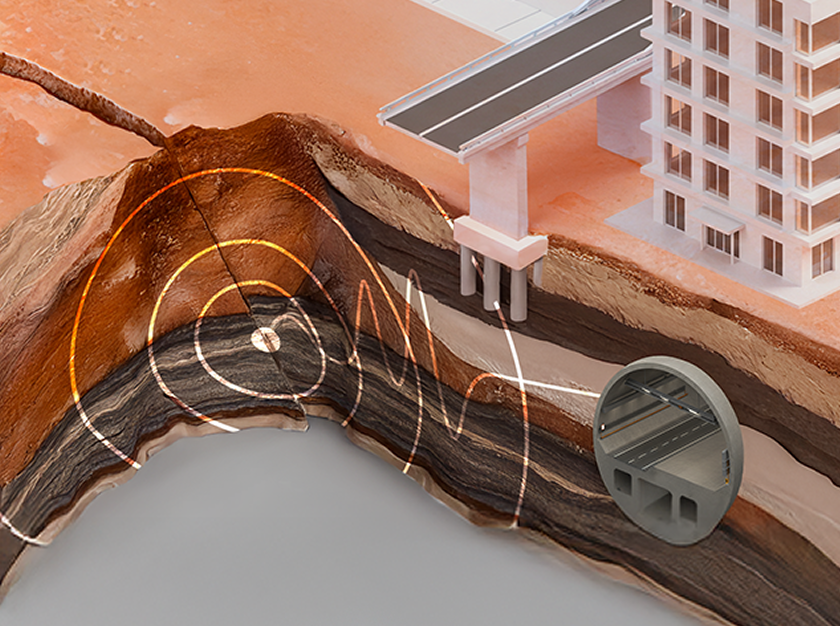
How RSSeismic Advances the Seismic Site Response Workflow
- Dylan Centella, Geotechnical Product Manager at Rocscience
- Dr. Youssef M A Hashash, at University of Illinois Urbana-Champaign
Seismic site response analysis has never lacked rigour. What it has often lacked is flow. Data moves between platforms, formats get reconciled by hand, and the gap between a field investigation and a final deliverable is filled with steps that slow teams down without adding insight. RSSeismic was built to close that gap.
Grounded in a 26-year scientific legacy and a modelling framework refined by Dr. Youssef Hashash and collaborators, RSSeismic has long been trusted across practice, research, and education for robust and rigorous 1D seismic site response. That foundation remains unchanged. What is new is the architecture around it.
The latest release introduces the first step towards an integrated, end-to-end workflow designed to connect every stage of a seismic study, from geotechnical data and ground motion selection through to modelling, export, and final deliverable. Direct access to external ground motion databases, seamless soil column import from field and laboratory data, one-click exports to advanced SSI platforms, and automated report generation all work together to reduce friction, sharpen traceability, and accelerate decision-making.
The result is not simply a faster analysis, but a coherent, auditable pathway from field investigation to design.
Importing Soil Columns from RSLog
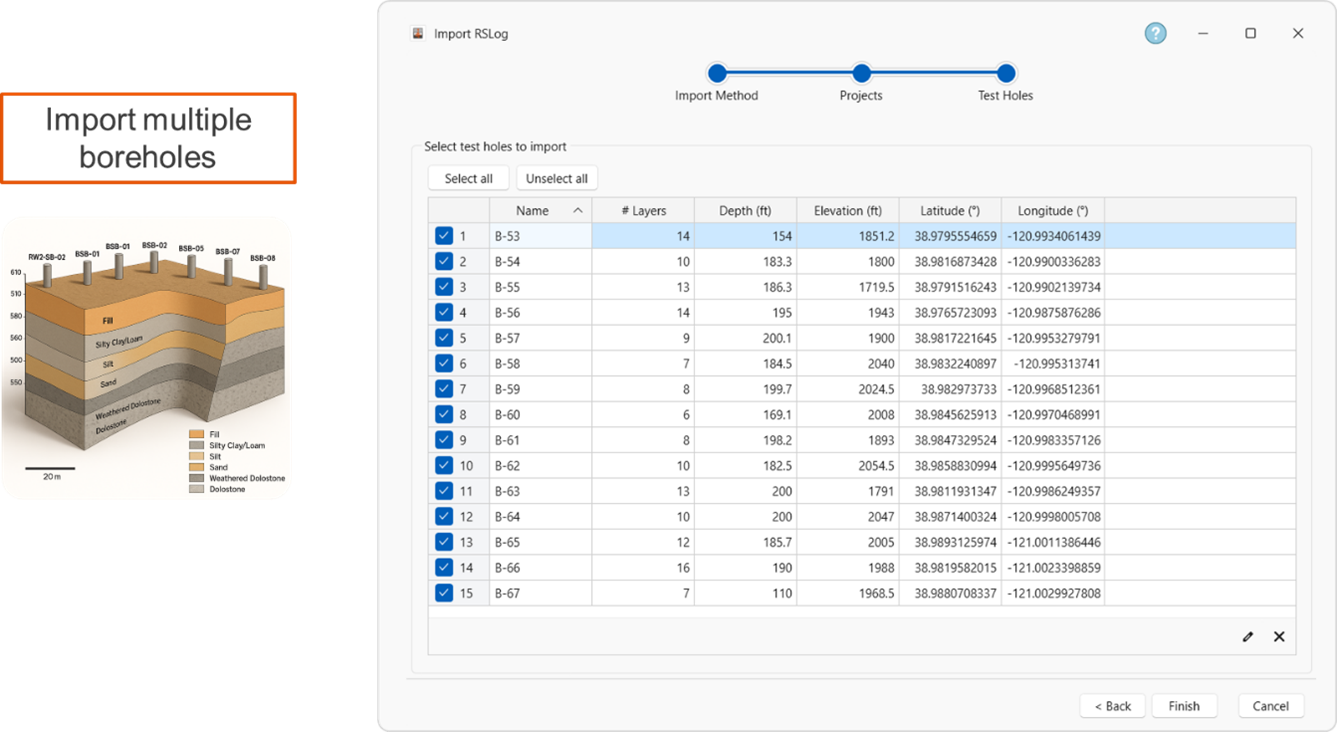
Most seismic site response projects begin with a set of boreholes. These logs which include stratigraphy, groundwater, field and/or laboratory test data including shear wave velocity, are the backbone of every soil column built for 1D site response analysis. For years, transforming borehole information into analysis-ready profiles has required careful manual transcription, reformatting, and reconciliation of units and material properties. Even in experienced hands, this process introduces opportunities for inconsistencies and delays.
The RSLog integration changes that entirely. Instead of re-entering data, information, boreholes can be imported directly from RSLog and automatically translated into RSSeismic soil columns. Stratigraphy is preserved layer-by-layer, layer thicknesses and elevations are carried over, groundwater conditions are retained, and soil properties assignments are mapped.
The result is a clean, consistent soil column that faithfully reflects the source investigation, allowing engineers to move quickly from field data to modelling with confidence that the geological story remains intact. The user still has the option to further refine the stratigraphy after importing a borehole log if needed.
Importing ground motions from external databases
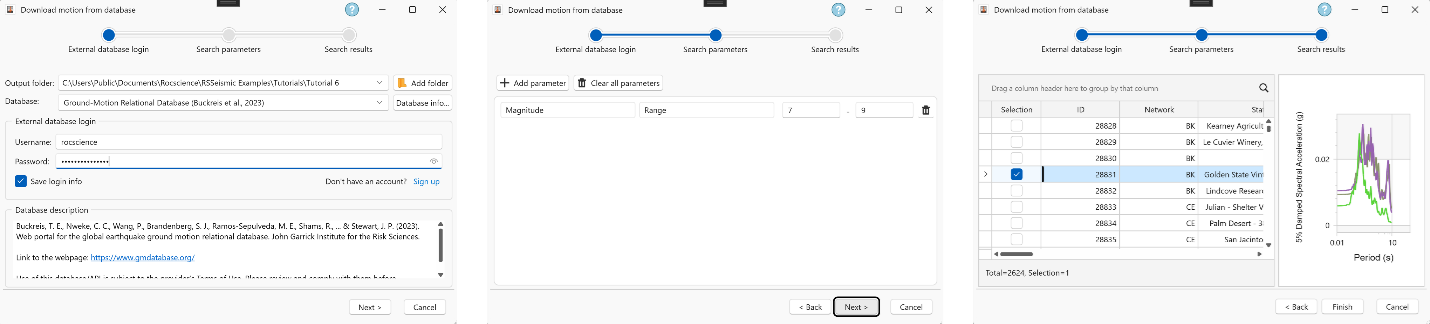
Ground motion selection has long been one of the most disruptive steps in the site response workflow. Engineers would typically have to search external repositories, download records, process them using separate tools, and only then import them into the site response model.
While effective, this multi-step workflow introduced unnecessary complexity and quietly accumulated opportunities for error.
That sequence is over. RSSeismic simplifies the cumbersome manual process through direct access to external ground motion databases within the software. Working alongside the built-in Motion Manager, engineers can now search records based on defined parameters, import them directly into the project, and prepare and manage motions without leaving the RSSeismic modelling environment.
What was once a tedious and fragmented task is now part of a continuous analytical workflow.
Effective Stress Analysis with Pore Pressure Generation and Complementary Total Stress Analysis
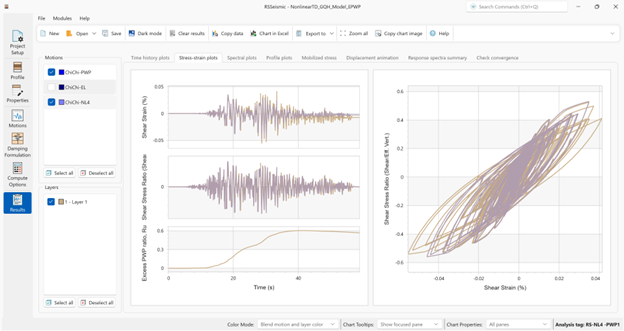
Capturing the influence of pore-pressure generation is essential for understanding effective 1D site response. At the same time, engineers often rely on complementary approaches to validate results and investigate unexpected behaviour.
In addition to the already available equivalent-linear analysis, RSSeismic introduces a complementary total-stress analysis that runs in parallel with the effective-stress analysis when pore-pressure generation is enabled. This approach reflects a long-standing RSSeismic philosophy in which equivalent-linear analyses complement nonlinear analyses, offering a reliable benchmark for comparison.
- Shared configuration: Both analyses use the same soil column, dynamic properties, base and boundary conditions, and suite of ground motions. This ensures a direct and meaningful comparison between analysis approaches.
- Synchronized outputs: Results are presented through coordinated, side-by-side plots that allow engineers to compare behaviour with depth and quickly interpret differences in response.
Together, these capabilities create a clearer analytical lens through which complex soil behaviour can be examined and understood.
Facilitating Export to Platforms for Structural and Soil–Structure Interaction Analyses
A site response analysis rarely ends with site response.
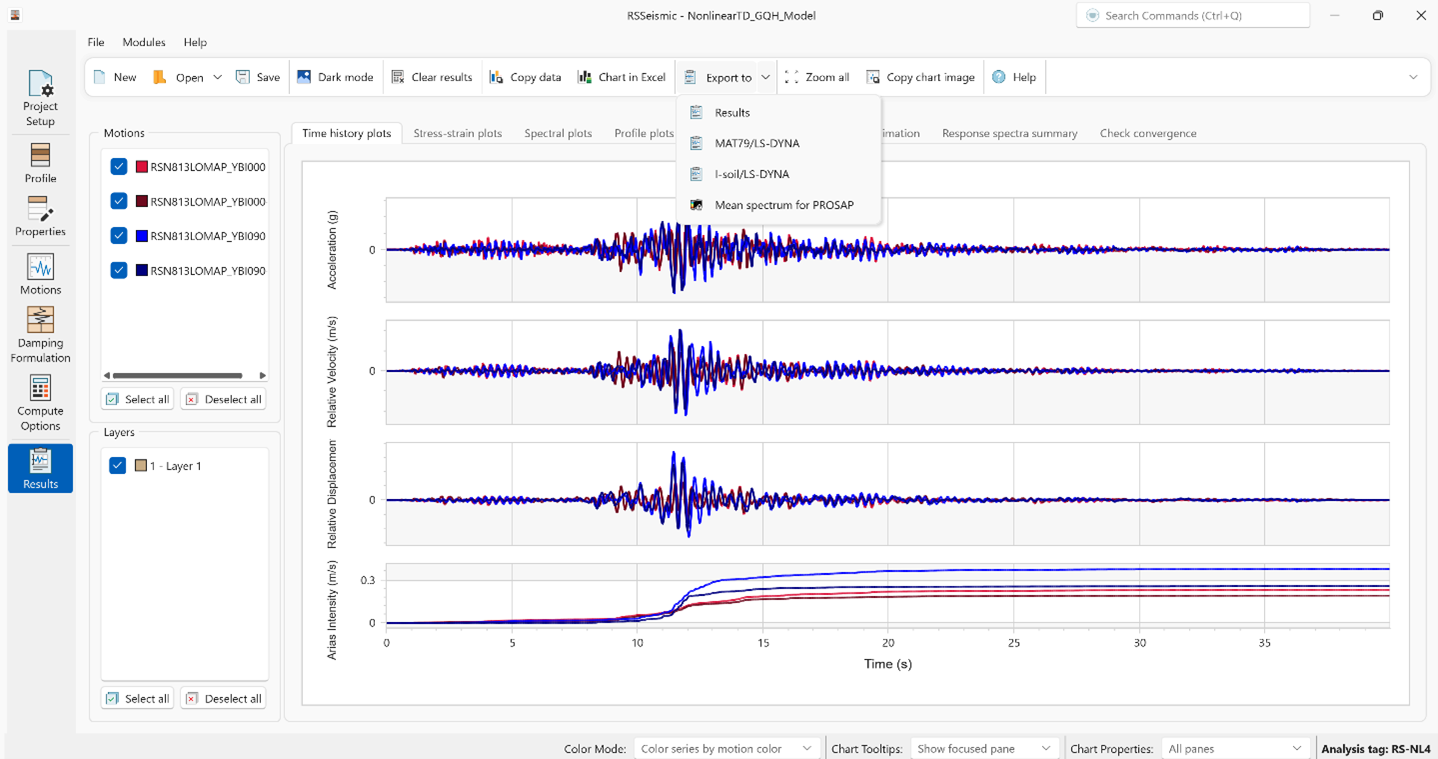
The outputs feed structural models, SSI setups, and the engineers who build them. RSSeismic now makes that handoff seamless. With one click, users can export the mean spectrum to PRO_SAP or generate an LS-DYNA shear-beam model with rigid or elastic base conditions, no manual averaging, no text-file formatting, no reformatting for the next platform.
- PRO_SAP mean spectrum (one-click): The mean response spectrum from selected runs exports directly to a PRO_SAP-ready file, clean and immediate.
- LS-DYNA shear-beam export (rigid or elastic base): Input decks generate with rigid or elastic base boundary conditions, accelerating the path from 1D site response to 3D nonlinear site response and SSI setups with minimal manual intervention. The LS-DYNA export options support two material constitutive models MAT-79 (Ansys, 2025) and I-soil (Numanoglu et al. 2023).
Automatic report generation
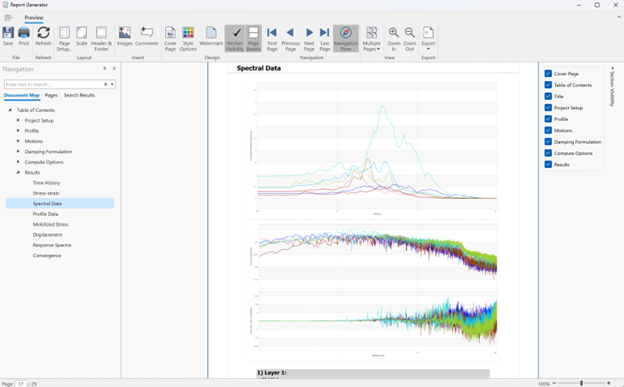
A study is only as valuable as the story it tells. The most thorough analysis loses something when the reporting that surrounds it is inconsistent, incomplete, or assembled under pressure at the end of a deadline. RSSeismic addresses that with automatic report generation that captures the entire workflow in one action.
Project metadata, soil columns, ground motion selection, and analysis configurations are pulled in automatically. Time histories, spectral responses, and layer-by-layer stress-strain behaviour are presented side-by-side, with every element traceable and every assumption visible. QA/QC summaries and detailed appendices are available for studies that demand them. Branded templates and editable sections mean the finished product, whether PDF or Word, looks as considered as the analysis behind it. From raw data to polished deliverable, the loop closes inside a single report.
Summary
The distance between a field investigation and a confident design decision is shorter than it used to be.
By unifying data import, modelling, ground motion management, complementary analysis types, downstream export, and automated reporting, RSSeismic reduces the friction that has always lived between these steps, without compromising an ounce of the scientific rigour built into the platform over more than two decades. Engineers can move faster, see more clearly, and deliver work that is fully traceable from first data point to final recommendation.
That is not a minor upgrade. It is a different way of working, and one that is long overdue. The science has always been there. Now, the experience is equal to it. Stay tuned, we plan to further enhance and add workflow capabilities in RSSeismic in the future.
References
- Numanoglu, O. A., Hashash, Y. M., Olson, S. M., Cerna-Diaz, A., Rutherford, C. J., Bhaumik, L., & Weaver, T. (2023). A simplified three-dimensional constitutive model for seismic modeling of dense sands. Soil Dynamics and Earthquake Engineering, 167, 107794.
- Ansys. LS-DYNA Keyword User’s Manual, Volume II: Material Models. Version R.16.