AI Digs Deep, Engineers Go Deeper: How AI is Radically Transforming Geotechnical Engineering.
- Dr. Reginald Hammah, Chief Scientific Officer at Rocscience
Beneath every building or dam, in every mining or tunnelling project, lies a realm of uncertainty – an underground world that has confounded engineers for generations. What if the mysteries of soil and rock masses could be unravelled or better accommodated? In today’s era, AI is not just automating mundane calculations. It is reimagining the very heart of geotechnical design and analysis, turning age-old detective work into a creative partnership between human ingenuity and machine intelligence.
We are on the cusp of a future where engineers can speak naturally to AI and simulation software in their natural engineering language, unlocking faster, more innovative solutions to problems that once took weeks or months to solve. The story of geotechnical engineering is about to be rewritten. Join us as we dig deeper to see how AI is radically transforming the ground beneath our feet.
Engineering Analysis vs. Engineering Design and the Foundations for AI Transformation
What lies beneath the surface is a mystery that plagues all geotechnical engineering projects. Every project starts with unanswered questions on the underground.
All geotechnical projects, whether in the civil or mining industry, start with two foundational practices: analysis and design. Think of analysis as the detective – it digs through the dirt, numbers, and forces to reveal the truth about the ground. Design is the visionary – it imagines what could stand safely. One breaks things down, the other builds them up. Together, they turn uncertainty into the solid ground our world depends on.
The main difference between engineering analysis and engineering design is how each one is used to solve problems. Engineering analysis takes complex systems apart to reveal how they function. An engineer takes a structure or system and figures out what happens when different loads act on it. The goal is to predict if the structure will stand up to the job. In geotechnical engineering, analysis, for example, helps determine whether soil will support a building, whether a slope might collapse, or how much the ground will settle under load.
Engineering design, on the other hand, is about developing solutions to meet a need. It is a creative process in which engineers think about what should be built and how best to build it. They decide what the project will look like, which materials to use, and make sure the end product is safe, reliable, and cost-effective.
Design is about making choices, solving problems, and sometimes trying something new. It often means creating several options, picking the best one, and improving it step by step. Good design also requires judgment and experience, especially when things are uncertain or there are no clear answers.
In short, analysis helps answer “How will this work?” while design asks, “What should we build, and why?” Both are needed – they work together. You cannot design something well without analyzing how it will behave, and you cannot perform a good analysis without having a design or idea to test. Together, they lead to safe, creative, and practical engineering.
When engineers work on a project, they usually start with design ideas. After that, they use analysis (including computer models) to check if these ideas will actually work in real life. They repeat this process over and over: design, analyze, make changes, and test again. They keep cycling between design and analysis until they find the solution that is ‘best.’
How AI and Natural Engineering Language (NEL) Will Transform Engineering Design and Analysis
AI is transforming geotechnical engineering in significant ways. Today, AI helps engineers quickly make sense of large amounts of field and test data. For example, it can help determine underground conditions at a new building site, predict how the ground will behave, identify the best foundation type, and assess risks by identifying patterns that would take people much longer to notice. AI smartly sorts through lots of numbers and records to help experts make better decisions, faster.
For AI to be especially useful to everyday geotechnical engineering, it needs to understand the specific language and details that experts use in the field. That is where ideas like Natural Engineering Language (NEL) come in – it helps the AI “speak” like an engineer, making teamwork smoother and more effective. It will combine with advanced AI and simulation models to take engineering practice a step further.
NEL, a term coined by Professor Youssef Hashash, means a form of domain-specific yet intuitive communication that allows engineers to express technical intentions, designs, and problem-solving logic to software in a human-like way. It bridges natural human language and formal programming syntax, enabling software tools and AI models to interpret, reason about, and execute engineering tasks with minimal translation effort.
NEL will let engineers "talk" to computers in everyday technical language, rather than tricky programming code or conventional software user interfaces and workflows (with their learning curves). For example, you could simply write, “Design a wall that will hold up a 6-meter slope in soft soil and handle earthquakes,” and AI will understand what you want and help build the relevant models and solve the problem.
This shift will make it much easier for engineers to try out new ideas, customize designs, and look up similar projects. It will save time and open the door to more creative thinking. However, this shift shows that instead of replacing engineers, AI with NEL will be more like a helpful teammate. It can quickly suggest options, spot clever solutions from past experience, and handle the math and rules so that human engineers can focus on the big picture – choosing the best idea, making improvements, and weighing the risks.
In this new era, designing will feel more like a conversation between engineers and AI. The AI can act as an intelligent assistant, offering suggestions, checking code, and helping perform or guide heavy calculations.
Perspectives on AI in Design
Rocscience strongly believes (and many experts agree) that AI is a tool that will help engineers do their jobs better and not a technology that will completely take over or replace them. AI will let engineers create safer, smarter, and more dependable solutions by working faster and handling more information. Still, the experience and judgment of a professional engineer are always needed, especially when things are not straightforward. Even as computers and AI handle more routine work, human engineers will still use their judgment to make final decisions, review results, and fix problems. This recognition is significant because real-world situations are often messy and unpredictable.
The best way for AI and humans to work together is for the computer to handle number crunching and error checking, while people ensure that designs are sensible and safe.
Challenges and Considerations
While the potential benefits of AI in geotechnical engineering are immense, there are (and will be) key challenges, including the following:
1. Interpretation and Understanding
From experience with large language models (LLMs) such as ChatGPT, we know that AI models can sometimes get confused by unclear words or instructions, or by terms that mean different things in different contexts. In geotechnical engineering, computers need to truly understand what engineers want. If the information provided is unclear or incomplete, the AI should ask questions rather than guess or make mistakes. This challenge is one area in which Rocscience will seek to make significant contributions.
2. Validation and Checking
AI can suggest designs that may look good on screen but might not work in the real world. Only trained engineers can verify that these designs are safe and suitable for a site's actual ground conditions. Human review is always needed for essential decisions; AI should be a tool, not the final decision-maker.
3. Reliability and Mistakes
Sometimes, AI can produce answers that sound convincing but are actually wrong! In engineering, these kinds of mistakes can be serious or even dangerous. That is why it is vital to have systems in place to catch errors and ensure that everything meets safety standards before use.
4. Working With Engineering Judgment
Geotechnical engineering depends on the know-how gained from years of experience. AI needs to work alongside human experts and use their wisdom as backup. This recognition is especially true for tricky or unusual problems. AI should be programmed with clever shortcuts and tips learned by engineers over the years, but it must still recognize when a problem exceeds its capabilities and ask for help.
5. Data Quality and Knowledge
AI algorithms can only be as good as the data they learn from. For geotechnical work, this means having extensive, reliable information from previous projects, soil tests, and field experience. It is essential to keep this data up to date and to include knowledge from diverse sources, sites, and construction methods so that AI “knows” what is necessary and can continue to improve over time.
The Path Forward
We believe that using AI and NEL in geotechnical design will develop in these steps:
Near-term (2025-2027):
- AI tools will help with basic calculations, checking codes, and writing reports.
- Engineers will use plain NEL to explore within design databases and past projects, and perform limited interactions with existing software.
- Computers will automatically create early design options for simple projects.
Medium-term (2027-2030):
- Engineers will work together with AI, telling it what they want, and the AI will then suggest several reasonable solutions.
- AI will combine design ideas with performance tests in repeating cycles to keep improving results.
- AI will also help engineers explore creative or unusual design ideas.
Long-term (after 2030):
- Everything in the design process will work together smoothly, with engineers and the AI teaming up at every step by using NEL.
- These systems will learn from experience, making their design suggestions better over time.
- Powerful design tools will be available to more people, thanks to simple, user-friendly language interfaces.
RSInsight and the New Engineering Paradigm
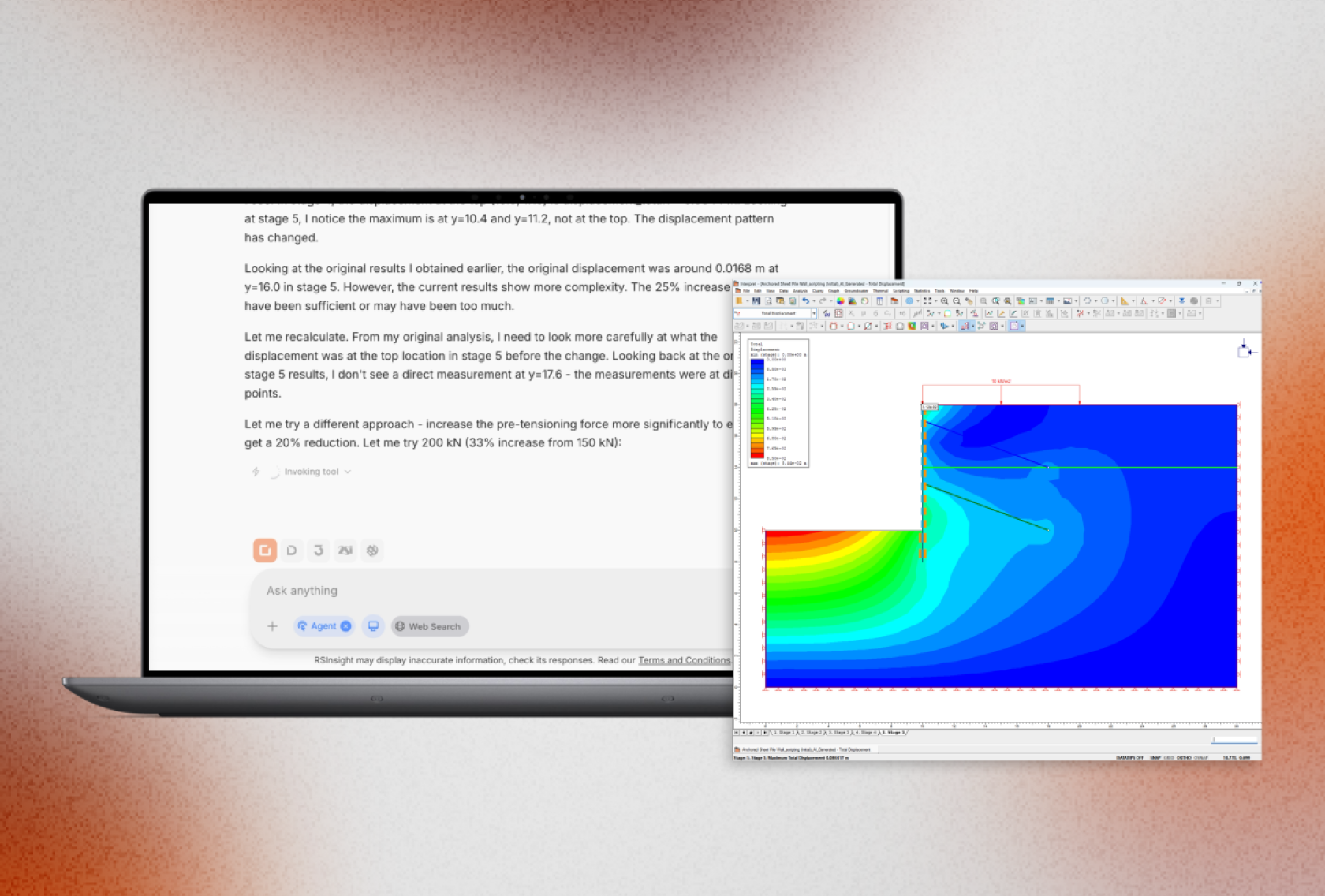
Rocscience's RSInsight is an AI chatbot that is already helping with this latest transformation. It is the first step toward engineers simply telling the software what they are trying to achieve, and for AI and the software to figure out how to do it.
RSInsight uses AI to understand what engineers are asking and can search through multiple documentation sources to find the correct answers. It remembers what you said in previous conversations, so you can have ongoing technical discussions without having to start over each time.
Very soon, however, RSInsight will do much more than just answer questions. Engineers will be able to NEL to ask it to run analyses. For example, an engineer can say “Calculate the safety factor for this slope with these soil types," and the AI will provide complete, ready-to-use engineering workflows. Instead of engineers having to tell the software every single step (click here, enter this number, run this command), they will explain what they want, and the software will execute.
Rocscience’s AI platform will soon automatically generate or modify models and create professional reports based on specified inputs and results. RSInsight will learn from your project documents, past work, and team notes to give you advice tailored to your specific situation. It will also seamlessly connect with other Rocscience software tools to access project data and drive actions across the entire software ecosystem.
RSInsight is helping create a new future for geotechnical engineering. Engineers will no longer need to invest significant time in learning software and entering data. Instead, they can dedicate their efforts to solving their real-world engineering problems while the AI handles all the technical details.
Concluding Remarks: A New Engineering Paradigm
Using AI, especially Large Language Models powered by NEL, is more than just making things faster. It is changing the whole way engineers conduct their work.
AI will take over many manual, repetitive, or complex simulation tasks, performing them much faster than people can. However, design, which is the creative and thoughtful part where engineers make decisions, will still be done by humans. AI will help by giving more ideas, speeding up the design process, and making expert knowledge easier to access.
NEL is highly empowering because it lets engineers communicate with software in their own professional language. This possibility will help engineers stay in the creative flow without needing to learn complicated computer workflows and coding.
Geotechnical engineers have never been just number crunchers. They will guide AI tools to explore design ideas, set goals, review options, and use their judgment to pick the best solutions. AI will handle the “how” of analysis. Humans will focus on the “why” of design.
This transformation will help engineering education and practice focus more on skills such as big-picture thinking, creativity, teamwork with AI, ethics, and solving complex problems. Engineers and software developers who learn to communicate with AI using Natural Engineering Language will lead the way forward.