Pore Water Pressure Dissipation
Pore pressure dissipation used in Lumped Mass solver
The pore water pressure dissipation model is based on Terzaghi 1-D consolidation theory:
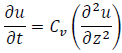 | Eq. 1 |
where 𝐶𝑣 is the coefficient of consolidation.
Dissipation of the excess pore water pressure is assumed to occur in the vertical direction only. Pore water pressure generation and dissipation occur simultaneously during ground shaking.
Pore pressure dissipation used in Finite Elements solver
In the FEM engine, excess pore pressure dissipation is governed by a 1-D vertical diffusion equation within the coupled Biot u-p formulation:
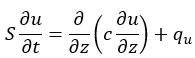 | Eq. 2 |
where u is excess pore pressure, S is fluid-storage/compressibility, c is vertical hydraulic conductance, and qu is the strain-driven pore pressure source term from soil deformation. The diffusion step is solved implicitly each time step (with sub-cycling), so dissipation remains stable while pore-pressure generation and dissipation occur simultaneously during shaking.