14 - Automate Probabilistic Analysis
1.0 Introduction
The Automate Compute option helps users quickly generate results for several UnWedge analysis cases at a time by reading in various model inputs from Excel. In this tutorial, we will familiarize you with the Automate Compute feature by automating the computation of 10 Probabilistic analysis cases, each case with 1,000 samples (i.e., 10 x 1,000 = 10,000 tunnel analyses).
Topics Covered in this Tutorial:
- Probabilistic Analysis UnWedge Model
- Input Excel File Format
- Adding Input Excel File(s) to Automate Compute File Queue
- Output UnWedge Automate Compute Results File
Finished Product:
The finished products of this tutorial can be found in the Tutorial 14 Automate Compute - Probabilistic Analysis folder, located in the Examples > Tutorials folder in your UnWedge installation folder. Inside, you will find:
- Tutorial 14 Automate Compute - Probabilistic_base file.weg5 UnWedge model file setup for automation
- Tutorial 14 Automate Compute - Probabilistic_inputs.xlsx Excel input file
- Tutorial 14 Automate Compute - Probabilistic_inputs folder containing the computed results files
2.0 Creating a New File
- If you have not already done so, run the UnWedge program by double-clicking the UnWedge icon in your installation folder or by selecting Programs > Rocscience > UnWedge > UnWedge in the Windows Start menu.
When the program starts, a default model is automatically created. If you do NOT see a model on your screen:
- Select: File > New

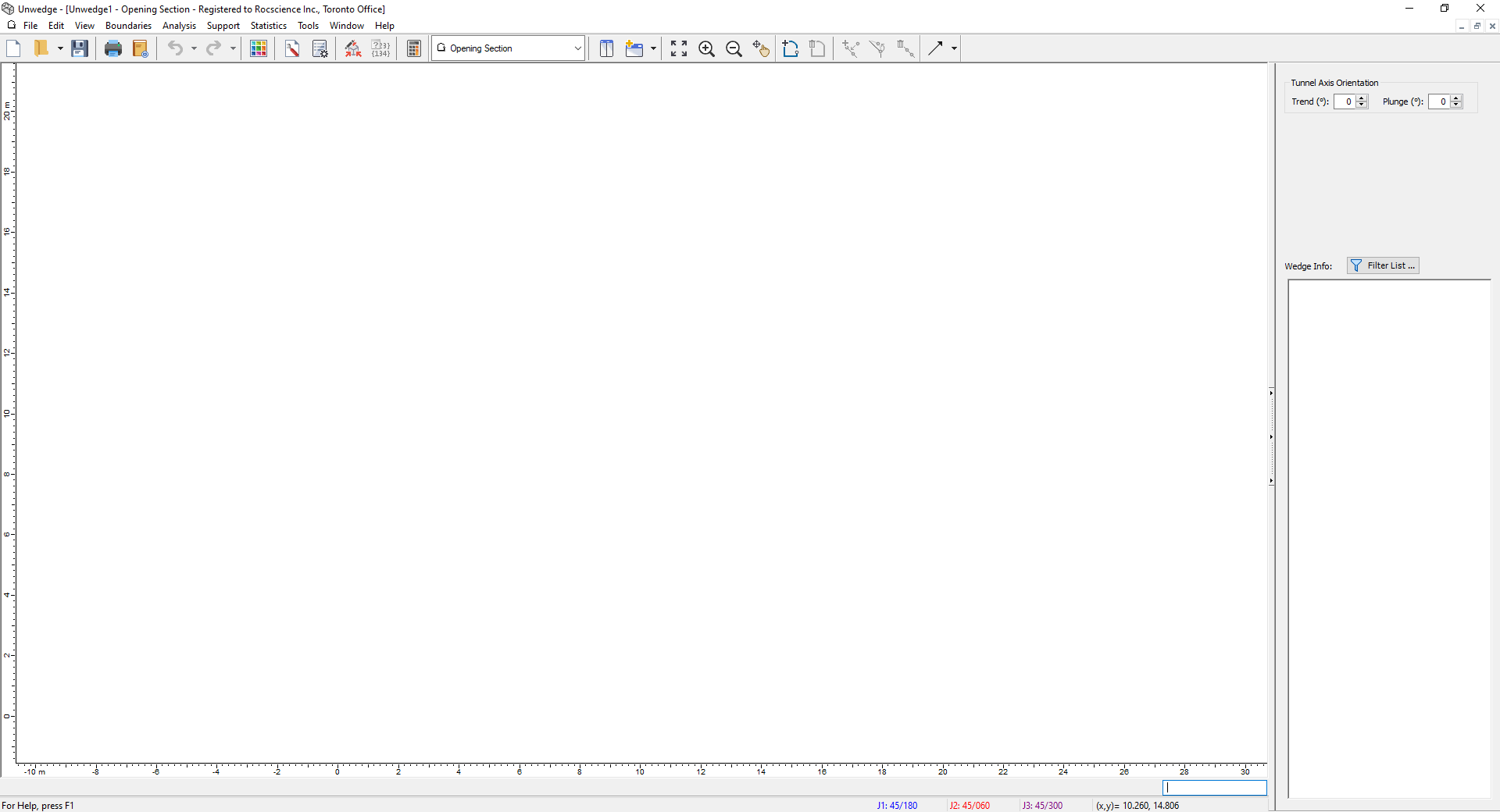
If the UnWedge application window is not already maximized, maximize it now so that the full screen is available for viewing the model.
Before we are ready to run Automate Compute, we must first set up the model environment in the following dialogs:
- Project Settings
- Input Data
- Field Stress
- Scale Wedge
In addition, the tunnel geometry must be defined (i.e., Opening Section).
Apply any other Boundaries (i.e., Ground Surface, Truncation Surface, End Truncation Plane), Water Pressure Grid, or Supports, as required; these are not automatable.
3.0 Project Settings
First, set the model Units, Analysis Type, and Sampling.
- Select Project Settings
 from the Analysis menu to open the Project Settings dialog.
 - Set the Units = Metric, stress as MPa .
- Set the Analysis Type = Probabilistic.
- Set Wedge Computation to Compute End Wedges.
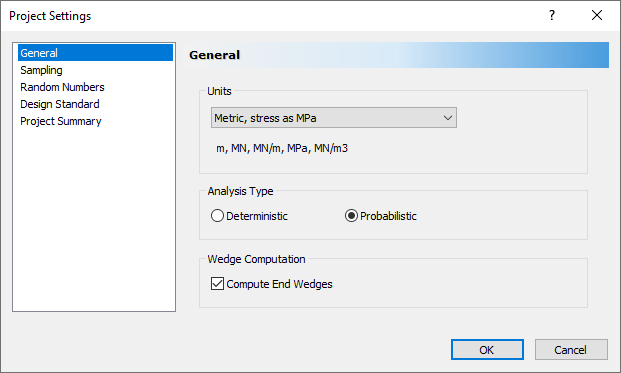
- Set the Sampling Method = Latin HyperCube.
- Set the Number of Samples = 1000.
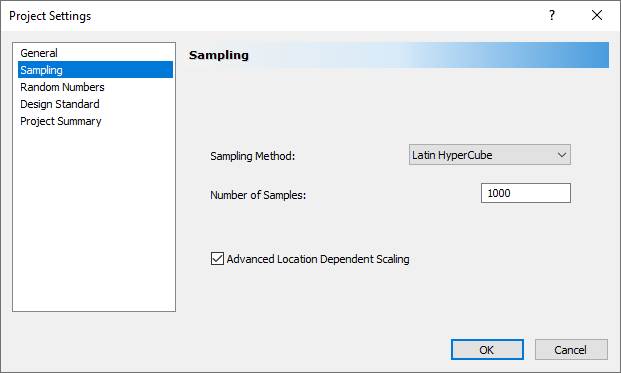
- Select OK to close the dialog.
4.0 Model Geometry
We will start by defining the tunnel opening section.
- Select Add Opening Section
 on the toolbar or the Boundaries menu.
 - Type "i" into the prompt line followed by ENTER.

- In the Circle Options dialog:
- Select Circle definition method = Center and radius.
- Set the Radius = 10.
- Select Circle to polyline conversion method = Number of segments.
- Set the Number of segments = 40.
- Select OK to close the dialog.
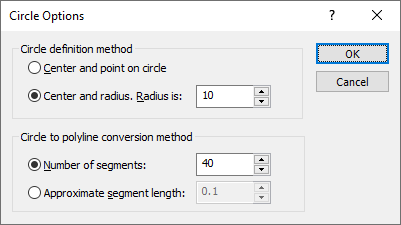
- Type the circle centre " 0,0" into the prompt line followed by ENTER to draw the circle.

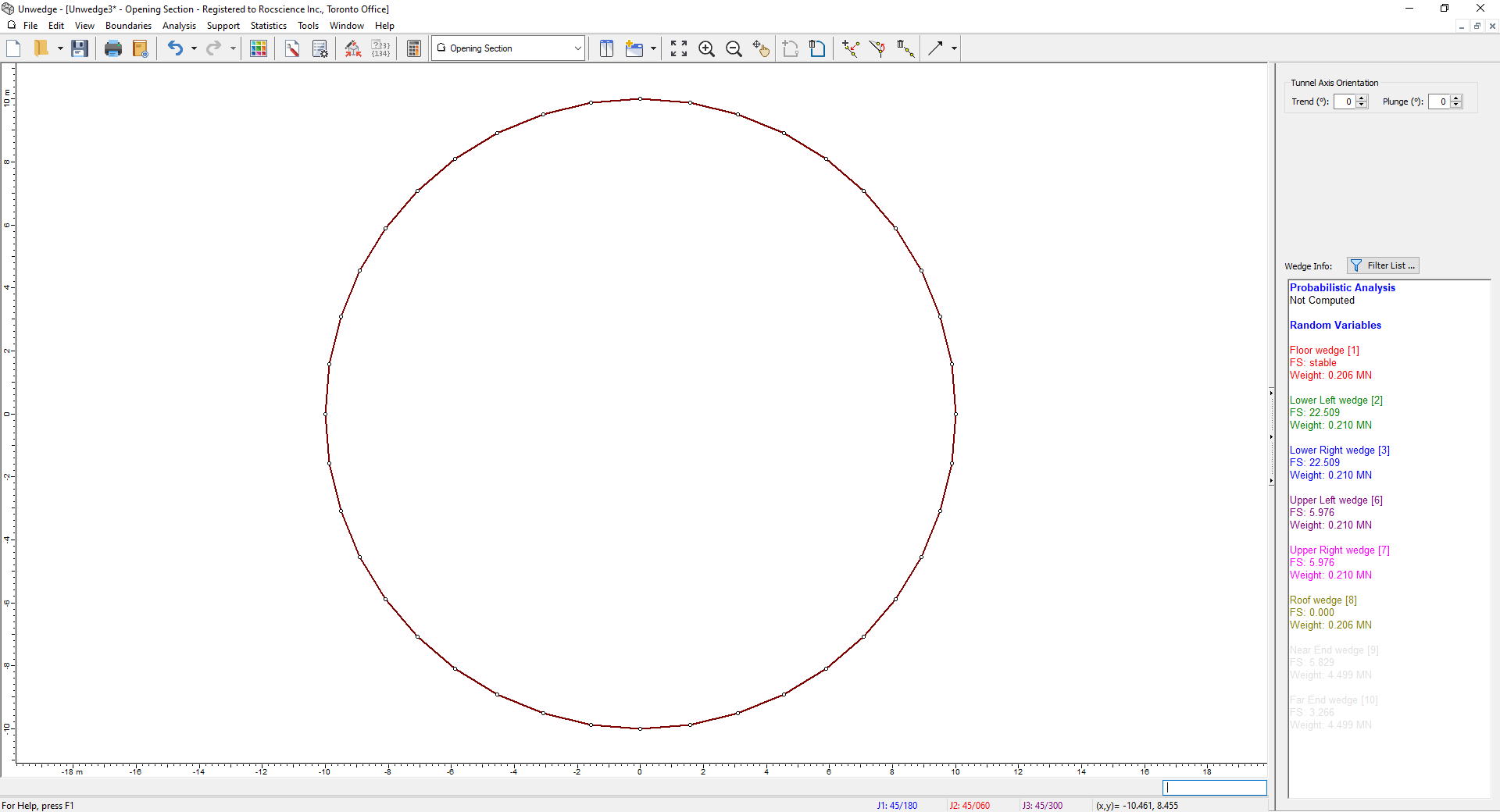
The Opening Section view should look like this:
5.0 Input Data
Next, set the optional input data.
- Select Input Data
 from the Analysis menu to open the Deterministic Input Data dialog.
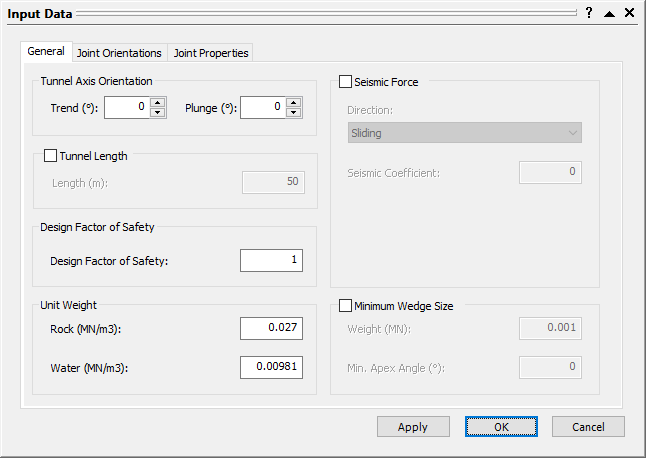
 - Navigate to the General tab.
We will keep all the checkbox controls in the default state. Keep in mind that the following are required input parameters that have to be specified later on in the Input Excel File (mean values):
- Tunnel Trend
- Tunnel Plunge
- Design Factor of Safety
- Unit Weight of Rock
- Unit Weight of Water
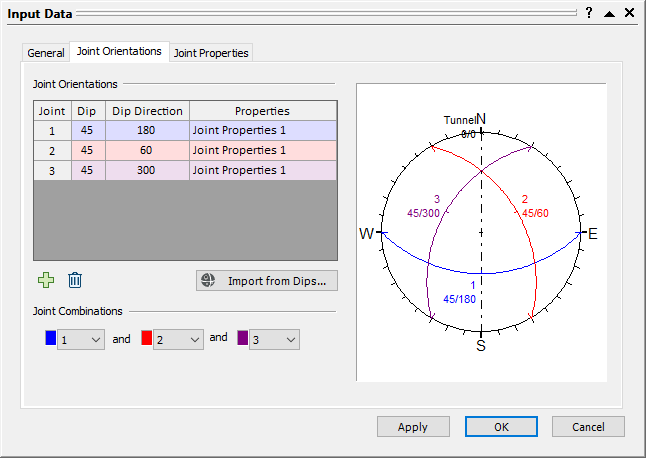
By default, there are three joints defined in the Joint Orientations table. We will keep the default joints and their Properties (Joint Properties 1).
Keep in mind that the following are required input parameters that have to be specified later on in the Input Excel File for all three joints (mean values):
- Joint Dip
- Joint Dip Direction
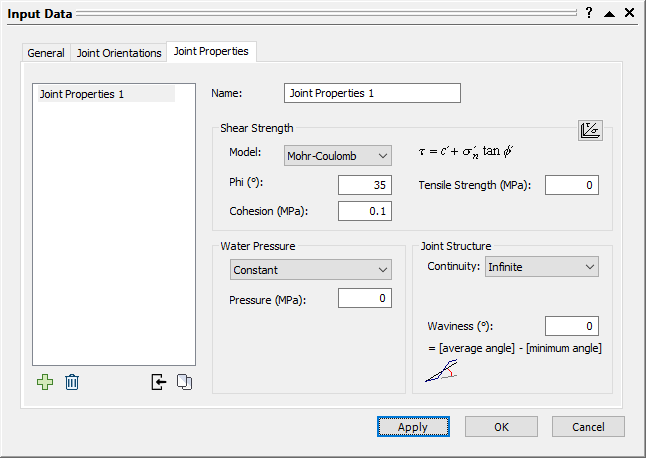
By default, one property is already defined (Joint Properties 1). We will leave all the dropdown controls in the default state.
Keep in mind that the following are required input parameters that have to be specified later on in the Input Excel File for Property 1 (mean values):
- Phi
- Cohesion
- Tensile Strength
- Water Pressure
- Waviness
6.0 Statistic
Next, set the statistical variables.
- Select Joint Orientations
 from the Statistics menu.
 - In the Joint Orientation Statistics dialog:
- Set Joint 1, Joint 2, and Joint 3 to Use Fisher Distribution.
- Leave Option = Standard Deviation for all three joints.
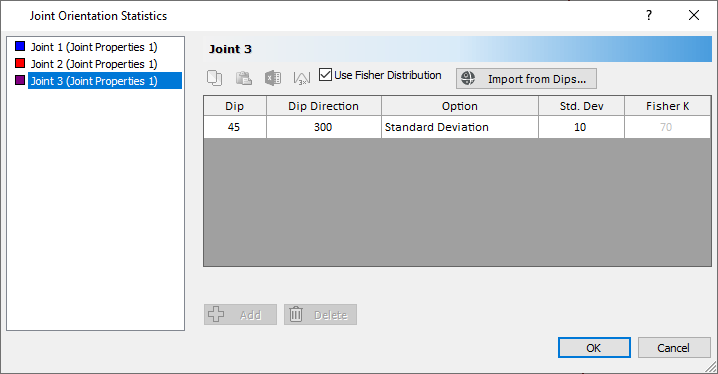
Keep in mind that the Standard Deviation has to be specified later on in the Input Excel File for all three joints:
- Select OK to close the dialog.
7.0 Input Excel File
Now, let's take a look at the structure of the input Excel file.
- Obtain the UnWedge Probabilistic Excel Template by selecting Analysis > Automate Compute > Probabilistic Excel Template from the menu.
A Read-Only Excel workbook titled UnWedge Automation Template_Probabilistic.xlsx will be automatically opened (if you have Excel installed on your local machine).
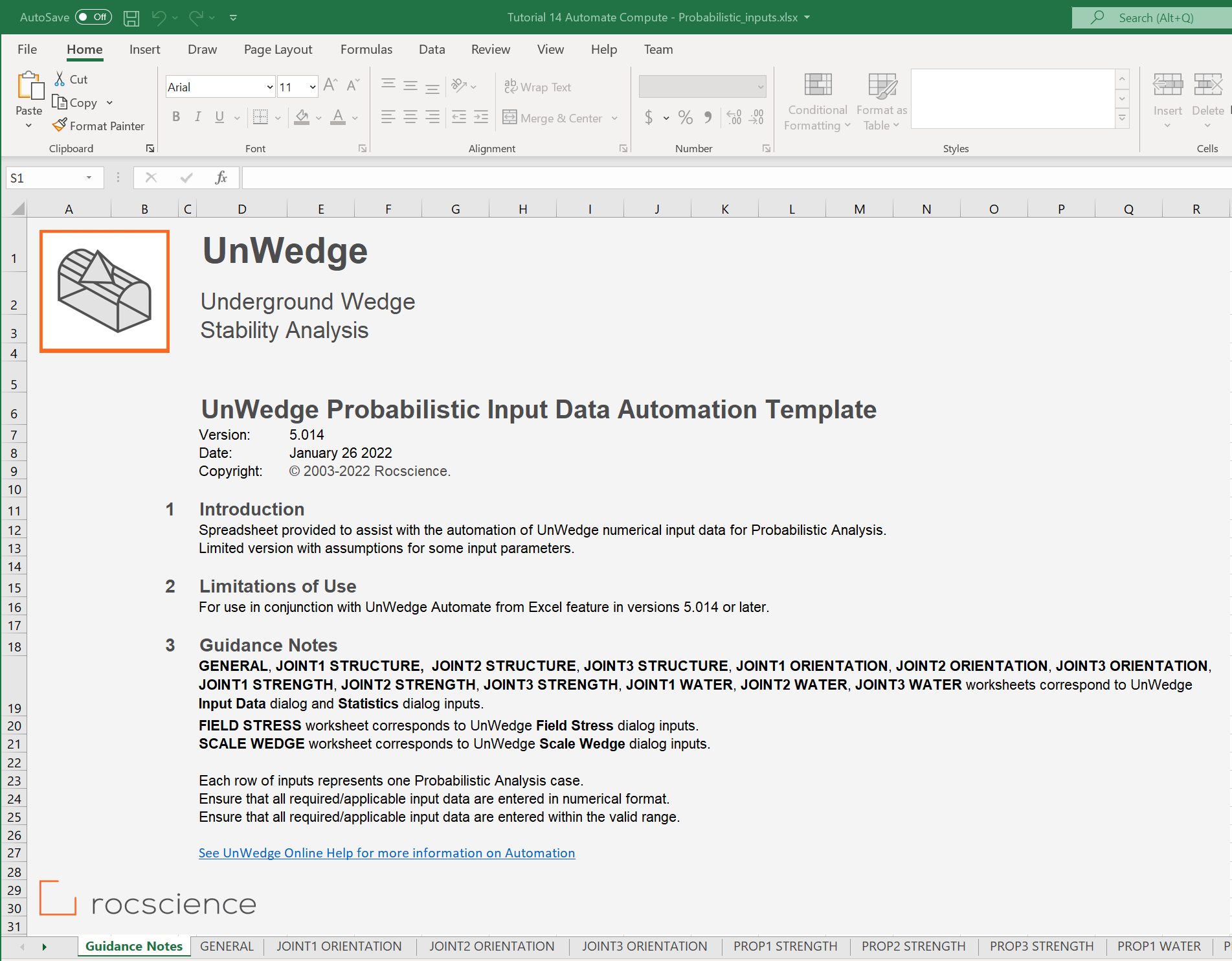
Guidance Notes Worksheet The UnWedge Probabilistic Input Data Automation Template Excel workbook and worksheets are protected to prevent any accidental modification to the tab structure and headers. The input Excel template contains 15 worksheets for inputting numerical parameters for automation.
- Create a folder called Tutorial 14 Automate Compute - Probabilistic.
7.1 General
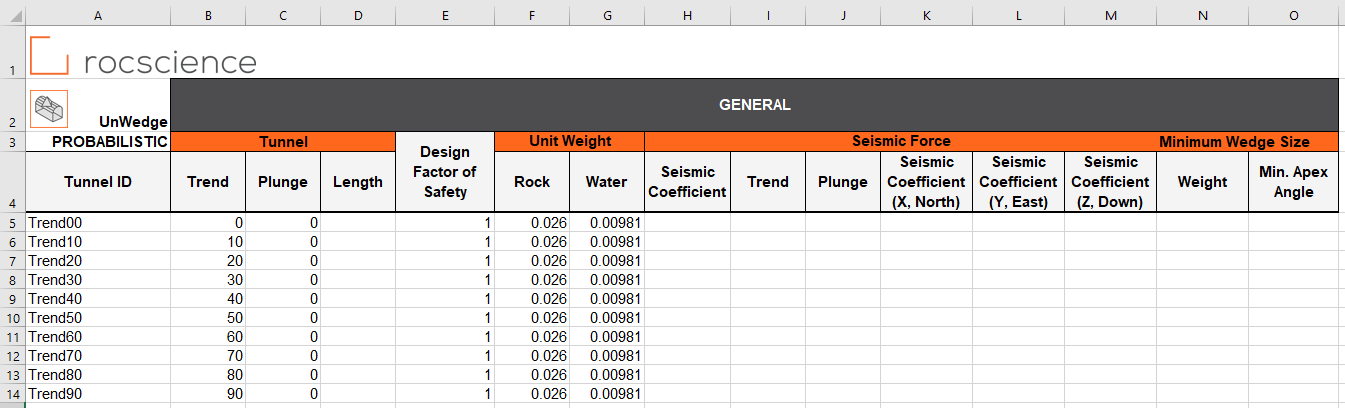
- Navigate to the GENERAL worksheet.
- Under the Tunnel ID column, provide the names of the tunnel analyses. We will name them arbitrarily Tunnel A, Tunnel B, and Tunnel C. Each row in the input Excel file represents one Deterministic Analysis case in UnWedge.
Enter the following:
Tunnel ID
Tunnel
Design Factor of Safety
Unit Weight
Trend
Plunge
Rock
Water
Trend00
0
0
1
0.026
0.00981
Trend10
10
0
1
0.026
0.00981
Trend20
20
0
1
0.026
0.00981
Trend30
30
0
1
0.026
0.00981
Trend40
40
0
1
0.026
0.00981
Trend50
50
0
1
0.026
0.00981
Trend60
60
0
1
0.026
0.00981
Trend70
70
0
1
0.026
0.00981
Trend80
80
0
1
0.026
0.00981
Trend90
90
0
1
0.026
0.00981
As set up previously in the UnWedge Probabilistic Input Data dialog, only the above input data are required since Tunnel Length, Seismic Force, and Minimum Wedge Size are not applicable (i.e., checkbox controls are unchecked). Be aware of units set in UnWedge Project Settings when entering data into the input Excel file. The units should be the same for both!The GENERAL worksheet should look like this:
7.2 Joint Orientation
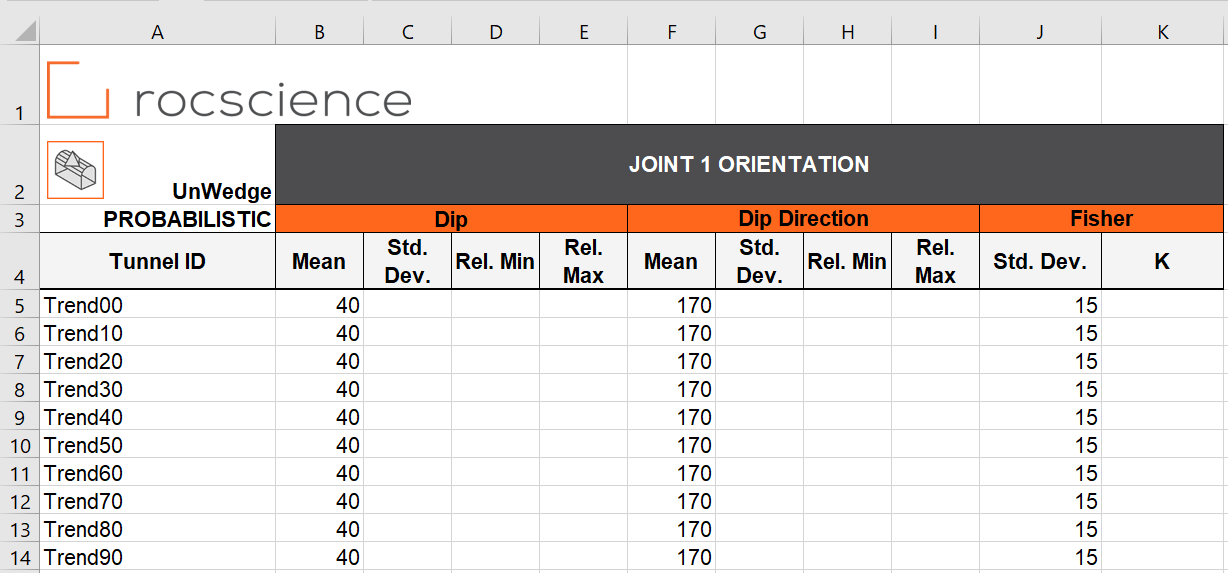
- Navigate to the JOINT1 ORIENTATION worksheet.
- Under the Tunnel ID column, provide the names of the tunnels (Trend00, Trend10, ... Trend 90).
Enter the following:
Tunnel ID
Joint 1 Orientation
Dip
Dip Direction
Fisher
Mean
Mean
Std. Dev.
Trend00
40
170
15
Trend10
40
170
15
Trend20
40
170
15
Trend30
40
170
15
Trend40
40
170
15
Trend50
40
170
15
Trend60
40
170
15
Trend70
40
170
15
Trend80
40
170
15
Trend90
40
170
15
As set up previously in the UnWedge Input Data dialog, all three Joint Orientations will be automated.The JOINT1 ORIENTATION worksheet should look like this
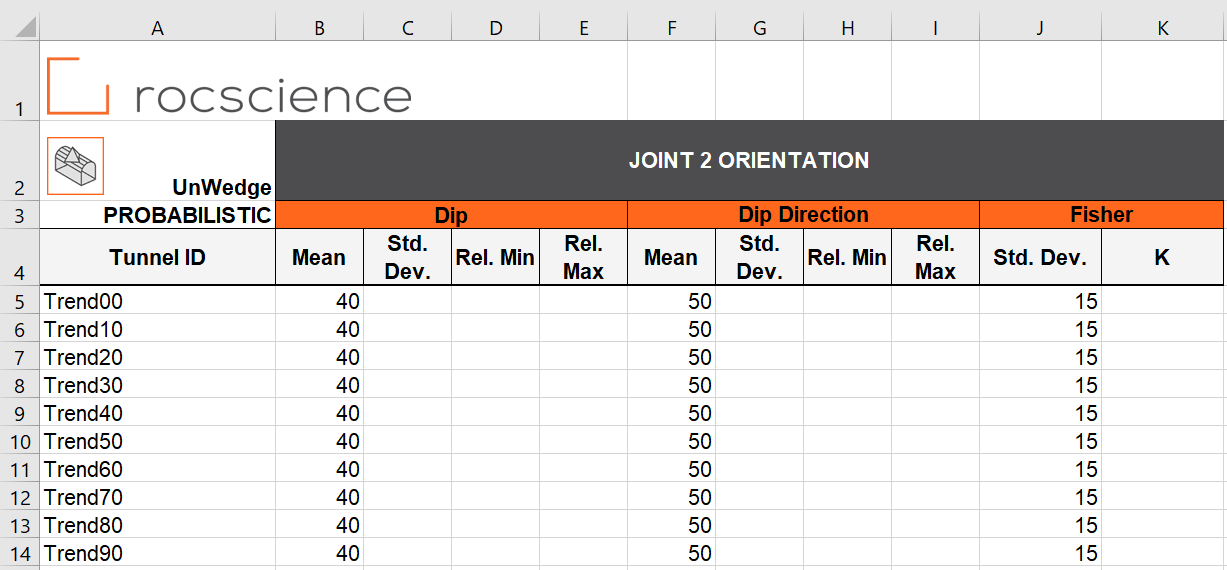
- Navigate to the JOINT2 ORIENTATION worksheet.
- Under the Tunnel ID column, provide the names of the tunnels (Trend00, Trend10, ... Trend 90).
Enter the following:
Tunnel ID
Joint 2 Orientation
Dip
Dip Direction
Fisher
Mean
Mean
Std. Dev.
Trend00
40
50
15
Trend10
40
50
15
Trend20
40
50
15
Trend30
40
50
15
Trend40
40
50
15
Trend50
40
50
15
Trend60
40
50
15
Trend70
40
50
15
Trend80
40
50
15
Trend90
40
50
15
As set up previously in the UnWedge Input Data dialog, all three Joint Orientations will be automated.The JOINT2 ORIENTATION worksheet should look like this
- Navigate to the JOINT3 ORIENTATION worksheet.
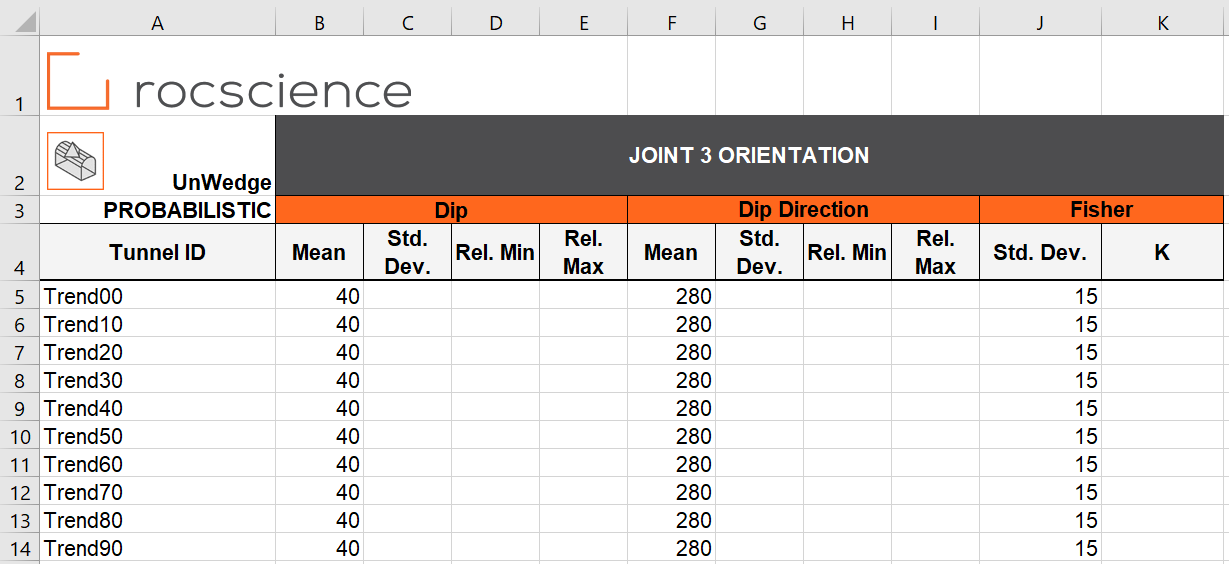
- Under the Tunnel ID column, provide the names of the tunnels (Trend00, Trend10, ... Trend 90).
Enter the following:
Tunnel ID
Joint 3 Orientation
Dip
Dip Direction
Fisher
Mean
Mean
Std. Dev.
Trend00
40
280
15
Trend10
40
280
15
Trend20
40
280
15
Trend30
40
280
15
Trend40
40
280
15
Trend50
40
280
15
Trend60
40
280
15
Trend70
40
280
15
Trend80
40
280
15
Trend90
40
280
15
As set up previously in the UnWedge Input Data dialog, all three Joint Orientations will be automated.The JOINT3 ORIENTATION worksheet should look like this
6.3 Joint Strength
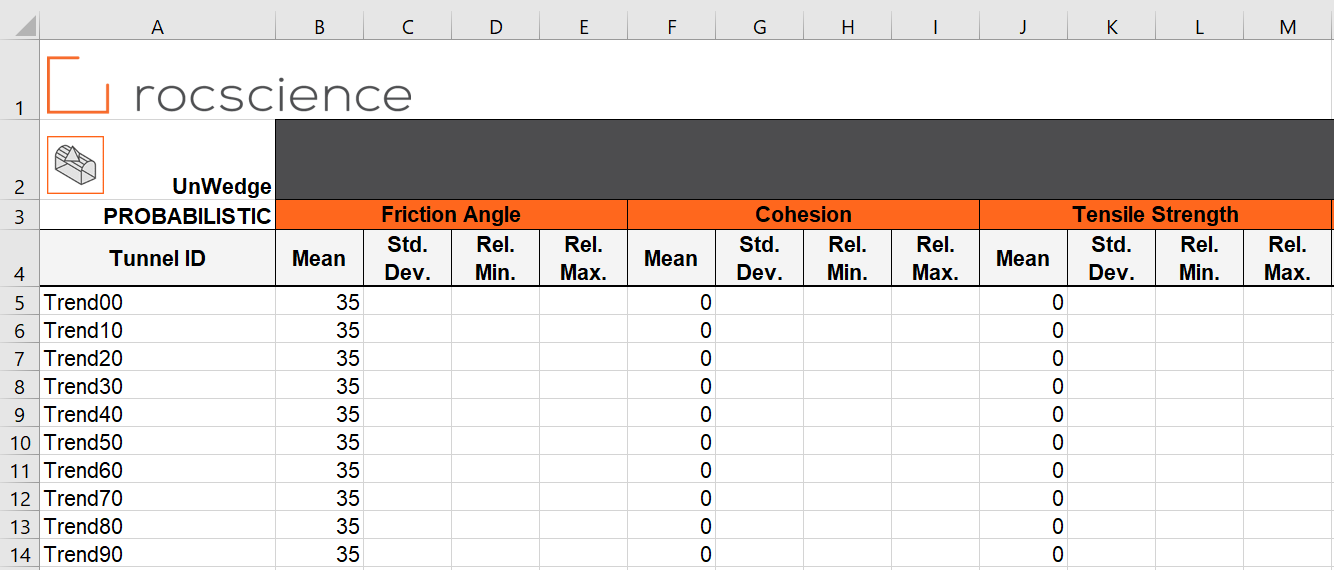
- Navigate to the PROP1 STRENGTH worksheet.
- Under the Tunnel ID column, provide the names of the tunnels (Trend00, Trend10, …, Trend 90).
Enter the following:
Tunnel ID
Property 1 Strength
Friction Angle
Cohesion
Tensile Strength
Mean
Mean
Mean
Trend00
35
0
0
Trend10
35
0
0
Trend20
35
0
0
Trend30
35
0
0
Trend40
35
0
0
Trend50
35
0
0
Trend60
35
0
0
Trend70
35
0
0
Trend80
35
0
0
Trend90
35
0
0
As set up previously in the UnWedge Input Data dialog, only the above input data are required since only one Joint Property is defined. No inputs are required for PROP2 STRENGTH or PROP3 STRENGTH worksheets,The PROP1 STRENGTH worksheet should look like this:
6.4 Joint Water Pressure
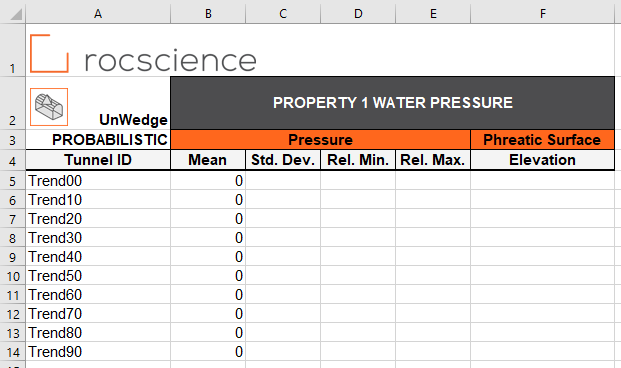
- Navigate to the PROP1 WATER worksheet.
- Under the Tunnel ID column, provide the names of the tunnels (Trend00, Trend10, …, Trend 90 ).
Enter the following:
Tunnel ID
Property 1 Water Pressure
Pressure
Mean
Trend00
0
Trend10
0
Trend20
0
Trend30
0
Trend40
0
Trend50
0
Trend60
0
Trend70
0
Trend80
0
Trend90
0
As set up previously in the UnWedge Input Data dialog, only the above input data are required since only one Joint Property is defined. No inputs are required for PROP2 WATER or PROP3 WATER worksheets.The PROP1 WATER worksheet should look like this:
6.5 Joint Structure
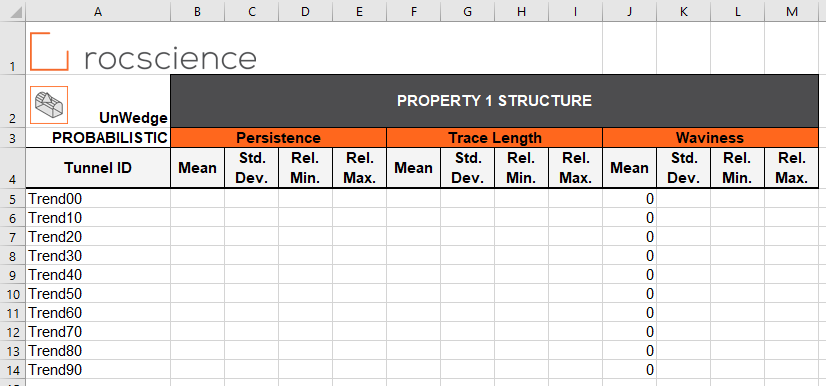
- Navigate to the PROP1 STRUCTURE worksheet.
- Under the Tunnel ID column, provide the names of the tunnels (Trend00, Trend10, …, Trend 90).
Enter the following:
Tunnel ID
Property 1 Structure
Waviness
Mean
Trend00
0
Trend10
0
Trend20
0
Trend30
0
Trend40
0
Trend50
0
Trend60
0
Trend70
0
Trend80
0
Trend90
0
As set up previously in the UnWedge Input Data dialog, only the above input data are required since only one Joint Property is defined. No inputs are required for PROP2 STRUCTURE or PROP3 STRUCTURE worksheets.The PROP1 STRUCTURE worksheet should look like this:
- We do not need to enter any data in the FIELD STRESS, or SCALE WEDGE worksheets since those are not applicable.
- Save the Excel file as Tutorial 14 Automate Compute - Probabilistic_inputs.xlsx to the Tutorial 14 Automate Compute - Probabilistic folder previously created.
We are now ready to automate computations in UnWedge by reading from the input Excel file.
8.0 Automate from Excel
Return to the UnWedge model.
The Automate Compute dialog allows you to add Excel input automation files to the queue, select an output format, and compute the results.
8.1 ADD FILES TO FILE QUEUE
To add multiple files to the File Queue:
- Select Automate from Excel
 from the Analysis menu to open the Automated Compute dialog.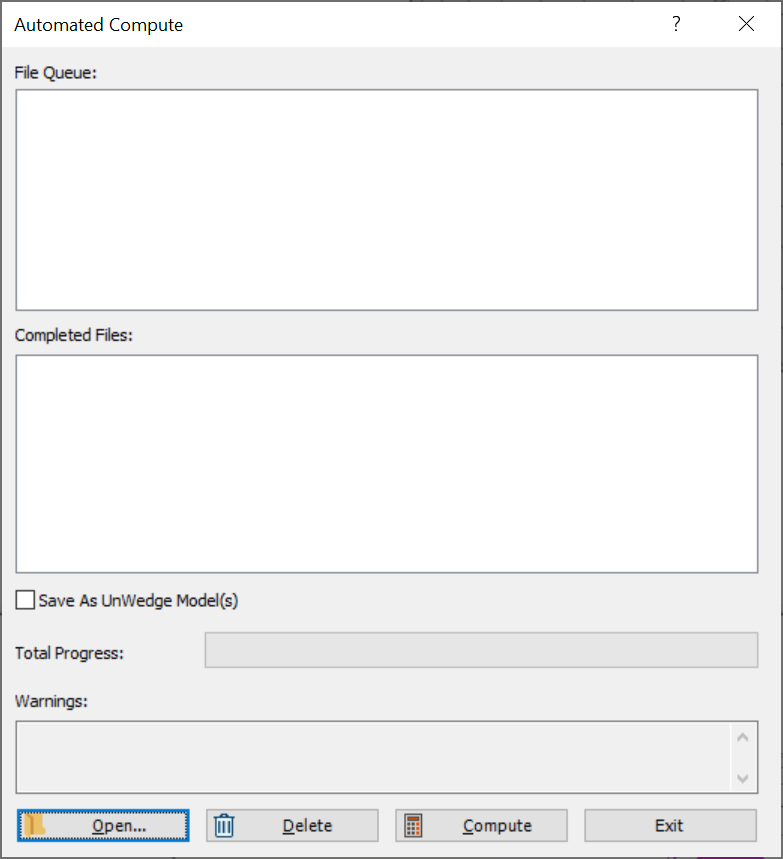
- Select the Open
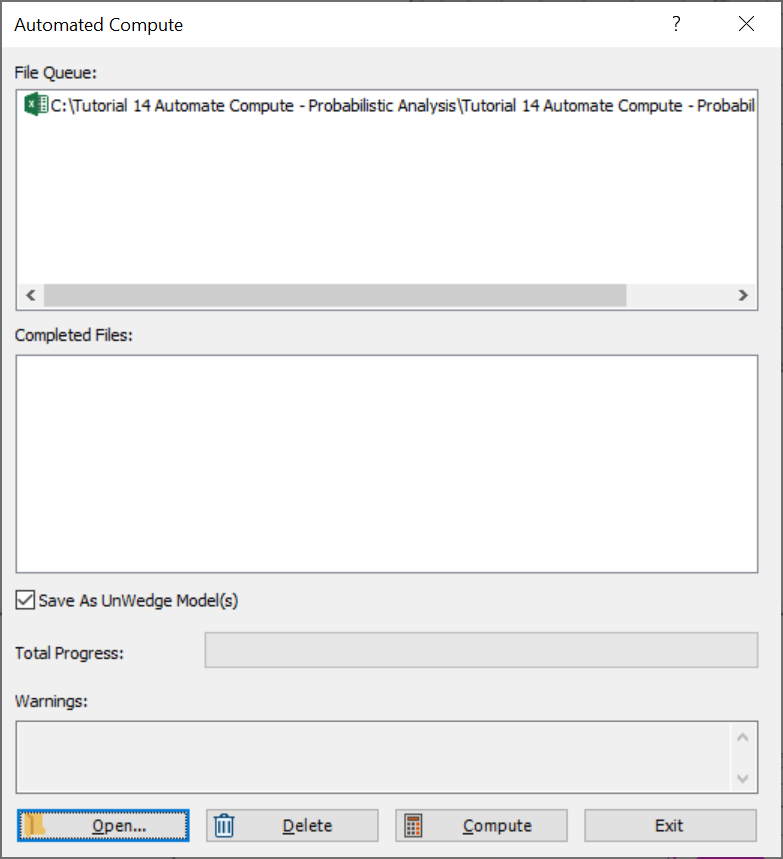
 button to open a standard dialog to choose an Excel input file. Navigate to the Tutorial 14 Automate Compute - Probabilistic folder and select the Tutorial 14 Automate Compute - Probabilistic_inputs.xlsx file.
You will see the Excel input file appear under the File Queue list box. - Select the Save As UnWedge File(s) checkbox. This will save each automated compute case as an UnWedge file.
9.0 Output Result Files
Results files are automatically generated and saved into the same directory as the input Excel file after Automated Compute is complete. Before we run Compute, first ensure that the Output File Format is set to the desired format. Users can select from either Text File or Excel format.
9.1 EXCEL FILE FORMAT
While still in the Automated Compute dialog:
- Select the Compute
 button to start the automated computing process.
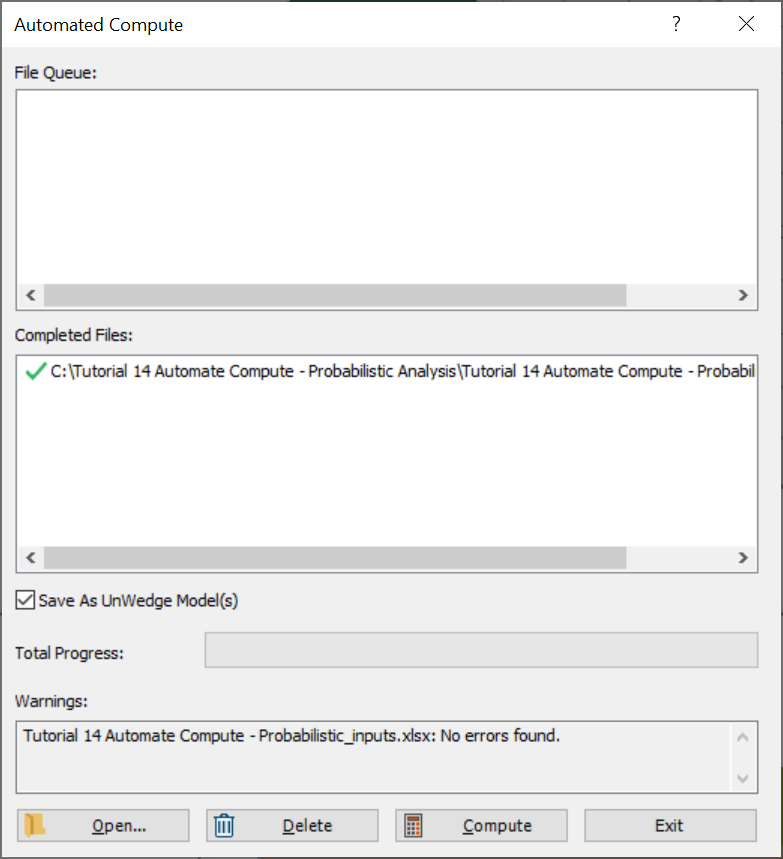
The Total Progress can be seen at the bottom of the dialog. When files have finished computing, they will appear in the Completed Files list box.
- When all files have finished computing, select Exit to close the dialog.
For each input Excel file case, an Excel file (*.xlsx) containing all results data is generated.
For a Probabilistic Analysis (Tutorial 14 Automate Compute - Probabilistic_inputs.xlsx), the results data for each case are output to a separate Excel file since each case tends to contain hundreds or thousands of tunnel samples. Inside each Excel file, results for all probabilistic tunnel samples are outputted following the header row. Each row of data represents one sample case. Each data type is separated by column.
- Take a look at the ResultsTrend00[0].xlsx result file.
The Probabilistic Values sheet contains global tunnel, design, unit weight, and seismic information shared across all wedges.

The Field Stress sheet contains global field stress information shared across all wedges.
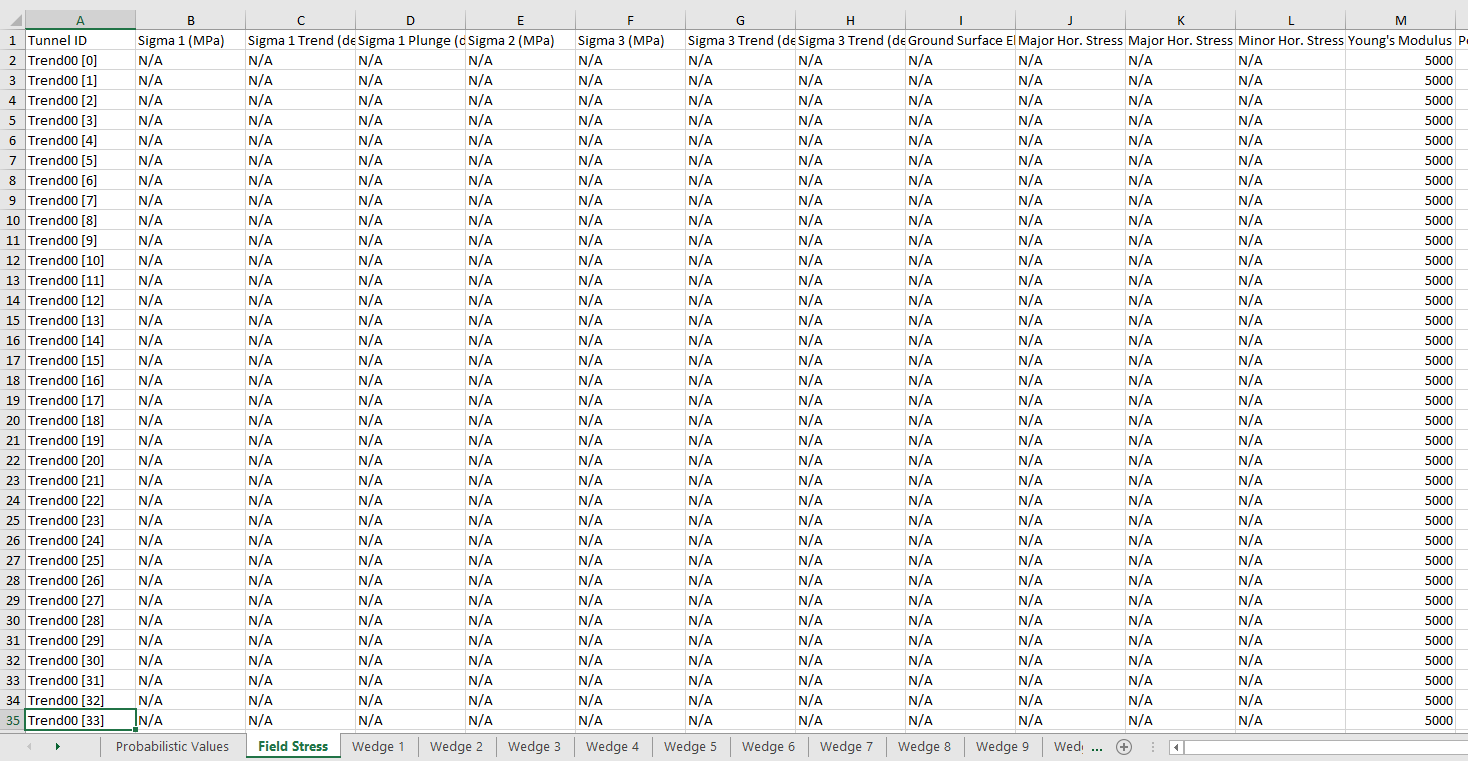
There are 10 sheets which contain wedge-specific information, including values computed at each of their three joints.

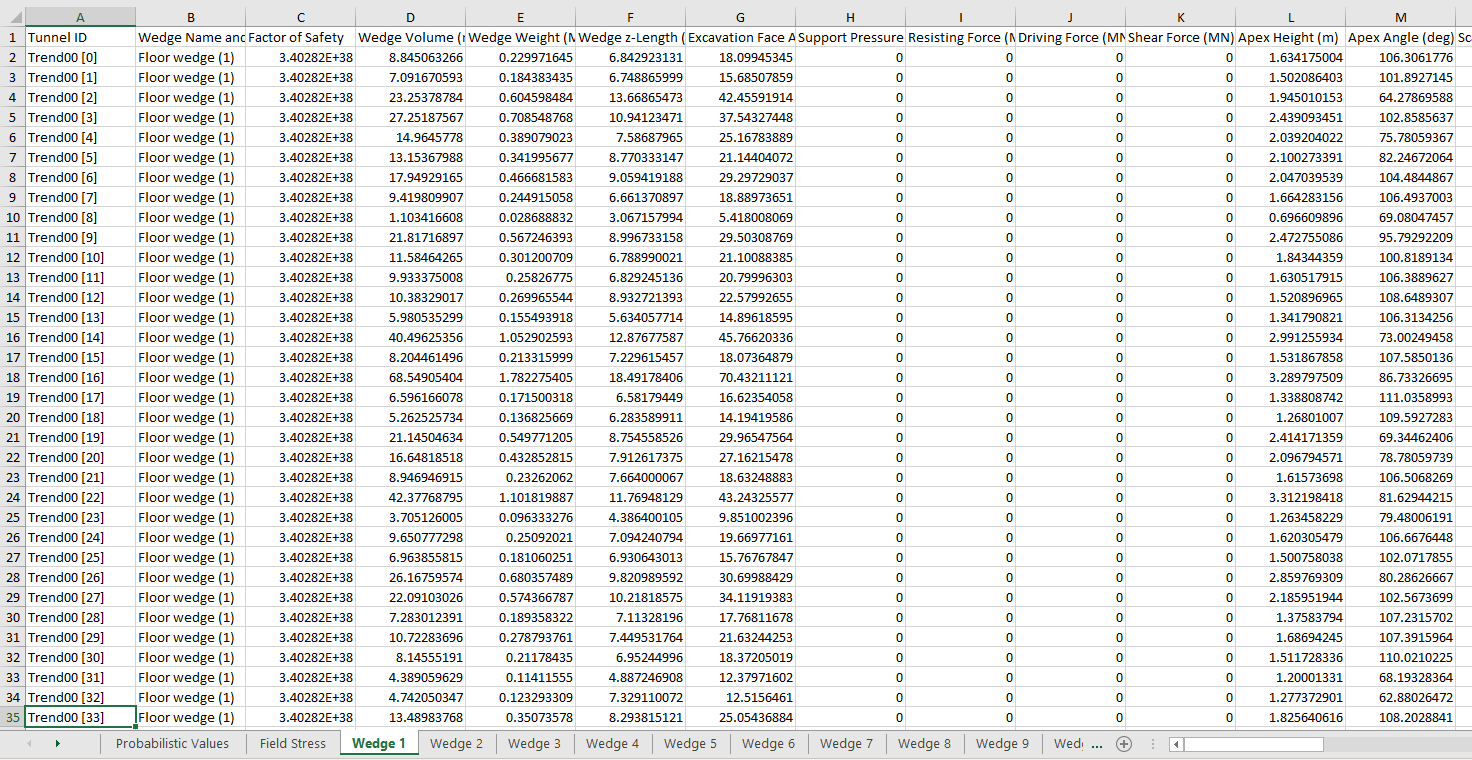
Note that a total of 10 files with the same format (i.e., ResultsTrend00[0].xlsx, ResultsTrend10[1].xlsx, ..., ResultsTrend90[9].xlsx ) have been created; one file per case. Each file contains information for all 1,000 samples.
10.0 Error Log
As you may have noticed, an Error Log is also generated for each input Excel file. For each input Excel file, an Error Log text file (Automate Compute Error Log.txt) is generated and saved into the same directory as the output file directories. Always check that the Error Log reports "No errors found" before post-processing the raw results data. If any errors do occur as a result of missing (i.e., blank cells) or invalid inputs, the Error Log will indicate which worksheet(s) and cell(s) are problematic.
This concludes the tutorial. You are now ready for the next tutorial, Tutorial 15 - Tunnel Orientations Analysis in UnWedge.