RSWall, Expanded: Multi-tiered Walls, Python-powered Workflows
- Eric Wang, Geotechnical Project Manager at Rocscience
- Sina Javankhoshdel, Senior Manager - LEM at Rocscience
Tall retaining walls and tight site boundaries rarely afford the luxury of simple geometry. When designing multi-tiered Mechanically Stabilized Earth (MSE) walls, engineers face a core structural challenge: the behaviour of an individual tier directly influences – and is influenced by – the stability of the entire system. Compounding this challenge, evaluating multiple design alternatives has traditionally meant hours of repetitive modelling, analysis, and manual result processing.
RSWall cuts through this friction with two powerful updates: the Multi-Tiered Wall Wizard – built in accordance with AASHTO and FHWA guidelines – to simplify the creation and analysis of multi-tiered wall configurations, and RSWall Scripting, powered by Python, which enables engineers to automate modelling tasks, run analyses, investigate design alternatives, and customize the analysis and visualization of results.
Together, these capabilities support workflows that move from defining complex wall geometries to systematically evaluating different design scenarios.
Model Multi-Tiered Walls with Greater Flexibility
For tall retaining walls, utilizing multiple MSE wall tiers helps engineers manage overall geometry, improve constructability, and adapt to tight site constraints.
However, a multi-tiered configuration requires more than placing separate structures at different elevations. Because the geometry and relative positions of tiers directly influence the overall behaviour of the system, designs must account for both individual and combined performance.
The new Multi-Tiered Wall Wizard in RSWall streamlines this process. Engineers can specify the height of each tier, the horizontal and vertical offsets between tiers, and the shape of the intervening terrace. Wall unit dimensions can also be defined, with the number of courses automatically calculated from tier heights and unit dimensions.
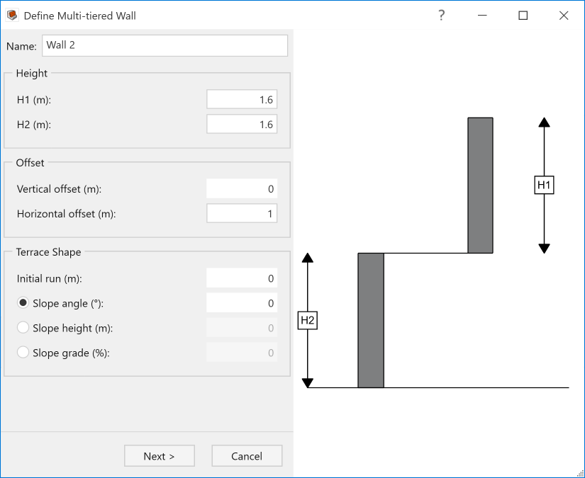
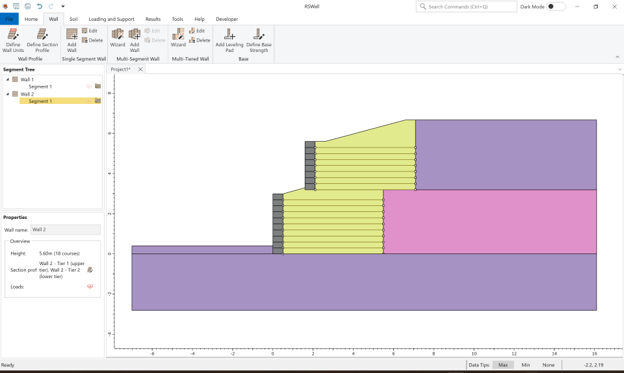
Once the wizard is complete, RSWall automatically generates section profiles for each tier. Engineers can review and refine these profiles prior to analysis, eliminating the need to build each tier from scratch.
Accounting for Interaction Between Tiers
The relationship between tiers is a critical factor in multi-tiered design. Because relative positioning affects the behaviour of the entire structure, analyzing each tier in isolation can overlook key interaction effects.
RSWall analyzes multi-tiered wall configurations in accordance with AASHTO and FHWA guidelines, accounting for interactions between tiers and evaluating both individual and combined behaviour. This allows engineers to investigate the configuration as an integrated system while retaining the flexibility to review and modify individual section profiles.
Automate RSWall with Python Scripting
Defining a wall configuration is only the first step. Evaluating multiple alternatives, updating model inputs, and organizing results often introduce repetitive work when investigating various design parameters.
RSWall Scripting provides a programmatic solution via the RSWall Python API Library. By exposing model inputs and computed results, the API enables engineers to use Python throughout the design workflow – from creating and modifying models to running analyses and evaluating alternative designs.
Given Python’s widespread adoption in engineering for numerical computation, data analysis, and automation, it accommodates both routine scripting and advanced, customized workflows.
Engineers can begin by automating routine modelling operations. Those with more Python experience can build on the same API to develop parametric studies, compare design alternatives, and create analysis workflows tailored to specific project requirements.
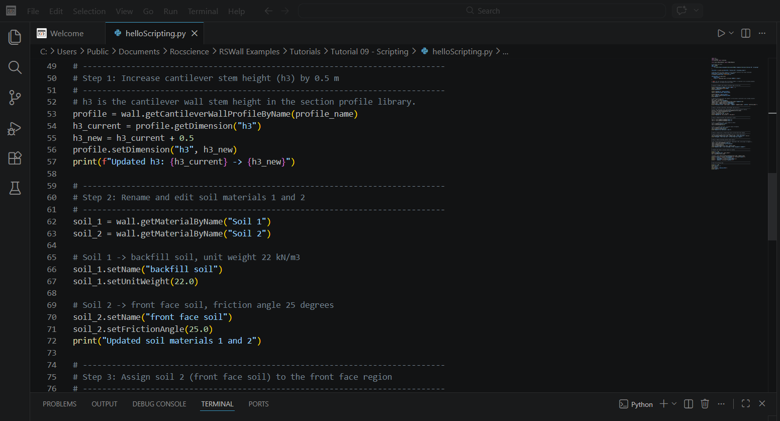
RSWall scripting can be accessed through RocScript – the built-in Python editor – or via a separately configured Python environment for integration into broader computational pipelines.
From Model Creation to Design Optimization
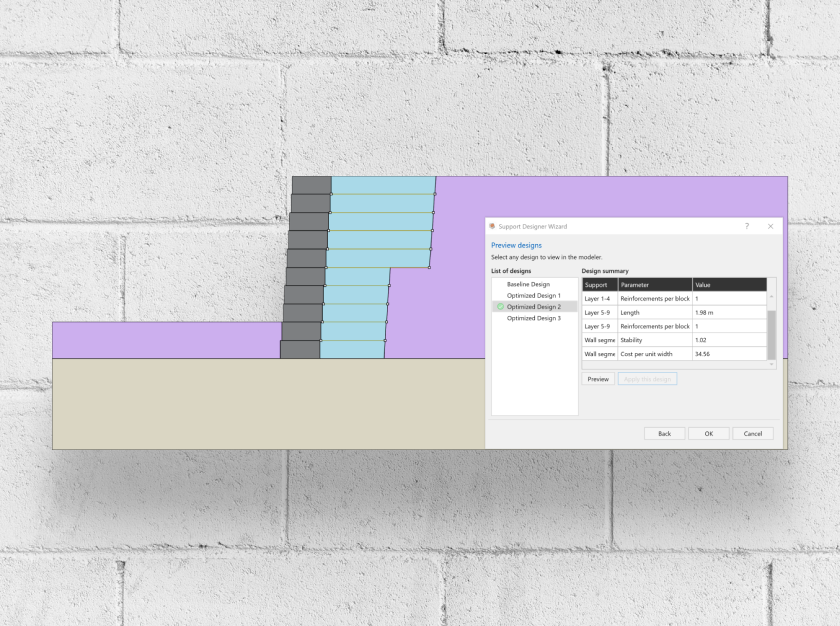
The RSWall Python API provides programmatic access to many modelling operations available in the software, including the creation and modification of soils, wall types, section profiles, segments, loads, reinforcement, and project settings.
Beyond reducing manual effort, scripts bridge the gap between model generation and analysis, enabling the systematic investigation of multiple design scenarios.
For example, a Python script can dynamically modify model inputs, execute an analysis, retrieve the results, and repeat the process for different design parameters. Engineers can then compare the resulting designs according to project-specific criteria, creating a foundation for customized parametric studies and optimization workflows.
This programmatic coordination allows engineers to efficiently manage repetitive investigations, apply consistent procedures across scenarios, and evaluate how design parameter variations impact computed results.
Analyzing and Visualizing Results with Python
RSWall Scripting also provides access to computed results, enabling engineers to extend their analysis beyond the standard RSWall workflow. Scripts can retrieve factors of safety for various failure modes and load combinations, streamlining comparisons across multiple design scenarios.
Furthermore, the API integrates seamlessly with established Python libraries like NumPy, Pandas, and Matplotlib. These libraries support numerical calculations, data processing, and customized visualization, respectively, enabling engineers to examine results, identify trends, and compare the behaviour of different designs.
By connecting RSWall with the broader Python ecosystem, engineers can build tailored workflows that span from basic data handling to advanced parametric optimization.
A More Flexible Approach to RSWall Workflows
The introduction of the Multi-Tiered Wall Wizard and RSWall Scripting marks a significant step forward for retaining wall design, transforming how engineers approach complex geometry and repetitive analysis.
By pairing an intuitive wizard for AASHTO- and FHWA-compliant multi-tiered walls with the expansive power of Python automation, RSWall bridges the gap between modelling and deep evaluation. Together, these capabilities empower engineers to move beyond manual iteration — enabling them to streamline complex system configurations, build custom workflows, and tailor designs precisely to project needs.
Put Theory into Practice:
- Master the step-by-step workflow for defining and modelling complex tiered structures with the Multi-Tiered Wall Tutorial.
- Discover how to leverage the RSWall Python API Tutorial to build custom scripts, automate repetitive tasks, and scale your design capabilities.
Ready to Optimize Your Retaining Wall Workflows?
Experience how the Multi-Tiered Wall Wizard and Python automation can enhance your geotechnical projects.
Start Your Free Trial